The Most Remote National Park In The Lower 48

Hovering far off the coast of northern Michigan, amidst North America's largest freshwater lake, and accessed solely by ferry or seaplane, Isle Royale is the most remote national park in the Lower 48. Given the non-trivial travel logistics, the minimal infrastructure across the park's 850 square miles of wolf-harboring wilderness, and a season that runs barely six months, it comes as no surprise that just 29,091 people visited Isle Royale National Park in 2025. That makes it the least-visited national park outside of Alaska. With that said, if you shift the focus to national parks with the highest percentage of repeat visitors, then Isle Royale suddenly shoots to the top of the list. This speaks to the quality of the experience and the life-changing adventures that await on and around Isle Royale National Park. Here's how you can make it happen.
Where Is Isle Royale National Park?

Though much closer to the mainlands of northeastern Minnesota and northern Ontario, Canada, Isle Royale National Park falls under Michigan's purview. This makes it, by far, the northernmost place in The Great Lake State. The park's focal point is its namesake island, 45 miles long and nine miles wide at its widest point. It is also surrounded by nearly 400 smaller islands scattered across western Lake Superior — the largest freshwater lake by surface area on the planet. The park covers 850 square miles, 99 percent of which is federally designated Wilderness, and a large share of which is submerged: the boundary extends 4.5 miles out into the lake.
How To Get There

The only way to reach Isle Royale National Park is by ferry, private boat, or seaplane — and only for part of the year. Isle Royale is the only national park in the country that closes entirely for the season, open from April 16 through October 31 and shut from November 1 through April 15, when Lake Superior makes the crossing too dangerous and park headquarters moves from Mott Island to the mainland at Houghton.
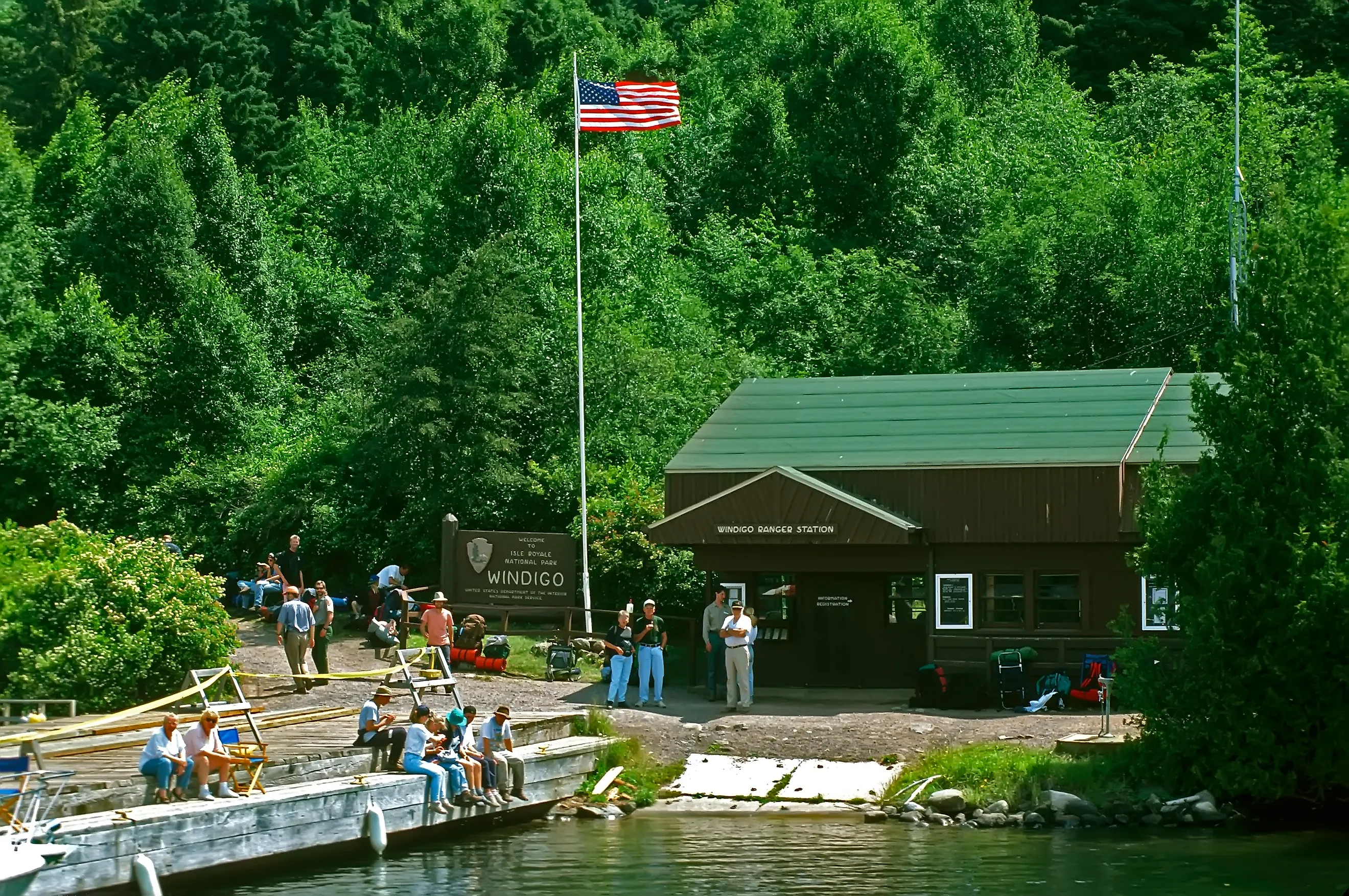
Ferries serve two island marinas, Rock Harbor in the east and Windigo in the west, from three mainland ports. Here are the basic routes:
- Houghton, MI to Rock Harbor via the Ranger III (6 hours)
- Copper Harbor, MI to Rock Harbor via the Isle Royale Queen IV (an estimated 3.5 hours)
- Grand Portage, MN to Windigo via the Voyageur II (2 hours) or the Sea Hunter III (1.5 hours)
Each boat keeps its own calendar, and none of them runs daily all season. The NPS-operated Ranger III is the big one, sailing from Houghton at 9:00 a.m. on Tuesdays and Fridays from late May to early September and returning Wednesdays and Saturdays. There is no same-day round trip, so this route commits you to at least a couple of nights.
The Sea Hunter III is the day-tripper's boat, running mid-June into early September and delivering you to Windigo by mid-morning with a mid-afternoon return. The Voyageur II has the longest season, roughly May into late September, and after its Windigo stop it carries on around the island towards Rock Harbor, docking at remote shoreline campgrounds like McCargoe Cove and Belle Isle, an invaluable experience for paddlers and anyone wanting a one-way traverse. Check current dates with each operator, and note that sailings may be cancelled last-minute due to inclement weather, so no matter your intended schedule, be prepared to stay an extra night.
The same rule applies for seaplanes. Running from spring until about mid-September, flights can be reserved with Isle Royale Seaplanes, operating out of Houghton and Grand Marais, MN, servicing both ends of the island. Depending on your departure and arrival points, flights range from an estimated 25 to 45 minutes.
As you can see, part of the Isle Royale odyssey involves simply getting to one of these four mainland towns. Driving up from Minneapolis, you're looking at a six to seven hour drive to the Michigan basecamps, and a four to five hour drive to Minnesota's northern fringe.
Given that there are no cars on Isle Royale (or roads of any kind), you may prefer to fly into Houghton County Memorial Airport, which receives daily United Airlines flights, and then take the ferry over. Another workaround would involve flying into Thunder Bay International Airport, in the neighboring province of Ontario, and then renting a car for the final 50-mile drive down to Minnesota's ferry town of Grand Portage.
However it is you choose to arrive, an America the Beautiful pass will have to be presented, or the $7 daily entrance fee paid for each visitor aged 16 and over - Children 15 and under are exempt. If you are staying a week or more, the $60 Isle Royale season pass covers the holder plus up to three adults. The only members of the family that aren't welcome on Isle Royale are pets.
Getting Around The Island
Once you've touched down on Isle Royale, there are three main ways to get around: hiking, paddling, or boating. Isle Royale National Park maintains 165 miles of hiking trails, ranging anywhere from a one-mile loop to the 40-mile Greenstone Ridge traverse of the island. Water taxis can be used to turn laborious round-trip trails into expedited, one-way adventures. There are also ranger-led hikes for anyone looking to peek into the wilderness without getting in over their head.
If you arrived with your own watercraft, minor docks dot the periphery of the island. Finally, canoes and kayaks can be rented at Windigo and Rock Harbor, or paddlers can arrange to bring their own crafts aboard the ferries.
Believe it or not, Isle Royale is partially wheelchair-accessible at Rock Harbor, where they will be met with a spacious dock, paved path, visitor center, and restaurants.
History of Isle Royale

The Isle Royale archipelago constitutes a portion of an ancient lava flow, perhaps the largest the Earth has ever known, that was pressed, carved, and ultimately, submerged by Ice Age glaciation.
Called Minong (meaning "the good place") in the Indigenous Anishinaabemowin language, modern day Isle Royale represents ancestral land of the Grand Portage Band of Lake Superior Chippewa. They believe it to be home to the Mishepeshu manitou, which takes the form of an underwater lynx. The isolated and unspoiled grounds of Isle Royale National Park are still used by Minnesota-based natives for fishing, plant gathering, and spiritual purposes.
Artifacts of 19th-century industrial expansion can be found all around Isle Royale. More than 25 ships have gone down on the archipelago's reefs, and ten of those wrecks are listed on the National Register of Historic Places, from the sidewheeler Cumberland in 1877 to the freighter Emperor in 1947. They are among the best-preserved wrecks on the planet, thanks to the clean, cold waters of Lake Superior.
Four lighthouses listed on the National Register, dating from 1855 to 1908, also dot these islands. Several defunct copper mines exist across the island, holding remnants of the copper booms that swept through Michigan's Upper Peninsula (namely, the Keweenaw Peninsula) and out to Isle Royale in successive waves through the 1800s. Following the final bust, the archipelago's commercial focus shifted to fishing and logging. Of course, with the establishment of Isle Royale National Park on April 3, 1940, tourism became a significant economic pillar.
Building on the momentum to protect and highlight this exceptional archipelago, on October 20, 1976, 99 percent of Isle Royale's footprint was federally designated as Wilderness, the highest preservation status available in the US. Four years later, United Nations Educational, Scientific and Cultural Organizations (UNESCO) designated Isle Royale as an International Biosphere Reserve.
Outdoor Recreation
Thanks to such well-protected wilderness, Isle Royale boasts world-class outdoor recreation. The main island is networked by 165 miles of hiking trails with some single-tracks through the woods and others dynamic traverses of the rocky shoreline. Thirty-six campgrounds give overnight visitors ample places to spread out. Along with self-sufficient, by-permit and "Leave No Trace" backcountry sites, there are some primitive cabins to rent, and even full-amenities hotel rooms courtesy of Rock Harbor Lodge that book up well in advance. The lodge and marina combo on the island's northeast end offers boat rentals, sightseeing tours, and fishing charters.
Isle Royale eagerly accommodates those unfamiliar with isolated wilderness, but if you do plan to push off on your own, it's vital that you are a competent hiker or paddler familiar with the island's wildlife.
Moose, Wolves & Other Wildlife
Isle Royale National Park protects 19 species of mammals, including moose and wolves. Moose are the animal most visitors hope to see, and you will need to be vigilant while hiking. Females are highly protective of their young during the spring and summer, and bull moose can be extra aggressive during the fall rut. So no matter what, keep your distance, and give a wide berth if a moose refuses to move off the trail.
The herd is thinner than it used to be, though. The 2026 winter survey counted an estimated 524 moose, down roughly 75 percent from a peak near 2,000 in 2019, and for the first time in 68 years of counting, researchers spotted no calves at all.
Wolves, meanwhile, are surging. Three packs totaling 37 wolves were documented in the winter of 2026, the highest count since the late 1970s, and predation accounted for nearly a quarter of the moose population over the preceding year. That rebound was engineered when inbreeding had collapsed the island's original wolf line to just two animals by 2016. The National Park Service translocated 19 wolves from around the Lake Superior region in 2018 and 2019.
The Isle Royale hosts the longest-running large mammal predator-prey study in the world, conducted nearly every year since 1958.

Smaller critters commonly seen throughout the national park include foxes, hares, beavers, squirrels, mice, loons, toads, spiders, and wasps (which can be problematic after a dry summer). Look to the sky and you'll see gulls, ravens, and even the odd eagle or osprey.
Safety Considerations
As you've probably ascertained by now, visiting Isle Royale National Park requires some forethought. Extensive travel logistics aside, there is the possibility that weather, wildlife, and our own bodies don't cooperate. Sure, you can opt for a day-trip out of Grand Portage, sticking close to the visitor center or allowing park rangers and tour operators to show you around, but even still, your return ferry or seaplane isn't guaranteed if Lake Superior kicks up one of her famous fits. As such, it is worth packing overnight gear and extra grub, regardless of your timeline.
If you wade into Isle Royale's extensive backcountry, know that there is limited cell coverage, if any, throughout the island. A satellite messenger or personal locator beacon is worth carrying, and every overnight visitor needs a free backcountry permit, picked up in person at Rock Harbor or Windigo. Basic emergency services are available, but a proactive plan for bad weather and self-rescue is still necessary. Treat all water you draw on the island, whether it comes from an inland lake or Lake Superior itself.
With Great Isolation, Comes Great Preservation
Isle Royale National Park sits deep in the embrace of Lake Superior, far removed from any developed shorelines. This, the most remote of the Lower 48's national parks, demands a multi-day investment simply to arrive at one of its two main docks, but once (strategically) lost on its trails, paddling its hidden coves, or relaxing in one of its 36 campgrounds, you're bound to see more moose than people. No wonder Isle Royale has achieved the trifecta of protective designations: National Park, Wilderness, and Biosphere Reserve. On a map, this major island of the Great Lakes doesn't look terribly isolated from civilization, but once you factor in the drive up, the ferry or flight over, and a self-supported backcountry experience, you might as well be in Alaska.