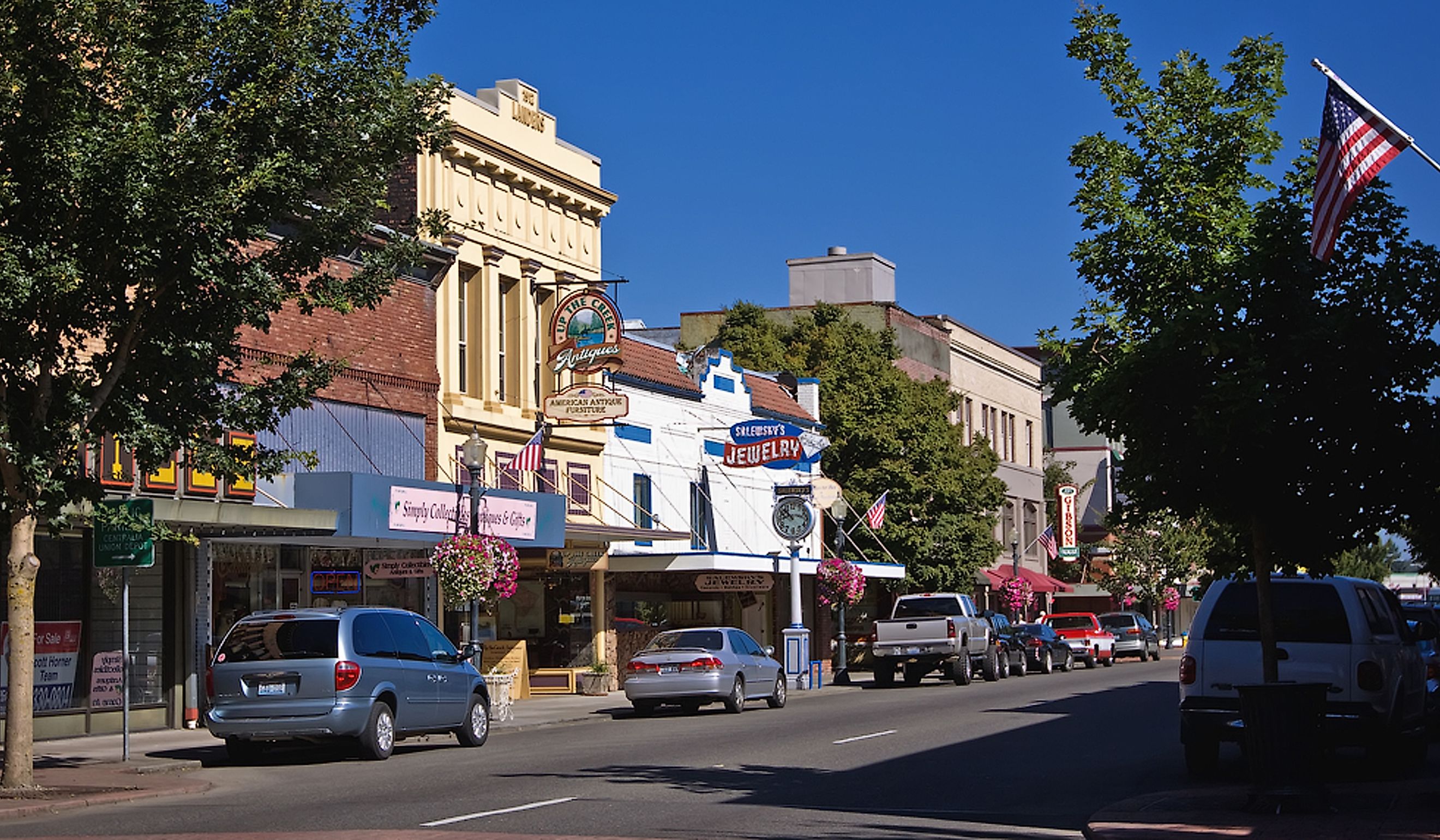
These 7 Washington Towns Have The Best Historic Districts
It's easy to get lost in the list of Washington's designated historic districts, but these 7 rise to the top of that list. Edmonds preserves its past inside a century-old Carnegie Library, while Leavenworth's historic Ski Hill celebrates the town's longtime connection to winter recreation. Snohomish's historic district has a Carnegie Building of its own, along with its reputation of being the Antique Capital of the Northwest. These seven Washington towns offer a chance to experience history one block at a time.
Chehalis

In between Portland and Puget Sound in southwestern Washington, Chehalis preserves its historic roots for future perusal. In 1892, two fires burned the downtown area, and the town center shifted to Market Street, where future development grew. On the edge of the Chehalis Downtown Historic District, the Lewis County Historical Museum features seven permanent exhibits. Displays include Chehalis and Cowlitz Indian Tribal items, examples of a 1900s kitchen, a blacksmith shop, a small country store, and an interactive HO Model Train built by the Lewis County Model Railroad Club.
Southwest of town, the Chehalis-Centralia Railroad and Museum not only restores historic engines and rail cars, but also offers scenic and seasonally themed rides. Nearby, the Veterans Memorial Museum exhibits memorabilia honoring the community's veterans, and they host regular events to bring the community together. Further south, the Willapa Hills State Park can be accessed via the relatively flat Chehalis Trailhead, which begins with asphalt for the first five miles before transitioning to compact gravel for around another 20 miles, inviting pedestrians, cyclists, and equestrians. This railroad town maintains its historic and natural areas.
Centralia

Four miles north of Chehalis, Centralia also fosters a mix of historic and natural areas. Soon after the coming of the railroad in 1872, the Pioneer House hotel was built where Main Street and Tower Avenue intersect today. Listed on the National Register and located within the Centralia Downtown Historic District, the McMenamins Olympic Club was built in 1908 on Tower Street near the corner of Main Street. Retaining most of its historic allure, McMenamins expanded on the Olympic Club's traditional resort by creating a family-friendly experience through lodging, dining, movies, and regular events.
A few blocks west from downtown next to Centralia College, Holy Grounds Brew Temple pays homage to the 100-year-old building's past as a former synagogue and the renovations created a gathering place for the community. They offer espresso drinks, teas, smoothies, breakfast, lunch, beer and wine while the event space upstairs houses yoga classes fostering a welcoming environment.
Located two blocks northwest of downtown, the Evergreen Playhouse has entertained the community since 1959 and is currently celebrating their 67th season. Their events calendar showcases regular performances throughout the year.
Port Townsend

A National Historic Landmark and one of three surviving Victorian-era seaports in the nation, Port Townsend maintains their natural and historic draw. Positioned at the gateway to Puget Sound, Water Street became the town's main downtown thoroughfare. Located on Water Street and listed on the National Register, the Jefferson County Museum of Art and History occupies the historic 1892 City Hall building. The permanent "evergreen" exhibit tells stories from Port Townsend and Jefferson County's history while current installations include work by the Community Printshop and local artists. Listed on the National Register and located a few blocks away, the 1868 Rothschild House opens seasonally in partnership with Washington State Parks. Perched on a bluff overlooking downtown and the water, the Victorian home retains its original furnishings and the family heirlooms from the merchant D.C.H. Rothschild. This preservation effort gives the community a sneak peek into the town's early years.
Located in the Port Townsend Historic District, the Rose Theatre also stands as an example of successful restoration efforts. Originally built for a Vaudeville playhouse in 1907, the theatre transitioned over time until 1992 when it was restored. They currently maintain a regular calendar of movie showings to entertain the community.
Edmonds

North of Seattle, the waterfront town of Edmonds supports an assortment of art and history. Incorporated in 1890, Edmonds constructed their Carnegie Library in 1910, listed on the National Register, in the north end of downtown. The City Hall and police department moved to the bottom floor of the building. After renovations to the old brick and stone library in 1973, the Historical Society opened the Edmonds Historical Museum with the lower floor dedicated to Edmonds history, including an original jail cell and a reconstructed room from the 1894 Stevens Hotel.
The Historical Society also offers a Stages of History walking tour with a PDF map. The map highlights 12 historic buildings located on 4th and/or Main Streets, described as the first permanent business block in Edmonds. This includes the Princess Theatre, now the Edmonds Theater. Built in 1923, the current building changed hands, and in 1999 it was restored to its original Art Deco style. In the last 40 years, the theater served as a venue for the Mayor's State of the City Address, Rick Steves' travel classes, community Santa gatherings, as well as currently showing both classic and new movies.
A few blocks away near the waterfront, the Cascadia Art Museum celebrates the artistic heritage of the Northwest from 1870 to 1970. Current rotating exhibitions explore the artists that shaped the region. The art museum also curates an active calendar hosting art workshops, filmography, live music, writers-in-conversation events, and more. Edmonds serves up the past and present through art and history.
Leavenworth

Incorporated in 1906, the mining-turned-lumbering town Leavenworth leaned into its alpine surroundings. In the 1960s, businesses invested in authentic Bavarian-style remodels to revitalize the town and inspire tourism. Decorated with a Bavarian facade northeast of downtown, the Leavenworth Festhalle civic center accommodates concerts, weddings, conferences, meetings, and more. The Festhalle also maintains a regular calendar including the annual fall Oktoberfest, winter Christmastown, and summer Accordion Festival.
Less than two miles north of town, the Leavenworth Ski Hill Historic District, listed on the National Register, facilitates mountain recreation. The ski hill includes two rope tows, a tubing hill, Nordic trails, snowshoeing, fat biking, mountain biking, and more. Built in 1936, the historic lodge also transforms into a rentable event venue outside of operating hours. The Bavarian-inspired town encourages festivities and immersion in nature.
Snohomish

First platted in 1871, streets running east to west were numbered while avenues running north to south were lettered in the river town of Snohomish. Bounded by Fifth Street and the Snohomish River, the Snohomish Historic District, listed on the National Register, feels as if it has history to share. Built on Avenue B in 1878, the Blackman House Museum showcases 19th-century furnishings, artifacts, and exhibits. Donated by family to the Snohomish Historical Society, the museum pays homage to the first family of Snohomish's lumber industry. Nearby, the Snohomish Carnegie Building now serves the community as an event venue. Built in 1910, volunteers from the Snohomish Carnegie Foundation lead seasonal tours of the upper floor of the historic building.
One block south, the paved Snohomish Riverfront Trail parallels the river through downtown with multiple access points to First Street and all of the antique shops. In the forties, a block-long row of brick storefronts on First Street was boarded up after repeated flooding until they were torn down in the sixties and replaced with Cady Park with access to the riverfront trail. Known as the Antique Capital of the Northwest, visitors can also take home a piece of history of their very own.
Lynden

In the northwestern corner of Washington and five miles south of the Canadian border, Lynden celebrates its Dutch influence and more. In the 1880s, businesses sprang up along Front Street. In the 1980s, Lynden remodeled part of Front Street in a Dutch theme complete with a Dutch bakery. Since 1907, the Lynden Dutch Bakery has featured baked comfort goods. Located across the street and listed on the National Register, the Lynden Department Store now houses Village Books and Paper Dreams among other small businesses. Since 1980, the bookstore has been "building community one book at a time" and, in 2015, opened its second location in the historic building.
Less than a block east, the Jansen Art Center maintains a regular calendar of ceramics, jewelry, music, textiles, paint and fine arts instruction. They also exhibit work from local artists and host performances and recitals. One more block to the east, the Lynden Heritage Museum preserves a 55,000-item collection within the three-story institution. Exhibits include a life-sized replica of Front Street and the largest collection of horse-drawn buggies west of the Mississippi River. Lynden's historic downtown fosters a mix of attractions within walking distance of each other.
That's a wrap on 7 Washington towns with the best historic districts. The railroad towns Chehalis and Centralia nod to their roots through scenic train rides. Port Townsend and Edmonds share the importance of art and theater to waterfront towns. The Ski Hill Historic District in Leavenworth preserves the importance of outdoor recreation to mountain towns. All of these towns offer their own mix of attractions to keep things interesting.