The Blue Ridge Towns That Empty Out After Leaf Season
Highlands, North Carolina had a permanent population of 1,014 at the 2020 census. In season it reaches somewhere above 18,000. That is roughly eighteen people arriving for every one who lives there, and when the leaves drop they leave. The same pattern runs the length of the Blue Ridge, and the mechanism behind it is not sentiment about autumn color. It is that the road these towns are strung along physically closes.
The Parkway Shuts In Sections

The Blue Ridge Parkway is not a road that stays open and gets quieter. Large parts of it stop existing as a route.
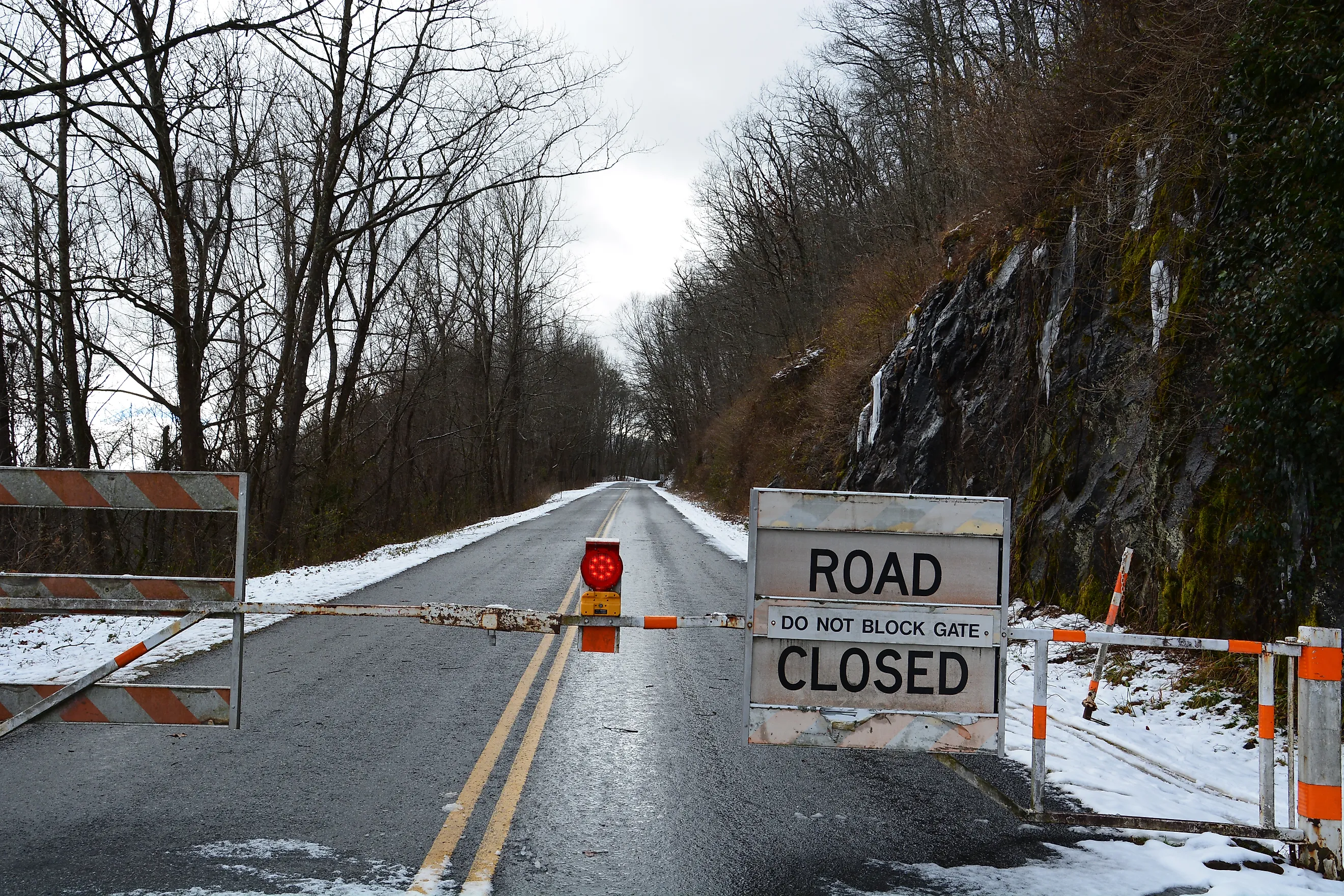
Winter closures run from November through March, with gates shut wherever the road is impassable and often without much advance notice. Higher-elevation sections around Craggy and Pisgah close for snow and ice and typically do not reopen until late March or April.
On a single day in November 2025 the Parkway was closed from Milepost 355 at Mount Mitchell all the way to 469 at Great Smoky Mountains National Park, plus most of the stretch between 285.5 near Boone and Blowing Rock and 307 at Beacon Heights. That is hundreds of miles of road behind gates.
Highlands Loses Almost Everybody

The sharpest swing on the Blue Ridge belongs to the highest town on it. At 4,118 feet Highlands is one of the highest incorporated towns east of the Mississippi, and the census counted 1,014 permanent residents in 2020. Visitor guides put the in-season figure above 18,000, with the broader year-round community sometimes given as around 3,200.
Whichever baseline is used, the town operates at a multiple of itself for part of the year and then returns to a four-block main street with the restaurants shut.
Blowing Rock More Than Doubles

The best-known town on the North Carolina stretch runs a smaller but still substantial cycle.
Blowing Rock has a population of less than 1500 across about 3.1 square miles. Seasonal population more than doubles that, which is why the town can feel quiet one week and crowded the next.
Local sources are candid about the tradeoffs of living there full-time: cold winters, seasonal parking pressure downtown, and occasional road or Parkway closures.
Little Switzerland Exists Because Of The Road

Some communities along the Parkway have no other reason to be where they are, and they feel the closure hardest.
Little Switzerland is an unincorporated resort community sitting just off the Parkway on NC 226A between Marion and Spruce Pine. It was built as a mountain resort and its relationship with the Parkway has been close enough to be contentious, including a lost fight over access to its own tower on Grassy Mountain.
When the gates close either side of it, the settlement is not simply quieter. It is off the route entirely.
Helene Extended The Off-Season

The usual winter pattern has been compounded by storm damage still waiting on repair.
Sections from Linville south toward Mount Mitchell have remained closed pending Hurricane Helene repairs, and during peak color in October 2026 the Linville Falls Visitor Center was still shut along with the Parkway between mileposts 344 and 355 near Little Switzerland.
For towns whose entire trade arrives by that road, a closure during leaf season is not an inconvenience. It is the year.
The Economics Are Brutal And Compressed

These places earn in weeks what elsewhere gets earned across months. Local tourism officials describe businesses that survive off fall travel, and peak color in western North Carolina lasts a matter of weeks in October. Hotels, restaurants, galleries and outfitters take the bulk of their annual revenue inside that window plus the summer season.
Which is why so much simply shuts afterwards rather than running at a loss through the quiet months.
A Few Towns Do Not Empty

The pattern is not universal, and the exceptions share one obvious feature. Boone has Appalachian State University, which means roughly 20,000 students who do not leave in November. Banner Elk and Beech Mountain have ski areas, which converts winter from a dead season into a second one.
Blowing Rock and Boone sit on US 221 between them, with skiing, shopping and golf, which is why both are described as year-round destinations in a way the Parkway-dependent settlements are not.
The Little Parkway Stays Open

There is an alternative route, and knowing it is the difference between a trip working and not.
US 221 between Linville and Blowing Rock is known as the Little Parkway Scenic Byway, an 18-mile stretch of curves and elevation changes that offers access to Grandfather Mountain. It is a state highway rather than a national park road, so it is maintained for ordinary winter traffic.
Other detours exist where the Parkway is shut, including US 221 between Linville and Marion and US 70 or Interstate 40 between Craggy and Asheville.
Check The Gates Before Going

The practical advice for anybody traveling the Blue Ridge outside summer is unusually specific.
Closures are not always posted far in advance, and gates simply shut where conditions are unsafe. The National Park Service maintains a road status and closures page, and it is worth checking the morning of a drive rather than the week before.
Closed also means closed to everything. Walking, cycling and hiking on closed roadway sections are all prohibited.
The Short Answer

Blue Ridge towns empty after leaf season because the Blue Ridge Parkway closes in sections from November to March, and the settlements strung along it lose their access road rather than merely their visitors. Highlands drops from above 18,000 to a census population of 1,014. Blowing Rock halves.
The towns that survive the winter intact are the ones with something other than the road: a university at Boone, ski areas at Beech Mountain and Banner Elk, or a state highway that gets plowed. Everywhere else waits for April.