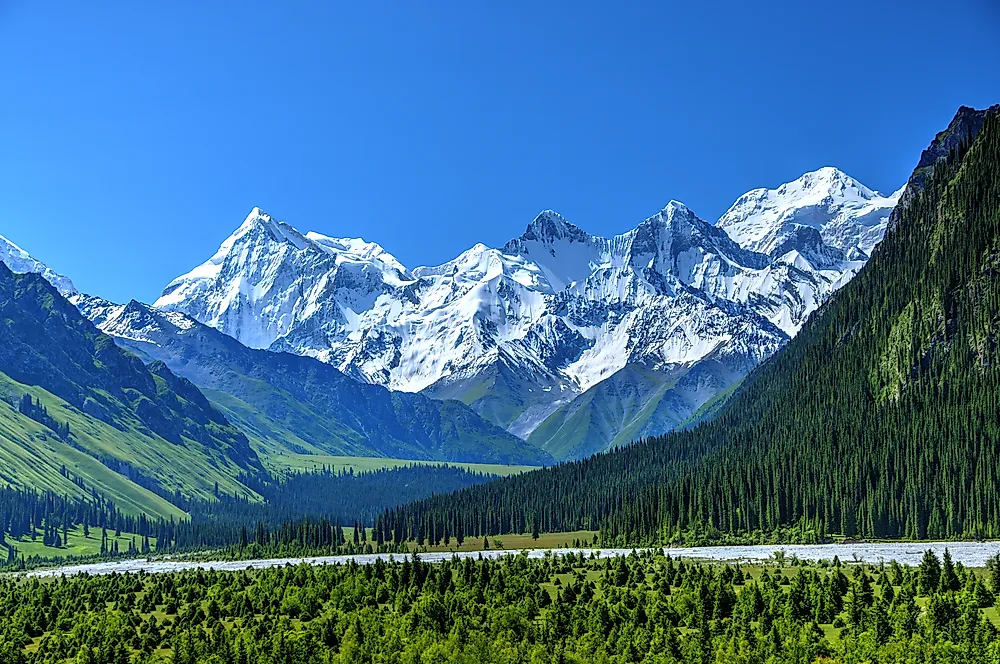
The Longest Mountain Ranges in Asia
Mountain ranges do not come with tape measures. They fade into foothills, splinter into sub-ranges, and argue with cartographers about where exactly they end, so every "longest range" figure below is a careful estimate rather than a surveyed fact. With that caveat firmly in place, Asia, the largest and lumpiest continent on Earth, is the natural home of the contest. It covers more than 17 million square miles, holds roughly 60% of humanity, and was assembled in large part by a slow-motion continental pile-up that threw up more long mountain chains than anywhere else on the planet. Here are the longest of them, starting with a 3,000-kilometer giant most people have never heard of.
The Big Three: Asia's 2,500-Kilometer Club

The longest mountain range in Asia is one most people could not point to on a map. The Kunlun Mountains run for roughly 3,000 kilometers (1,900 miles) along the northern rim of the Tibetan Plateau, above the Tarim Basin in western China. Chinese tradition calls them the "ancestor of ten thousand mountains," which sounds grand until you learn how few people visit: the entire range is crossed by just two roads. Its highest peak, Liushi Shan, tops out at 7,167 meters (23,514 feet), and its glaciers feed rivers with names that sound made up, the Black Jade and the White Jade.
Second place goes to the Tian Shan, the "Heavenly Mountains," which stretch about 2,900 kilometers (1,800 miles) across China, Kazakhstan, and Kyrgyzstan, linking the Pamirs in the south to the Altai in the north. Silk Road caravans threaded its passes for centuries, and its crowning summit, Jengish Chokusu, stands 7,439 meters (24,406 feet) high.

Third place is a technicality that Asia shares with Europe. The Ural Mountains run about 2,500 kilometers (1,550 miles) from the Arctic Ocean toward the Caspian Sea, and they are famous less for their height than for their day job: they are the agreed-upon boundary between Europe and Asia. For a range that long, they are strikingly modest, with a high point, Mount Narodnaya, of just 1,895 meters (6,217 feet). Asia's third-longest mountain range is, in other words, a very long and very low fence.
The Himalayan Hat-Trick

Ranks four, five, and six all belong to the same mountains, which is what happens when one range is built in triplicate. The Himalaya proper runs about 2,400 kilometers (1,500 miles) across Nepal, Bhutan, China, India, and Pakistan, and it is the undisputed heavyweight, home to Mount Everest at 8,848 meters (29,029 feet), the highest point on the planet.
Running parallel to it, like ripples racing ahead of a shove, are two lower belts of the very same collision: the Lesser Himalaya and, in front of them, the Siwalik Hills. Each stretches roughly the same 2,400 kilometers, because each is simply another wrinkle in the same crumpled edge of the continent. Counting them as three separate ranges is a bit like counting a stack of three towels as three floors, but they do run the full length, so onto the list they go.
The Middleweights
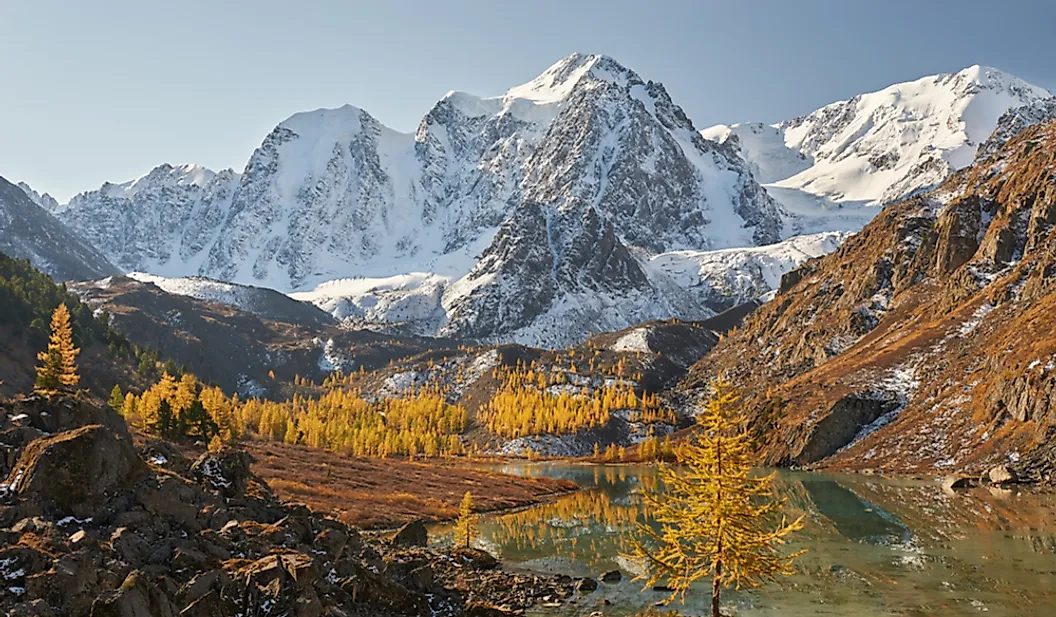
Below the giants sits a band of ranges between 1,600 and 2,000 kilometers long. The Altai Mountains reach about 2,000 kilometers (1,240 miles) across the corner where Russia, China, Mongolia, and Kazakhstan meet, feeding the mighty Ob and Irtysh rivers and topping out at twin-peaked Belukha (4,506 meters). Then comes the odd one out: Indonesia's Barisan Mountains run some 1,700 kilometers down the spine of Sumatra and are genuinely volcanic, a real rarity here, crowned by the smoking cone of Mount Kerinci.

The Zagros Mountains of Iran and Iraq run about 1,600 kilometers (990 miles) and look, on a geological map, exactly like what they are: the crumpled zone where Arabia is slowly ramming into Eurasia, folded like a rug shoved against a wall. Their highest peak is Dena, at 4,409 meters, and their folds cradle much of Iran's oil. Tied with them at 1,600 kilometers is India's Western Ghats, a biodiversity hotspot running down the country's western edge, wetter and greener than anything else in this group and home to thousands of species found nowhere else.
The Long Tail
The bottom of the list runs through Siberia and beyond. The Chersky and Sayan ranges, each around 1,500 kilometers, corrugate eastern Russia, the Chersky peaking at the aptly named Pobeda ("Victory") and the Sayan straddling the Russia-Mongolia border. Turkey's Taurus Mountains, also near 1,500 kilometers, carry the best origin story on the list: the name means "bull," the emblem of the ancient Near Eastern storm-god, and locals once read the range's violent thunderstorms as that god hard at work.
Rounding things out are Russia's Kolyma Mountains at about 1,300 kilometers and China's Greater Khingan at roughly 1,200, the latter a low, forested range whose meltwater helps feed the Argun, a headwater of the great Amur River. None of them will ever be as famous as Everest, but together they show how thoroughly Asia has cornered the market on long mountains.
Why Asia Grows Them So Long
Almost none of these ranges are volcanoes, whatever older accounts might claim. They are wrinkles. When two slabs of continent collide and neither will slide under the other, the crust caught between them has nowhere to go but up and sideways, buckling into long parallel ridges. The Himalaya, Kunlun, Tian Shan, and Zagros are all products of the same great era of collisions, chiefly India slamming into Asia over the last 50 million years and shoving up the roof of the world. That is why Asia's ranges tend to run long and roughly parallel rather than round and alone: they are the folds in a tablecloth that several continents keep pushing together. Sumatra's Barisan is the rare truly volcanic exception, which is exactly why it sits on this list wearing a different hat.
The Full Ranking
| Rank | Mountain Range | Country | Approx. Length (km) |
|---|---|---|---|
| 1 | Kunlun Mountains | China | 3,000 |
| 2 | Tian Shan | China, Kazakhstan, Kyrgyzstan | 2,900 |
| 3 | Ural Mountains | Russia (Europe-Asia border) | 2,500 |
| 4 | Himalaya | Nepal, Bhutan, China, India, Pakistan | 2,400 |
| 5 | Lesser Himalaya | India, Nepal, Bhutan | 2,400 |
| 6 | Siwalik Hills | India, Nepal, Bhutan | 2,400 |
| 7 | Altai Mountains | Russia, China, Mongolia, Kazakhstan | 2,000 |
| 8 | Barisan Mountains | Indonesia | 1,700 |
| 9 | Zagros Mountains | Iran, Iraq | 1,600 |
| 10 | Western Ghats | India | 1,600 |
| 11 | Chersky Range | Russia | 1,500 |
| 12 | Sayan Mountains | Russia, Mongolia | 1,500 |
| 13 | Taurus Mountains | Turkey | 1,500 |
| 14 | Kolyma Mountains | Russia | 1,300 |
| 15 | Greater Khingan | China | 1,200 |