The Highest Mountain In America You Can Drive To The Top Of In Winter
Colorado's Pikes Peak is the highest mountain in the United States that you can drive up in wintertime. With a summit elevation of 14,115 feet (4,302 meters), Pikes Peak ranks 30th on the list of Colorado's 53 official 14ers (14,000-foot plus mountains), but it ranks second in prominence, rising 8,100 feet above the Colorado Springs. Make sure you've got snow tires, all-wheel-drive, good brakes, and plenty of windshield washer fluid, because even though the route is well-maintained, conditions can change quickly at this altitude.
From Sacred Land To A Gold Rush

Often referred to as America's Mountain, Pikes Peak was sacred land for thousands of years to the indigenous Ute people, who called it Tava, or Sun Mountain. The local Arapaho also revered the mountain, calling it Heey-otoyoo, or Long Mountain. In November 1806, US Army Lieutenant Zebulon Pike attempted to climb the mountain while exploring the newly acquired Louisiana Territory. Caught in a fierce blizzard, he turned back and famously predicted that no human would ever reach the summit. He was wrong. In 1820 botanist Edwin James led the first successful recorded climb to the summit, and in 1858 Julia Archibald Holmes, wearing bloomers instead of mountaineering clothing, became the first woman to summit. Pikes Peak gained notoriety during the 1859 gold rush, serving as an important landmark on the horizon for prospectors, who adopted the rallying cry "Pikes Peak or bust!" Later, in 1893, the panoramic view from the top inspired poet Katharine Lee Bates to pen the lyrics to America the Beautiful.
The Road To The Summit

Thanks to the gold rush, trails to the summit were established in the late 1800s, and visitors were able to reach the top of Pikes Peak via burro trails, a steep carriage road, and the Manitou and Pikes Peak Cog Railway, which opened in 1891. In 1915, Colorado Springs entrepreneur Spencer Penrose financed an improvement to the carriage road into a wider highway for automobiles to promote tourism and his hotel, the Broadmoor Hotel. Gravel and dirt for decades, the highway was gradually paved between 2002 and 2011 following a lawsuit for an environmental group over gravel runoff and erosion.
The Race To The Clouds
To publicize his newly finished highway in 1916, Penrose founded the Pikes Peak International Hill Climb, also known as The Race to the Clouds. Attracting racers from around the world, the course is a grueling 12.42-mile (20 kilometers) section of the highway featuring 156 curves and corners, starting at 9,390 feet and finishing at the 14,115-foot summit for a vertical gain of 4,725 feet (1,440 meters). The inaugural race was won by Rea Lentz in a time of 20 minutes and 55.6 seconds. Over the decades, the race became synonymous with the legendary Unser racing family—Louis, Joe, and Jerry, followed by Bobby and Al—who won dozens of titles between them. Once the course was paved, speeds skyrocketed. In 2018, French driver Romain Dumas shattered the all-time course record in an all-electric Volkswagen, becoming the first person to break the eight-minute barrier with a time of seven minutes and 57.1 seconds. Because the race spans almost 5,000 vertical feet (1,450 meters) of elevation, drivers often start in warm sunshine only to experience hail, fog, and snow higher up. Thin air at high altitudes also saps engine power by up to 30 percent on internal combustion engines, making Pikes Peak an important proving ground for research on turbocharging and electric powertrains.
High Altitude Doughnuts and Stunning Scenery

While racers are hoping for a trophy at the summit, the rest of us have plenty to look forward to at the end of the road. The summit features the Pikes Peak Summit Visitor Center, a modern 38,000-square-foot building that opened in 2021. Designed to blend into the alpine tundra and meet strict environmental requirements, it offers dining, exhibits, and accessible outdoor viewpoints. The summit café is famous for its freshly made doughnuts, cooked in a specialized 1,500-pound machine calibrated for the low surrounding air pressure. Because of the unique recipe and pressure differences, the doughnuts are meant to be enjoyed at the summit as they tend to deflate at lower elevations. The self-serve cafeteria also offers burgers, pizza, soups, and hot dogs. The visitor center features interactive displays and high-tech digital exhibits that explore the mountain's geology, Indigenous and pioneer history, the surrounding extreme climate, and alpine conservation efforts. On a clear day, visitors can see across five states from the summit of Pikes Peak and near the overlooks, a large stone-and-metal monument marks the official 14,115-foot elevation alongside a brass USGS survey marker, making it the most popular photo opportunity on the peak.
The Route To The Top

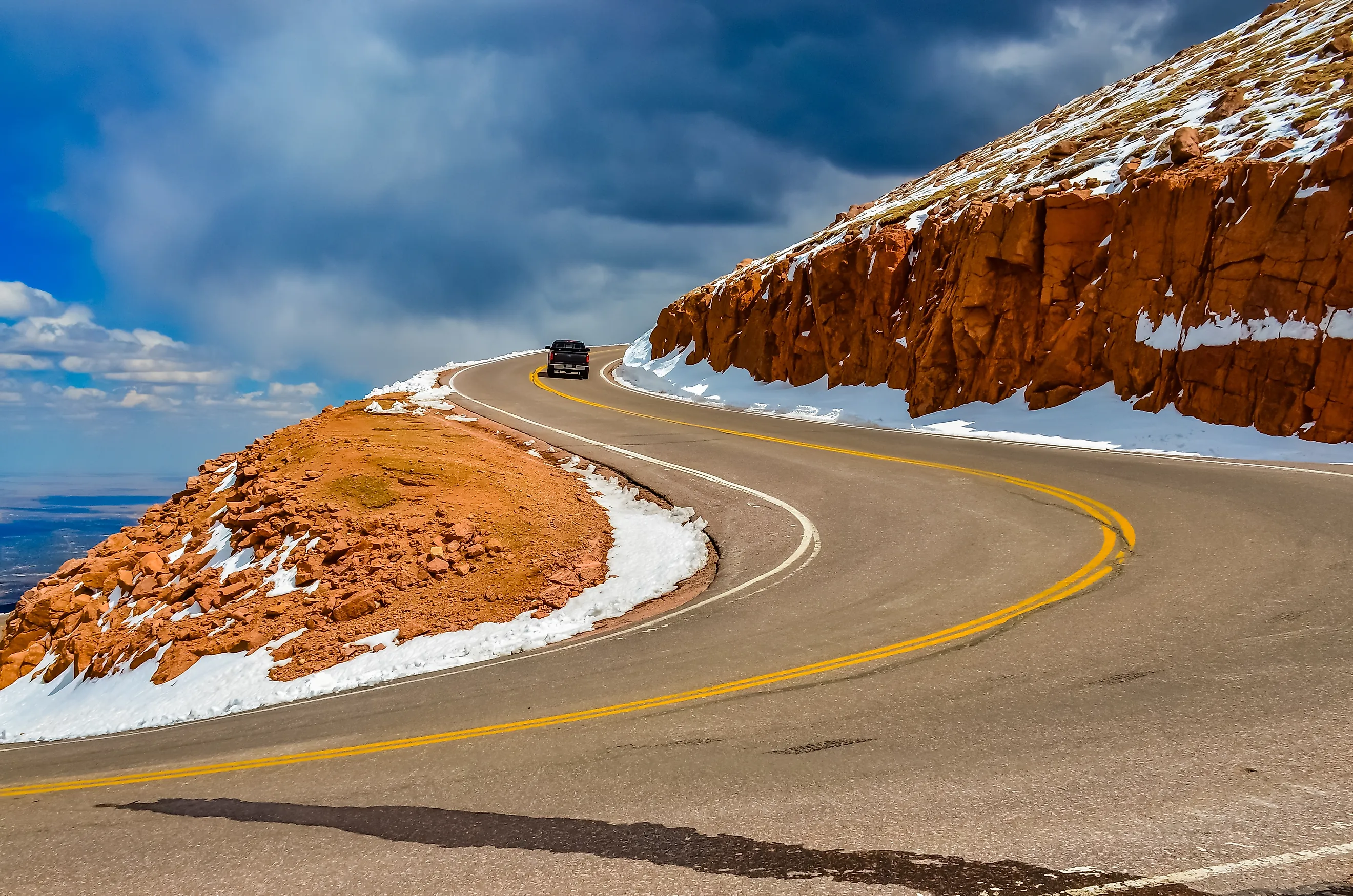
For recreational drivers, the Pikes Peak Highway is a 19-mile (30-kilometer) paved road and stays open 365 days a year, weather permitting. While the road aims to be open to the top every day, heavy snow, ice, or high winds can cause partial closures, stopping traffic at lower spots like Glen Cove at Mile 13. Even on a clear, dry day, the road is not for the faint of heart. It features tight switchbacks, steep drop-offs, minimum guardrails, vehicle preparation, and low-gear driving techniques. Visitors are recommended to start with at least half a tank of gas, turn off air conditioning as it puts an extra strain on the engine and may cause it to overheat, and brake pads, calipers, and rotors must be in good working shape. At about six miles down from the summit, rangers use infrared thermometers to measure rotor temperatures during busy periods to reduce the risk of brake failure.
A New World In Just 60 Minutes

Modern technology can put people in very different environments in a short period of time. On Pikes Peak, a beautiful day in the valley can quickly turn into a wintery storm on the summit, even in summer, and temperatures can vary by up to 30 degrees on any given day. The 38-mile (60-kilometer) round trip takes about two hours of driving time, and most visitors budget three to four hours total to enjoy the summit and scenic overlooks. Along with changing weather conditions, people also need to be aware of the potential of altitude sickness and know its symptoms. While climbing the highest peak in America you can drive during winter is a modern convenience, being prepared ahead of time will make this adventure safe and enjoyable.