The American Power Plants Built Inside A Mountain
Roughly 1,000 feet below a reservoir on Tennessee's Raccoon Mountain, four huge pump-generators sit in a chamber as long as a football field. It is one of several American power plants built inside mountains. Most are pumped-storage plants. They move water uphill when demand is low, then release it to make electricity when demand rises. Washington's Boundary plant works differently, using the Pend Oreille River to power turbines inside a limestone cavern. Their dams and reservoirs may be visible, but most of the working machinery is buried in rock.
Raccoon Mountain Pumped-Storage Plant, Tennessee

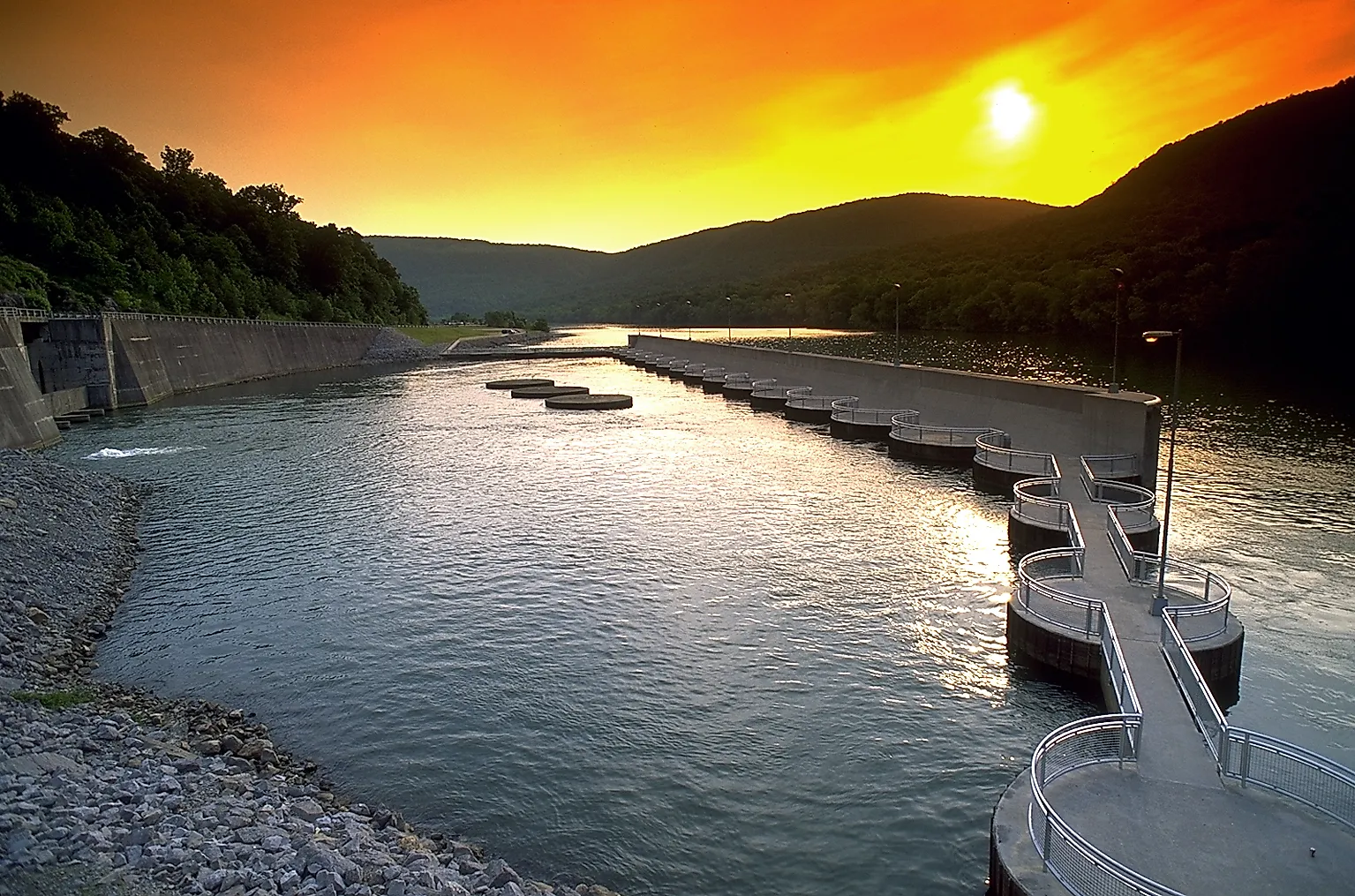
TVA placed its largest hydroelectric plant inside a mass of limestone six miles west of Chattanooga. The upper reservoir sits on Raccoon Mountain behind an 8,500-foot rockfill dam. Roughly 1,000 feet below its surface, four reversible units operate in a chamber carved to about the length of a football field. Crews also bored 12,000 feet of tunnels through the mountain. A road enters a portal on the north side and continues underground to the powerhouse.
The plant stores energy by lifting water from Nickajack Reservoir to the mountaintop when electricity demand is low. During a peak, the water descends through the mountain and spins the same machines in reverse. TVA says Raccoon Mountain can deliver more than 1,700 megawatts. Construction began in 1970, and the project was completed by 1979 after more than 1,000 workers excavated the underground complex and upper reservoir.
Bad Creek Hydroelectric Station, South Carolina

A city bus could pass through the entrance tunnel that cuts into granite at Bad Creek near Lake Jocassee. Six hundred feet underground, the powerhouse rises 164 feet through four levels. Its location takes advantage of a 1,200-foot elevation difference between the upper reservoir and the lake. Water travels through nearly three quarters of a mile of concrete tunnel before reaching the turbines. The plant began operating in 1991 beneath the Blue Ridge foothills.
Duke Energy completed a five-year modernization in 2024 that added 320 megawatts. The company reports 1,680 megawatts of generating capability after the upgrade. Its current federal filing uses a different measure and lists 1,400 megawatts of nameplate capacity. The units now switch between pumping and generation several times on some days. They can absorb surplus electricity during periods of strong solar production, then return power to the grid after sunlight fades or demand climbs.
Northfield Mountain Pumped Hydro Storage Station, Massachusetts

Northfield Mountain has a reservoir near the top of a wooded ridge and a powerhouse deep within it. Four reversible units fill a 328-foot-long underground chamber connected to a pressure shaft, branching penstocks, and a tailrace tunnel that reaches the Connecticut River. The plant was completed in 1972. FERC lists 1,166.8 megawatts of installed capacity. FirstLight rounds that figure to 1,168 megawatts.
The lower reservoir is the Turners Falls impoundment on the river. Its water can be lifted to the 286-acre upper reservoir, then sent back through the turbines when the regional grid needs electricity. FirstLight calls Northfield New England's largest energy-storage facility and says it can supply more than one million homes for as long as 7.5 hours. The 328-foot powerhouse lies beneath the ridge; trails and recreation areas cross the land above.
Bear Swamp Pumped Storage Development, Massachusetts

The Bear Swamp development is built into a steep slope above the Deerfield River in western Massachusetts. Its upper reservoir sits at an elevation of roughly 1,600 feet, high above the Fife Brook impoundment that serves as the lower reservoir. Between them, an approximately 1,430-foot tunnel system carries water toward two steel-lined penstocks.
The powerhouse is entirely underground, in a cavern 227 feet long and 79 feet wide. It rises 182 feet. Two reversible Francis units fit within that vertical space and provide 666 megawatts of authorized capacity. Separate draft-tube tunnels connect them to the lower reservoir.
Completed in 1974, Bear Swamp has two generating units, compared with four at Raccoon and Northfield. Its pair of turbines produces up to 666 megawatts in a cavern more than twice as tall as it is wide.
Helms Pumped Storage Plant, California

A 3,723-foot access tunnel leads into Helms in the Sierra Nevada northeast of Fresno. The tunnel opens into a rock chamber with a 336-by-83-foot footprint and a height of 125 feet. The excavated chamber contains three vertical pump-turbine units and an underground transformer bank.
Water moves between Courtright Lake above and Lake Wishon below. In generating mode, it travels through thousands of feet of tunnels and a penstock before the passage divides toward the three turbines. Pumping reverses the flow and returns the water to Courtright.
Helms entered service in 1984. Its three turbines have 1,080 megawatts of combined installed capacity. The generators, rated separately, total about 1,212 megawatts. The plant's largest working space sits in a granite cavern about 1,100 feet below the surface.
Edward Hyatt Powerplant, California

Edward Hyatt Powerplant sits in rock within the left abutment of Oroville Dam, the 770-foot embankment that holds back Lake Oroville in the Sierra Nevada foothills. Construction began in 1964 and finished in 1967. The underground complex contains two main penstock tunnels that divide into six branch lines before reaching six generating units. Three are conventional turbines. The other three are reversible pump-turbines capable of returning released water to the lake during off-peak periods.
California's current State Water Project tables list Hyatt at 645 megawatts of maximum dependable generating capacity. The plant's dependence on the reservoir became unusually clear in August 2021, when historic low water forced it offline for the first time. Autumn and winter storms raised Lake Oroville enough for generation to resume in January 2022. The machinery remained ready underground, but the reservoir had fallen below the elevation needed to operate it.
Boundary Hydroelectric Project, Washington

Boundary is the only plant here that does not pump water uphill for reuse. Water from the Pend Oreille River passes through a 340-foot arch dam in northeastern Washington, drives six turbines, and returns downstream. Its generating hall lies in a limestone cavern beside the dam. Beginning in 1963, crews removed 500,000 cubic yards of rock. The resulting machine hall stretches 477 feet, spans 76 feet, and descends 170 feet. At the time, it was the world's largest underground powerhouse.
Four generators began commercial operation in 1967. Space, waterways, and transformer bays for two additional units had already been excavated, so Seattle City Light installed them in 1986 without another major round of blasting. Later improvements raised the project's electrical capability to 1,117.4 megawatts. With all six units operating, Seattle City Light says Boundary can provide as much as 35 percent of Seattle's electricity.
The six pumped-storage plants use mountain relief to hold energy in elevated water. Boundary uses its limestone cavern to house generators beside a working river. Both approaches place huge machinery inside excavated rock, where a single powerhouse can deliver hundreds or even thousands of megawatts. At Raccoon Mountain, a surface portal opens onto a road that continues through the rock toward four pump-generators roughly 1,000 feet below the upper reservoir.