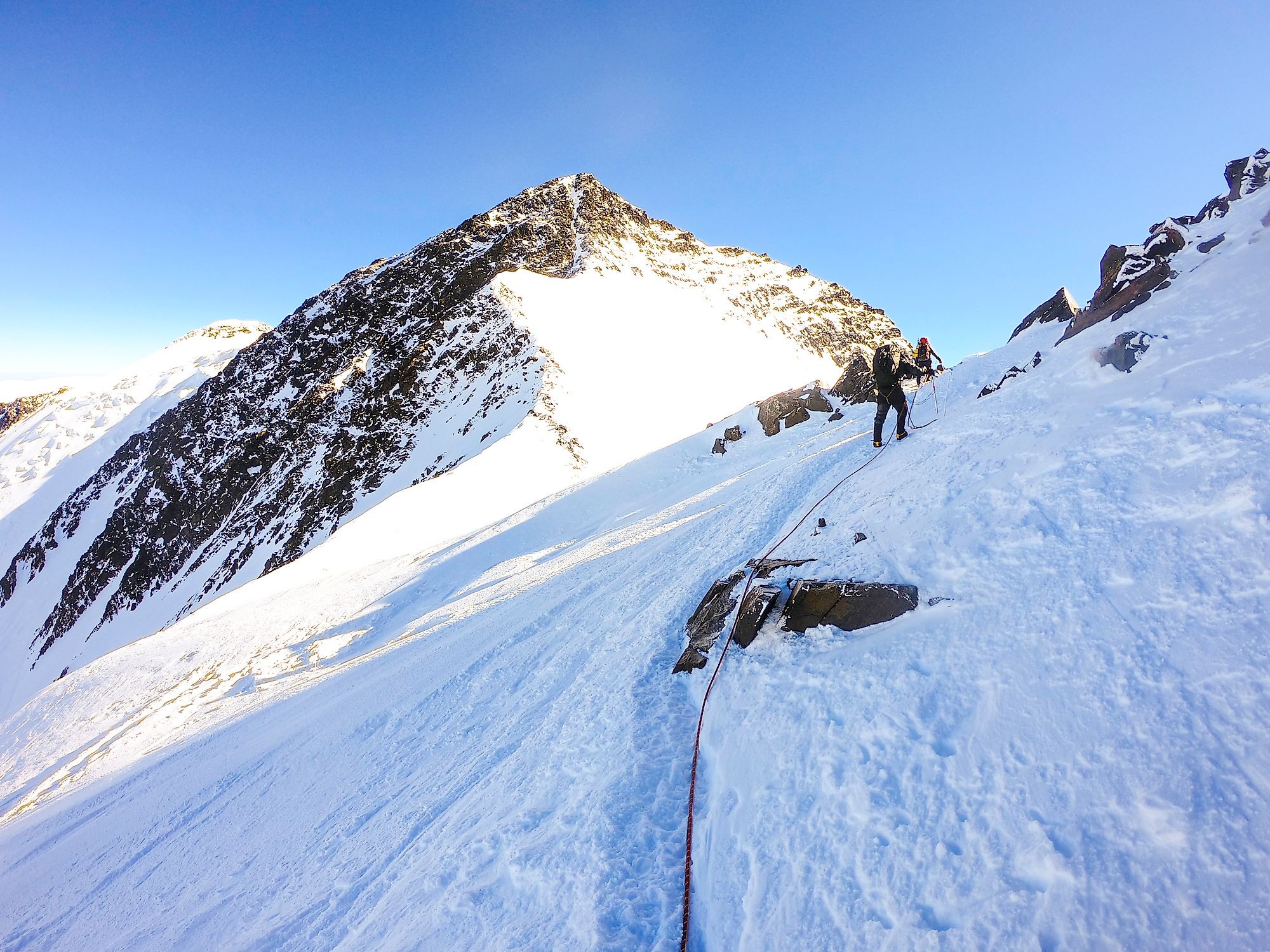
Why Denali Is Harder To Climb Than Everest
About half the climbers who set out for Denali's summit never reach it. Roughly a thousand register each year to attempt a peak that stands almost 9,000 feet lower than Everest. The catch is where the climb begins. Denali's base-to-summit rise of about 18,000 feet is the largest of any mountain standing entirely above sea level, so the route covers more vertical ground than Everest's does. No Sherpa teams carry the loads, no one stocks the camps, and no weather window can be counted on. On Denali, the thin air is joined by the weight, the cold, and the solitude.
Climbers Carry Everything on Their Own Backs

On Everest, a client climber rarely carries a full load. Sherpa teams fix the ropes, stock the high camps, carry much of the gear, and cook the meals, so paying climbers can focus on moving up. There is no such support on Denali. A team flies onto the Kahiltna Glacier at about 7,200 feet and from there moves every pound of food, fuel, and equipment on its own, frequently 100 pounds or more per person split between a backpack and a sled. Because no one can haul that weight up in a single push, teams end up climbing the mountain twice over in effect, carrying loads to a cache, dropping back down to sleep, then moving up again. A dropped sled or a load that slides on a steep pitch can cost a day of progress or cause an injury. At the end of each stage, climbers still have to build the camp themselves, cut snow blocks into walls against the wind, pitch the tents, and melt snow for water before anyone eats.
The Route Gains More Vertical Feet Than Everest's

Everest's climbers start high. The standard south-side route begins at a base camp near 17,500 feet, so reaching the 29,031-foot top means gaining roughly 11,500 vertical feet. There is no comparable head start on Denali. The West Buttress route begins at the Kahiltna Glacier base camp near 7,200 feet and reaches 20,310 feet, close to 13,000 feet of climbing. The lower mountain is the longer climb, and every one of those extra feet is gained on foot under a full load.
The Air Grows Thinner This Far North

Latitude thins the air beyond what the altitude alone would do. Denali stands at 63° North, only a few degrees south of the Arctic Circle, where the atmosphere is thinner than it is over the equator. Barometric pressure at a given elevation runs lower here than on a peak of the same height nearer the tropics, so the thin air at the top can feel closer to 22,000 or 23,000 feet. Everest climbers rarely meet their summit on raw air. According to National Geographic, about 95 percent of them use supplemental oxygen, while Denali is almost always climbed without it.
Storms and Deep Cold Arrive Without Warning

The cold on Denali is in a different class. At the 17,200-foot high camp, -40°F is routine rather than exceptional, and wind can drive the effective temperature far lower, with frostbite able to take exposed skin within minutes. Everest has its own severe weather, but its season is more predictable, with recognized climbing windows in the spring before the monsoon and a shorter one in the fall. In those windows, teams can time a summit push around the worst of the storms. There is no comparable schedule on Denali. Storms that form over the Gulf of Alaska move inland into the Alaska Range with little warning and can pin a team inside its tents for days, forcing climbers to ration food and fuel and give up hard-won ground.
A Team Is Largely on Its Own

Rescue is the last difference, and the most serious. Everest's standard routes are crowded and heavily guided, and an injured climber can sometimes be flown off the lower mountain by helicopter. Denali has a smaller safety net. The National Park Service staffs a ranger camp at 14,200 feet through the climbing season and can mount high-altitude helicopter rescues, but the storms that cause most of the trouble also ground the aircraft, so a team in difficulty high on the mountain may wait days for the weather to clear. The working rule is self-reliance. Once climbers commit to the upper mountain, they have to be ready to get themselves down.
The Lower Mountain Is Often the Harder Climb
None of this makes Everest easy. Its last few thousand feet lie in the death zone above 26,000 feet, where the body cannot recover no matter how long a climber rests. The point is narrower than that. By raw height, Everest is the bigger mountain, but height is only one axis of difficulty. On Denali, a climber gains more vertical feet, carries the full load without hired help, meets colder and less predictable weather, and does it at a latitude that makes 20,310 feet feel closer to 23,000. For many who have climbed both, those pressures stacked together outweigh Everest's thinner air, which is why the lower mountain so often proves the harder one.