The Largest Ships Sailing The Great Lakes Today
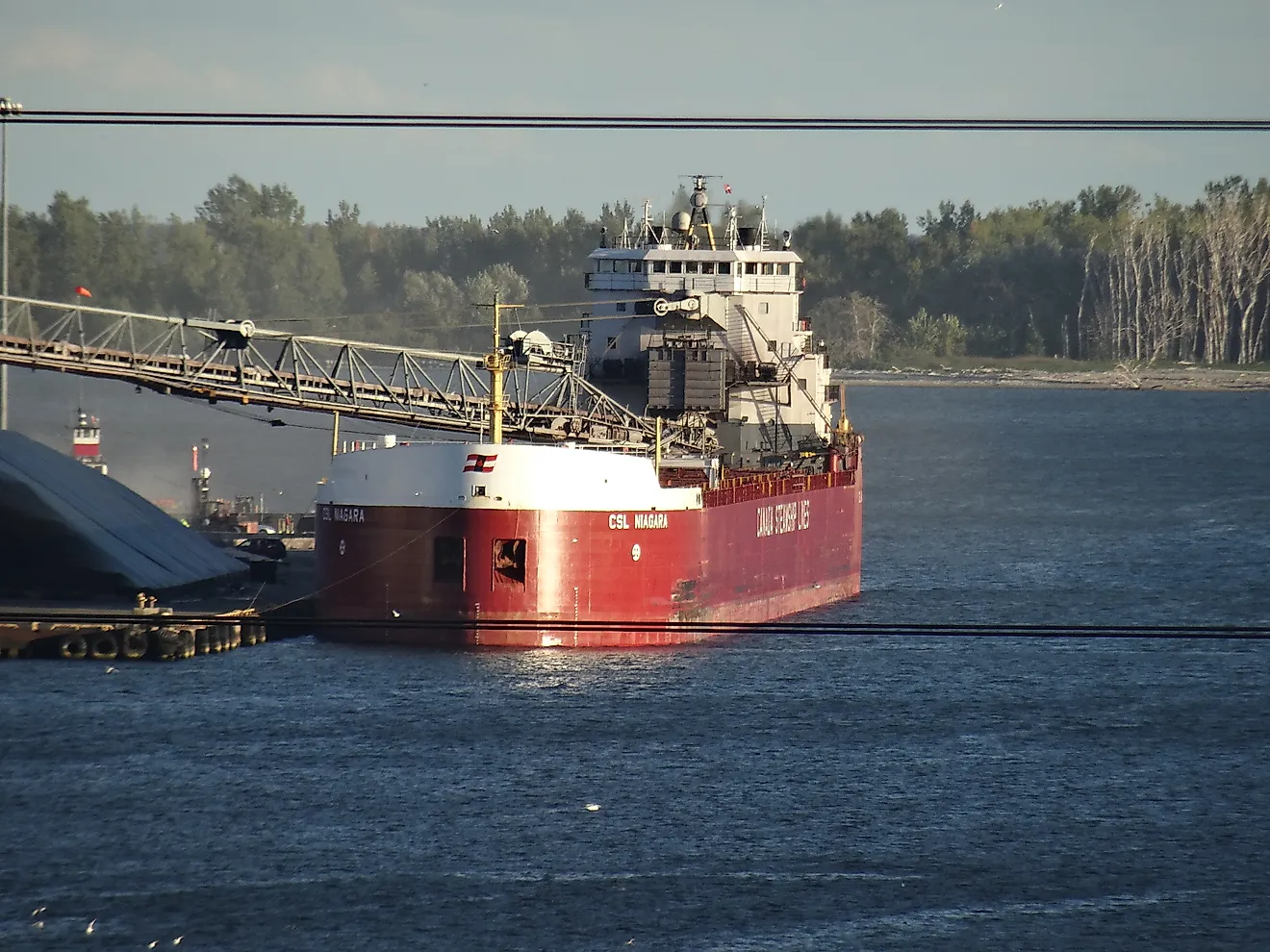
The largest ships working the Great Lakes belong to a very specific class. Thirteen active vessels reach at least 1,000 feet in overall length. Twelve are self-propelled bulk freighters. These ships were built for heavy bulk trades such as iron ore, coal, and limestone, with enormous cargo holds and onboard unloading systems suited to Great Lakes terminals. Their dimensions also separate them sharply from oceangoing vessels using the St. Lawrence Seaway. A Seaway vessel normally cannot exceed 740 feet in length, while the biggest lakers stretch more than 1,000 feet. Ranked by length, the group begins with one clear record holder and continues through a cluster of ships whose differences come down to a few feet, cargo capacity, machinery, and design.
Paul R. Tregurtha, 1,013.5 Feet

Paul R. Tregurtha holds the length record among ships operating on the Great Lakes. Interlake Steamship Company gives the vessel an overall length of 1,013.5 feet and a beam of 105 feet. It entered service in 1981 as William J. DeLancey and received its current name in 1990. Five cargo holds occupy much of the hull, with a self-unloading system feeding a 260-foot boom. Interlake states a carrying capacity of 68,000 gross tons of taconite pellets and up to 71,000 net tons of coal.
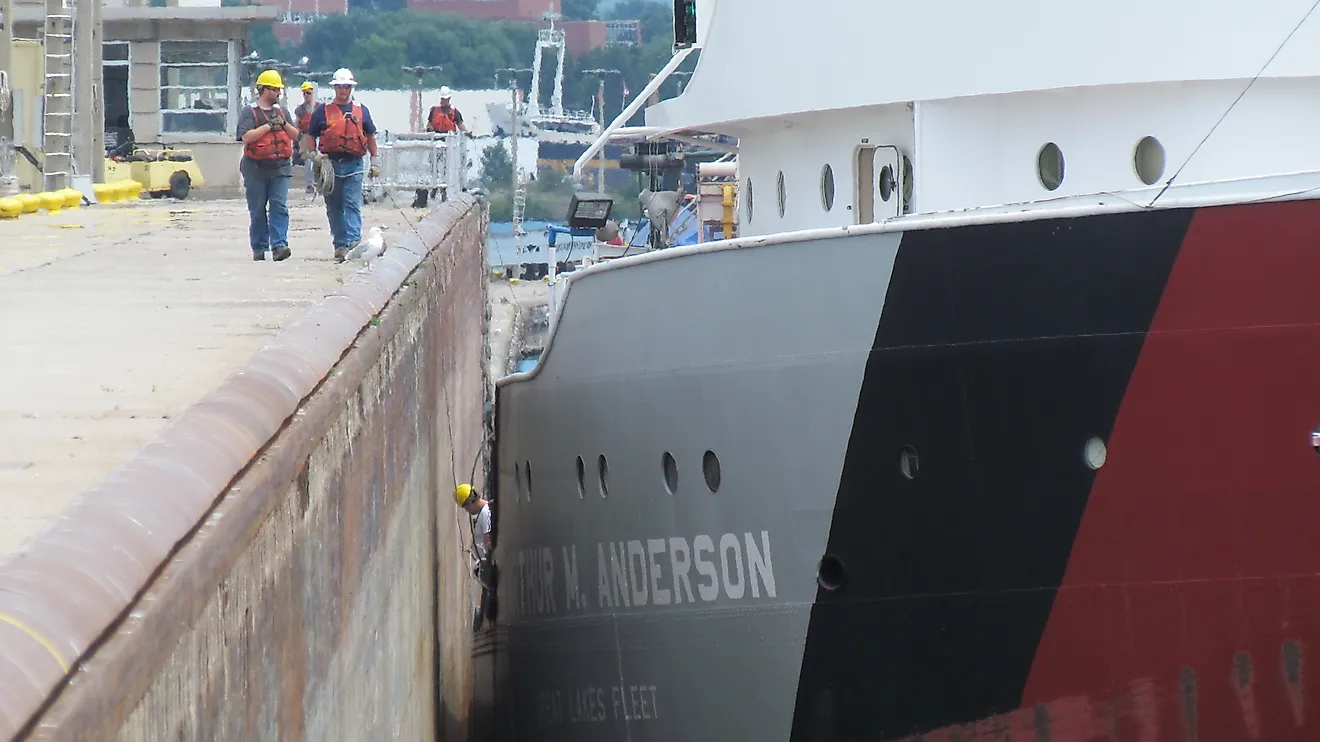
The scale becomes especially apparent at Sault Ste. Marie. The Poe Lock is 110 feet wide, leaving only a narrow margin beside the ship’s 105-foot beam. The Lake Carriers’ Association currently assigns Paul R. Tregurtha a 69,580-ton per-trip capacity in its standardized fleet table. No other active Great Lakes vessel exceeds its 1,013.5-foot overall length.
James R. Barker, 1,004 Feet

James R. Barker earned its place in Great Lakes history before carrying its first commercial cargo. Completed in 1976, it was the first 1,000-foot-class ship built entirely on the Great Lakes. Interlake lists the freighter at 1,004 feet long and 105 feet wide, powered by 16,000 horsepower. Its five-hold cargo system feeds a 250-foot unloading boom, allowing the ship to discharge bulk material without depending on a large shoreside crane. Interlake rates its gross carrying capacity at 63,300 tons, while the Lake Carriers’ Association uses a standardized per-trip figure of 67,475 tons. The Barker arrived only four years after Stewart J. Cort introduced the thousand-footer concept, yet its construction was far more conventional. There was no need to build major hull sections on the Gulf Coast and assemble the completed ship farther north. Its 1976 launch helped establish the basic giant-laker format that dominated new construction for the rest of that decade.
Mesabi Miner, 1,004 Feet
Mesabi Miner entered service in 1977, one year after James R. Barker. The two Interlake ships share the same 1,004-foot length, 105-foot beam, 16,000-horsepower rating, and 63,300-gross-ton capacity. Mesabi Miner carries its cargo in seven holds, giving it a different internal arrangement despite the nearly identical external dimensions.
Its self-unloading equipment is essential to the ship’s work. Cargo moves onto conveyor belts beneath the holds, then travels along the unloading boom to a terminal. That system reduces the amount of fixed unloading machinery a receiving dock needs.
The Lake Carriers’ Association gives Mesabi Miner a standardized per-trip capacity of 67,475 tons. Its dimensions also put it outside the limits of the St. Lawrence Seaway, so its working range is tied to the upper four Great Lakes and their connecting channels. Few ships make the scale of that inland transportation network clearer than a 1,004-foot freighter carrying tens of thousands of tons in a single load.
American Spirit, 1,004 Feet

American Spirit began its career in 1978 under a different name. The ship entered service as George A. Stinson and later became part of the American Steamship Company fleet. Mainstay Maritime records an overall length of 1,004 feet, a 105-foot beam, seven cargo holds, and 36 hatches. Propulsion comes from machinery producing 16,000 shaft horsepower.
Its unloading gear sets it apart visually once the ship reaches a dock. A 260-foot boom carries material ashore, and Mainstay gives the system a maximum unloading rate of 10,000 tons per hour. The Lake Carriers’ Association lists a standardized per-trip capacity of 66,080 tons. American Spirit is one of only a handful of current Great Lakes freighters measured at 1,004 feet instead of an even 1,000. Those extra four feet may look trivial on paper, but they place it in the second-longest group sailing the lakes today.
Edwin H. Gott, 1,004 Feet

Edwin H. Gott pairs a 1,004-foot hull with one of the strongest carrying-capacity figures in the current Great Lakes fleet. Built in 1979, the 105-foot-wide freighter belongs to Great Lakes Fleet and carries dry bulk cargoes on the upper lakes. The Lake Carriers’ Association assigns it a standardized per-trip capacity of 69,664 tons, higher than most other ships in the thousand-footer class. The vessel also received new propulsion machinery during a major repowering project in the winter of 2010-2011, extending the working life of a hull already more than three decades old at the time. That investment is significant in a fleet where nearly every thousand-footer dates to the 1970s or early 1980s. Edwin H. Gott remains one of the clearest examples of how extensive mechanical renewal can keep a very large bulk carrier commercially useful long after its original engines have reached the end of their practical service life.
Edgar B. Speer, 1,004 Feet

Edgar B. Speer joined Great Lakes Fleet in 1980 with the same headline dimensions as Edwin H. Gott: 1,004 feet in length and 105 feet across the beam. Its current Lake Carriers’ Association capacity figure is 69,552 tons per trip, placing it close behind the Gott.
The Speer is more unusual beneath the surface. Instead of relying on the long conventional unloading boom seen on many thousand-footers, it was built around a shuttle-type unloading arrangement suited to specific terminals. Great Lakes bulk carriers often work established industrial routes, making specialized cargo equipment practical when the ship regularly serves compatible docks.
That design gives Edgar B. Speer a different place in the thousand-footer fleet. Its size came from the same push toward maximum carrying efficiency that produced the other giants, but its unloading system was tailored much more closely to where the cargo would be delivered. The ship remains active more than four decades after entering service.
Stewart J. Cort, 1,000 Feet

Stewart J. Cort was the ship that pushed Great Lakes freighters through the 1,000-foot threshold. It entered service in 1972, several years before most of today’s giant lakers were built. Its construction required an unusual solution because a completed thousand-footer could not simply travel north through the St. Lawrence Seaway. The bow and stern were built at Pascagoula, Mississippi, temporarily joined, and moved north. At Erie, Pennsylvania, the sections were separated and connected to a newly constructed midbody.
Interlake lists the finished ship at 1,000 feet long, 105 feet wide, and 14,400 horsepower, with a gross carrying capacity of 58,000 tons. The Lake Carriers’ Association currently uses a 64,690-ton per-trip figure. The Cort also keeps its pilothouse at the bow. That forward arrangement makes it immediately recognizable beside later thousand-footers, whose superstructures are generally concentrated toward the stern.
Presque Isle, 1,000 Feet

Presque Isle belongs in the size ranking, although its engineering is different enough to require an asterisk. The 1,000-foot unit is an integrated tug-barge, not a conventional self-propelled freighter. A powered tug fits into a specially designed notch in the stern of the barge, creating a coupled vessel that works as a single unit. The combined length reaches 1,000 feet, while the beam is roughly 104 feet. The Lake Carriers’ Association lists Presque Isle with Great Lakes Fleet and gives it a standardized per-trip capacity of 58,240 tons. It entered service in 1973, making it one of the earliest members of the thousand-foot era. Including Presque Isle produces a total of 13 active Great Lakes vessels measuring at least 1,000 feet. Excluding tug-barge combinations leaves 12 conventional self-propelled freighters. That technical distinction matters in any scientific treatment of the fleet, even though the complete Presque Isle unit occupies roughly the same waterline length as its enormous neighbors.
Walter J. McCarthy Jr., 1,000 Feet

Walter J. McCarthy Jr. entered service in 1977 with the proportions that became standard among several American Steamship Company thousand-footers. Mainstay Maritime gives the ship a 1,000-foot length, 105-foot beam, seven cargo holds, and 37 deck hatches. Two propellers receive 14,000 shaft horsepower.
The vessel was also built to unload quickly. Its 250-foot conveyor boom has a stated maximum discharge rate of 10,000 tons per hour. That equipment allows an immense cargo to move ashore without the ship sitting beneath grab cranes for days.
For fleet-wide comparison, the Lake Carriers’ Association gives Walter J. McCarthy Jr. a per-trip capacity of 68,757 tons. The number places it near the upper half of the thousand-footer group. Its dimensions are shared by several ships built during the same period, but the combination of seven large holds, rapid unloading, and twin-screw propulsion made this basic arrangement durable enough to remain in commercial service nearly fifty years later.
American Integrity, 1,000 Feet

American Integrity arrived in 1978, when Great Lakes carriers were adding new thousand-foot ships at a remarkable pace. Mainstay Maritime records a 1,000-foot overall length, 105-foot beam, and 56-foot hull depth. Seven cargo holds sit beneath 37 hatches, while a 250-foot boom handles unloading. The system is rated at up to 10,000 tons per hour. Twin propellers draw on 14,000 shaft horsepower.
The Lake Carriers’ Association currently assigns American Integrity a standardized carrying capacity of 68,320 tons per trip. That figure is slightly lower than several sister ships despite their nearly identical external dimensions. Cargo capacity depends on more than hull length, with draft, internal arrangement, and operating limits all affecting how much material a vessel can carry. American Integrity therefore earns its place among the largest Great Lakes ships through sheer physical length, while its tonnage provides a useful reminder that ships with matching 1,000-foot hulls are not automatically equal in carrying performance.
Indiana Harbor, 1,000 Feet

Indiana Harbor entered service in 1979 and carries the familiar proportions of the American Steamship Company giant-laker fleet. Mainstay Maritime lists it at 1,000 feet long and 105 feet wide. Its seven cargo holds are reached through 37 hatches, and twin propellers are driven by 14,000 shaft horsepower. A 250-foot unloading boom can discharge bulk cargo at a stated maximum rate of 10,000 tons per hour. The Lake Carriers’ Association gives Indiana Harbor a standardized per-trip capacity of 68,757 tons. What makes that figure useful is the comparison with Walter J. McCarthy Jr., another 1,000-foot ship carrying the same LCA capacity number. The two vessels show how tightly shipbuilders had settled on a successful formula by the end of the 1970s. Huge rectangular cargo spaces, self-unloading conveyors, broad 105-foot beams, and twin-screw propulsion became recurring features because they suited the heavy ore and coal trades these ships were designed to handle.
Burns Harbor, 1,000 Feet

Burns Harbor is not the longest ship on the Great Lakes, but its cargo figure deserves attention. The Lake Carriers’ Association currently assigns it a standardized per-trip capacity of 71,120 tons, the highest number in the association’s U.S.-flag fleet table. The hull itself measures 1,000 feet long and 105 feet wide.
Mainstay Maritime records a 1980 build date, seven cargo holds, 37 hatches, and 14,000 shaft horsepower. Its 250-foot unloading boom is rated at up to 10,000 tons per hour. The machinery is familiar across several American Steamship Company vessels, yet Burns Harbor’s carrying figure stands above the rest.
That makes it useful when defining what “largest” actually means. Paul R. Tregurtha leads by physical length at 1,013.5 feet. Burns Harbor leads the current LCA table by standardized per-trip capacity. A science paper should keep those measurements separate, since length and cargo capacity answer different questions about ship size.
American Century, 1,000 Feet

American Century entered service in 1981, closing out the main generation of thousand-foot Great Lakes freighters still operating today. Mainstay Maritime lists a 1,000-foot length and 105-foot beam, with seven cargo holds beneath 37 hatches. Two propellers are powered by 14,000 shaft horsepower, while a 250-foot unloading boom is rated for a maximum discharge rate of 10,000 tons per hour.
The Lake Carriers’ Association gives American Century a standardized per-trip capacity of 68,880 tons. Its build year is especially useful in the wider history of the fleet. Paul R. Tregurtha also entered service in 1981, and no later construction wave replaced these vessels with even longer Great Lakes bulk carriers. The thousand-foot class remains dominated by ships built during a narrow period between 1972 and 1981. American Century therefore sits near the end of an unusually concentrated chapter in Great Lakes shipbuilding, when operators repeatedly ordered vessels at the maximum scale the upper lakes and Soo Locks could practically support.