The Lakes Where Invasive Plants Have Choked Out Boaters
A weed on the propeller is annoying. A mat of vegetation across the boat lane is a wall. On lakes across the United States, invasive plants have reached the wall stage, filling coves and covering ramps until managers answer with herbicides, harvesters, divers, and even plant-eating fish. Salvinia and water chestnut carpet the surface; hydrilla and milfoil climb from the bottom. Most of these lakes are still fantastic places to boat and fish, but only because someone keeps fighting the weeds back.
Caddo Lake, Texas and Louisiana

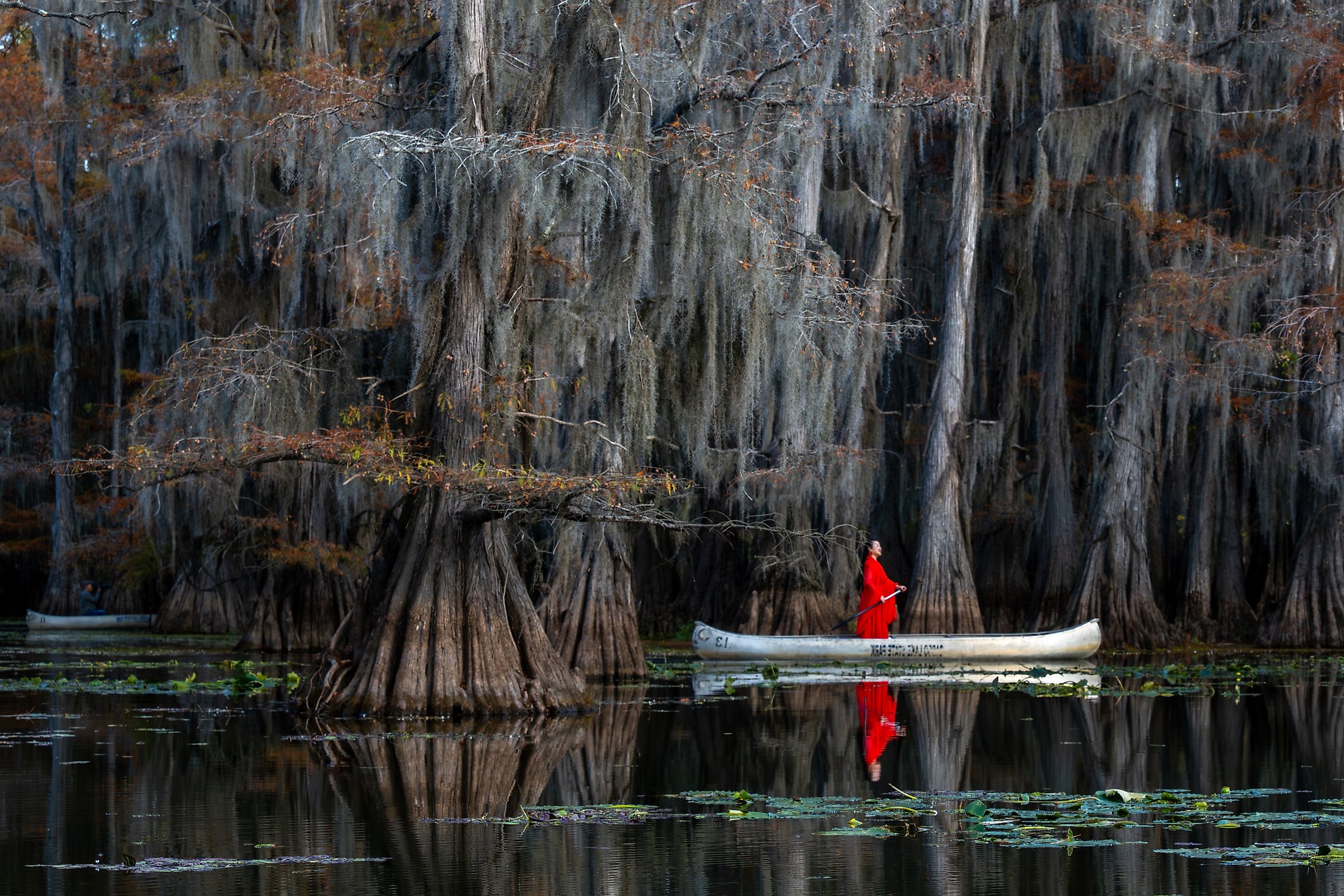
Caddo Lake already feels like a maze before invasive plants enter the picture. Cypress trunks, backwaters, and narrow boat lanes make navigation part of the adventure. Giant salvinia pushed that challenge much further. In February 2013, the Texas Parks and Wildlife Department reported that most ramps on Caddo were covered by the floating fern and that launching a boat without coating the trailer in salvinia was almost impossible. The same agency warns that dense salvinia mats can severely limit fishing and boating access. That matters on a lake where much of the fun comes from slipping into shallow coves rather than staying in open water.

Control work has kept Caddo usable, but the plant remains a management target. Salvinia spreads easily when fragments cling to boats, motors, and trailers, so cleaning equipment before leaving the ramp is especially important here. A visitor can still find first-rate paddling and fishing, but the lake's history shows how quickly a floating invader can turn the launch itself into the first obstacle of the day.
Lake Bistineau, Louisiana

Lake Bistineau has become one of Louisiana's clearest examples of a lake managed around an invasive plant. Giant salvinia can multiply so rapidly in summer that the Louisiana Department of Wildlife and Fisheries has repeatedly lowered the lake to strand the fern on exposed bottom. In July 2025, the department said nearly 70 days of contracted herbicide work had been unable to keep pace with the plant's expansion, prompting another drawdown. A similar 2024 operation followed an early-June estimate of about 640 acres of matted salvinia.
The drawdowns create their own boating complications, which shows how disruptive the plant can be even while managers are fighting it successfully. During the 2025 lowering, about 10,000 acres of water were expected to remain, but four public launches were identified for continued access and normal boat-lane clearance would be reduced. LDWF deliberately schedules these projects around recreation, trying to preserve as much summertime use as possible before the water drops. For anglers, vegetation control has effectively become part of the seasonal rhythm of Lake Bistineau.
Toledo Bend Reservoir, Texas and Louisiana

Toledo Bend is so large that an invasive plant does not need to occupy the whole reservoir to cause trouble. Giant salvinia was discovered there in 1998, then surged through protected backwaters and shallow areas. The Texas Parks and Wildlife Department recorded a historic high of 9,314 acres in 2013 and stated that the infestation impeded angler access.
The scale is striking because Toledo Bend is also a powerhouse bass destination. When floating mats collect along productive coves and near shore, anglers can lose access to exactly the water they came to fish. Giant salvinia can form thick surface cover and travel elsewhere when fragments catch on motors, trailers, or other boating equipment.
Conditions have not stayed frozen at that 2013 peak. TPWD later reported extensive reductions during many years as water-level fluctuations and increased herbicide treatments took effect. Toledo Bend therefore offers something more useful than a disaster story: it shows how a reservoir can remain busy and rewarding while managers keep an infestation once measured in thousands of acres from reclaiming its backwaters.
Lake Conroe, Texas

Lake Conroe's hydrilla episode was enormous even by invasive-plant standards. Hydrilla appeared in 1975, only two years after the reservoir was impounded. By 1979, it covered more than 4,500 acres and was causing significant problems for boaters, skiers, and swimmers. Texas Parks and Wildlife Department records put peak coverage at about 8,400 acres in 1981, roughly 40% of the reservoir. Another agency account described the infestation as seriously impeding recreational use and access to the lake.

The response was almost as dramatic as the outbreak. About 270,000 grass carp were introduced between 1981 and 1982, and by October 1983 aquatic vegetation had been removed from the lake. Hydrilla eventually returned, leading managers toward more measured combinations of monitoring and control. Conroe is once again a major boating and fishing destination, but its early history remains a striking demonstration of how a submerged plant can occupy enough water to change what skiers, anglers, and pleasure boaters are able to do.
Lake Tohopekaliga, Florida

Lake Tohopekaliga, better known as Lake Toho, makes the debate around hydrilla easy to understand. Some submerged vegetation is excellent fish habitat, and bass anglers often seek out its edges. Too much hydrilla can push into navigation routes and crowd useful native plants. The Florida Fish and Wildlife Conservation Commission treated invasive hydrilla in both January and May 2025 in areas where officials said it could affect navigation access and flood protection. FWC's habitat plan aims for 30% to 40% submerged vegetation cover, so the objective is not to scrape the lake clean. It is to preserve enough underwater growth for fish and wildlife without allowing one aggressive species to dictate where boats can travel. That balance suits one of Central Florida's best-known bass lakes, where healthy vegetation is part of the attraction right up until a thick canopy starts occupying water people need to cross.
Lake Seminole, Florida and Georgia

At Lake Seminole, invasive-plant control tracks the routes boaters actually use. The U.S. Army Corps of Engineers identifies hydrilla and water hyacinth among the invasive aquatic weeds commonly found in the reservoir and uses several strategies, including herbicides, to limit their spread. Hydrilla has been an especially persistent presence in this warm, shallow system.
The treatment locations make the boating problem unusually concrete. Corps planning has targeted hydrilla and other nuisance vegetation around Sealy Ramp, River Junction Ramp, Spring Creek Park, Trails End Marina, and numerous marked small-boat channels. Some treatment areas are explicitly identified for recreation, ramp access, marina use, or navigation. That does not turn the entire reservoir into a wall of weeds. Instead, it shows how a relatively narrow strip of vegetation can matter enormously when it occupies the route between a trailer and open water. Clearing those passages lets anglers reach the broad Flint and Chattahoochee arms and the grassy bass water that makes Seminole worth launching into in the first place.
Lake Okeechobee, Florida

Lake Okeechobee offers perhaps the clearest Florida example of floating plants getting ahead of their managers. When mechanical harvesting temporarily replaced routine herbicide control, water hyacinth multiplied faster than crews could remove it. The Florida Fish and Wildlife Conservation Commission later described lake conditions during that period as unsuitable for navigation and recreation. Water hyacinth is particularly formidable because its interlocking mats can block waterways and sharply restrict boat traffic.

Okeechobee still requires active control rather than historical admiration of a problem solved once and for all. FWC says managing invasive plants on the lake is important for accessible navigation as well as fish and wildlife habitat. Federal work continues too: the U.S. Fish and Wildlife Service describes ongoing water-hyacinth and water-lettuce treatment by the Army Corps of Engineers to maintain navigation and flood-control structures.
That work protects an unusually complicated playground of marshes, fishing grounds, canals, locks, and ramps. On Okeechobee, keeping vegetation under control is what keeps those pieces connected by water.
Lake Austin, Texas

Lake Austin's invasive-plant problem is unfolding right now. A Texas Parks and Wildlife Department vegetation survey found 575 acres of hydrilla in June 2026, and the City of Austin reported that the upper five miles below Mansfield Dam remained dense with the plant, bank to bank. Hydrilla had expanded astonishingly quickly the previous year, rising from about 74 acres in June 2025 to 456 acres by September. The city warns that large hydrilla mats can clog waterways and impede boats, and it specifically advises visitors to avoid boating through dense patches of underwater vegetation. Thousands of additional sterile grass carp have been stocked as part of the response. Lake Austin still has public ramps and plenty of usable water, but its narrow, river-like shape leaves expanding vegetation less room to hide. For anyone cruising, skiing, or heading out to fish, this is not an old cautionary tale. It is a live management challenge playing out during the 2026 boating season.
Lake Champlain, New York and Vermont

Southern Lake Champlain has an invasive plant that shows up right at the surface. Water chestnut grows in floating rosettes, and large colonies lock together into mats capable of stopping a small boat in its tracks. The U.S. Geological Survey reports that many bays in southern Lake Champlain that were previously fished became inaccessible after the plant spread. USGS also identifies the mats as a hazard for boaters and says small-boat use can be severely impeded by dense infestations.

Keeping those bays open has required extraordinary persistence. State organizations spent more than $5 million controlling water chestnut in Lake Champlain between 1982 and 2005, according to the USGS species profile, using mechanical harvesting and manual removal. Crews have an added reason to work before plants mature: water chestnut produces hard, spiny fruits capable of sustaining future infestations. For visitors, the payoff is immediate. The shallow southern reaches remain inviting fishing and paddling country instead of disappearing beneath a continuous floating garden.
Lake George, New York

Lake George's famously clear water shows off Eurasian watermilfoil more plainly than most lakes would, but the real nuisance begins when the stems climb into mats near the surface. The Lake George Association says the invasive plant can entangle boat propellers and interfere with swimming and fishing. It has been identified at more than 200 locations along the 32-mile lake, including clusters near busy boating areas around Lake George Village, Bolton Landing, Harris Bay, Warner Bay, and Huddle Bay.

The response is remarkably hands-on. Divers have spent decades pulling milfoil and using diver-assisted suction harvesting rather than surrendering infested coves.
The quantities are anything but small. About 186,590 pounds, roughly 93 tons, of Eurasian watermilfoil were harvested in 2020 alone. Lake George also requires inspections of trailered boats during the main boating season to reduce the chance of additional invasive species arriving. That combination of removal and prevention helps explain why a summer outing can still revolve around hopping between mountain-framed bays rather than stopping every few minutes to unwrap greenery from the propeller.
Lake Winnipesaukee, New Hampshire

Lake Winnipesaukee is where New Hampshire's variable-leaf watermilfoil problem first showed up. The U.S. Geological Survey records Moultonborough Bay as the state's first known site for the invasive plant in 1965. USGS says dense beds of variable milfoil have negatively affected boating, swimming, fishing, and property values in New Hampshire waters. Around Winnipesaukee itself, infestations have taken hold in sheltered embayments and coves where thick growth is particularly troublesome for recreation.
This is not merely a story preserved in an old lake survey. In August 2026, portions of the Balmoral Channel and Suissevale Marina in Moultonborough were scheduled for treatment to control non-native milfoil. Other local efforts have included hand pulling and diver-assisted suction harvesting. Channels, marinas, and protected coves are exactly where a wide-spreading underwater plant becomes most noticeable to people maneuvering boats at low speed. Winnipesaukee remains one of New England's classic summer waters, but keeping its quieter corners usable requires work season after season.
Lake Minnetonka, Minnesota

Eurasian watermilfoil made its Minnesota debut in Lake Minnetonka in 1987, and officials quickly learned how visible an invasive plant can become on a heavily used metropolitan lake. The Minnesota Department of Natural Resources says the species forms dense surface mats that inhibit water recreation. A DNR study of Minnetonka boaters found something even more telling: when people were asked to rate 17 potential problems on the lake, Eurasian watermilfoil ranked above every other concern.
The Lake Minnetonka Conservation District historically responded with mechanical harvesting specifically to maintain recreational access for the public and shoreline property owners. The district has also participated in coordinated herbicide treatments and broader invasive-species planning. Minnetonka's many interconnected bays make the problem easy to picture. Milfoil does not have to consume the entire 14,000-acre lake to spoil a route out of a dock, a shallow fishing edge, or a narrow passage. Keeping those local trouble spots usable became part of managing recreation on one of Minnesota's busiest waters.
Weeds, Ramps, and the Work That Keeps Them Apart
What connects these lakes is not the plant but the pattern. A floating fern, a submerged stem, or a spiny rosette gets a foothold in a warm cove, doubles and redoubles through a single summer, and reaches the ramps and boat lanes before anyone has agreed on a budget. What separates a lake people can still launch on from one they cannot is the response: the drawdown at Bistineau, the grass carp at Conroe and Austin, the divers at Lake George, the Corps crews working channel by channel at Seminole. None of it is finished, and most of it repeats every season. The reason these remain fantastic places to boat and fish is that the fight never really stops, and the day the fight falls behind is the day the weeds decide where the boats can go.