Why Some American Rivers Never Freeze Over
Every winter, people across the northern states cross bridges over rivers that are still open and steaming in the cold while the lake down the road holds a village of ice-fishing shanties. A river freezes only after every foot of its depth has cooled to 32°F and its current has slowed enough to hold a sheet of ice still, and some American rivers never get there.
The Horseshoe Falls has never frozen over, and one river in Yellowstone runs so warm that the trouble comes in summer, when the trout start dying. The same forces that keep those rivers open explain why thousands of bald eagles pile onto a few miles of the Mississippi every January, and why one nuclear plant shutdown killed hundreds of fish by letting the river cool.
A River Has to Cool Through Its Entire Depth

Lakes generally freeze before nearby rivers because fresh water is densest at about 39°F. As a lake chills in late fall, its cold surface water sinks until the whole lake reaches roughly that temperature. After that, the coldest water stays on top, and only that surface layer has to drop the last few degrees before ice forms.
In a river, turbulence mixes the water through its full depth and brings warmer water near the bed back up to the surface, so the entire column has to cool together. At Pittsburgh, the Monongahela flows north out of a watershed to the south and tends to run slightly warmer than the Allegheny, which flows south from colder country. With more heat to lose through its whole depth, the Monongahela usually stays open longer than the Allegheny.
Fast Water Makes Slush Before It Makes Ice

Moving water that has cooled all the way through dips slightly below 32°F, by a few hundredths of a degree at most, a condition called supercooling. In that supercooled current, the first ice forms as frazil, disk-shaped crystals about a millimeter across or smaller that appear throughout the flow. Frazil crystals stick to one another and clump into slush and floating pans, and a solid cover forms only where those pans can pile up and freeze together. Once the mean current tops about 2 feet per second, floes arriving at the upstream edge of an ice sheet tend to get pulled under and carried downstream, so the sheet stops growing.
The upper rapids of the Niagara River reach up to 25 mph near the falls, more than ten times that threshold, and the Horseshoe Falls has never frozen over. Much of the heavy ice seen on the Niagara in winter drifts in from Lake Erie. In hard winters, lake ice that goes over the falls jams against the Canadian bank and builds out to the American shore as an ice bridge. Upstream, an 8,800-foot ice boom has been stretched across the lake's outlet near Buffalo each winter since 1964 to hold back lake ice that would otherwise jam hydroelectric intakes and flood shoreline property.
Eagles Fish the Open Water Below the Mississippi's Dams

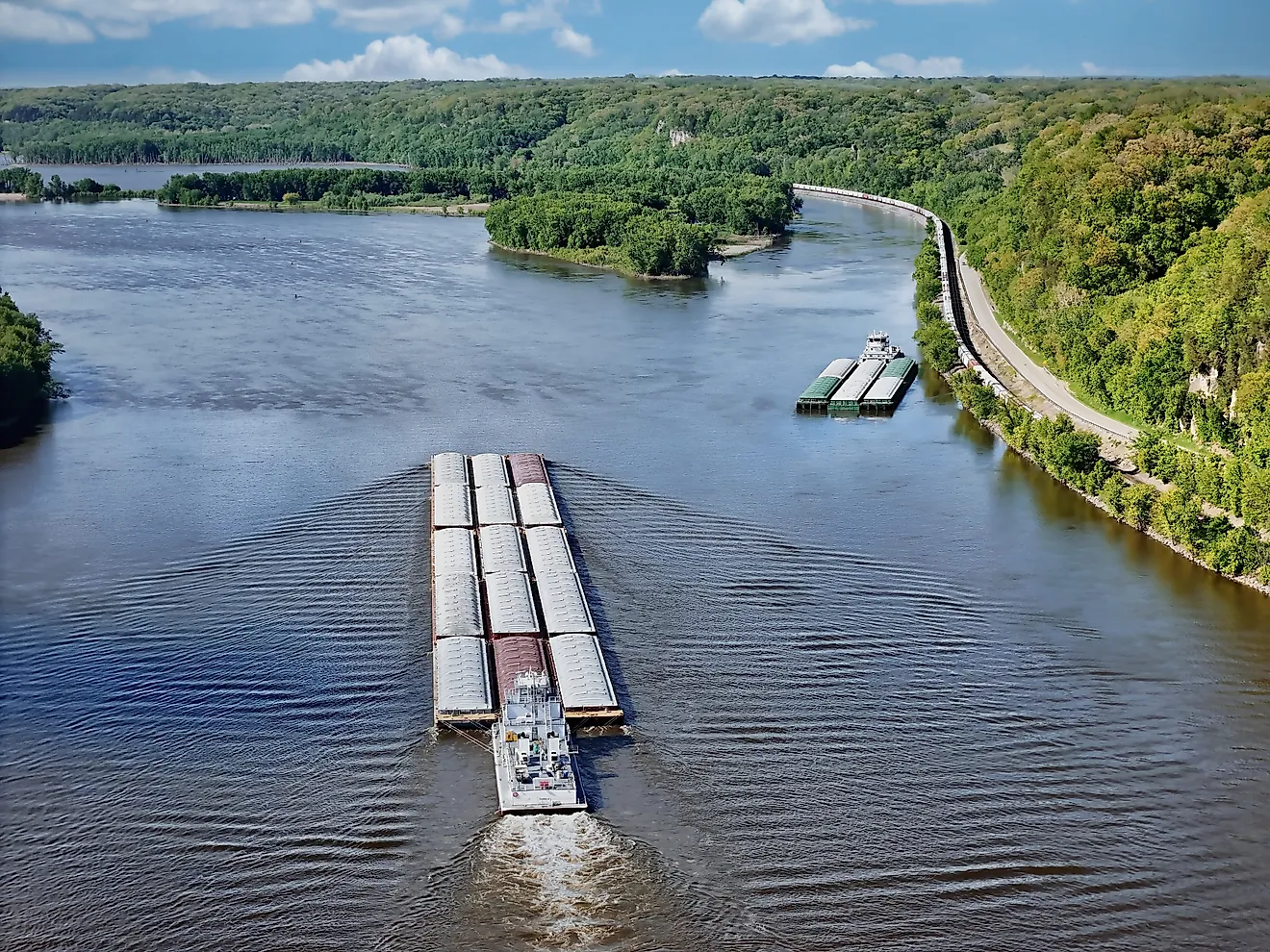
The Upper Mississippi is a staircase of navigation pools held back by locks and dams, and the water pouring out below each dam is too stirred up to freeze easily, so it stays open after much of the river around it has iced over. Somewhere between 4,000 and 7,000 bald eagles winter along the river, concentrating in those open stretches. Gizzard shad, a small fish prone to heavy winter die-offs, are stunned or killed in the turbulent water below the dams, where eagles can pick them off the surface. The crowds grow tighter as the weather turns colder, because ice closes more of the river and leaves the birds fewer places to hunt. Just after a cold snap, when ice has closed most of the river, Army Corps rangers counting eagles at Lock and Dam 18 near Gladstone, Illinois, have tallied several hundred birds in a single morning.
Water Released From Deep Reservoirs Stays Above Freezing

Below Yellowtail Dam on Montana's Bighorn River, the water runs cold and clear in summer and ice-free in winter, and trout can be caught there in any month, even during a snowstorm. Tailwaters like this one stay open because water leaves the reservoir upstream at a steady temperature. Water in a large reservoir settles into layers the way a lake does, so its deepest water stays near 39°F through the winter. When releases come from low in the reservoir, that bottom water enters the river several degrees above freezing.
Winter water released from Flaming Gorge Dam on Utah's Green River rarely falls under 39°F, and the river directly below the dam stays free of ice all season. The warmth wears off with distance, so in a hard winter ice can still close the river many miles downstream even while the tailwater at the dam never freezes.
Spring-Fed Rivers Hold Their Temperature Through Winter

Big Springs in eastern Idaho pours out more than 120 million gallons a day at a constant 52°F and feeds the headwaters of the Henry's Fork of the Snake River. Spring-fed flows keep stretches of the upper Henry's Fork open around Island Park and through Harriman State Park through the winter, even on subzero January mornings. Trumpeter swans need that open water both to feed and as a runway for takeoff, and in the fall of 1990 an estimated 500 of them, roughly a quarter of the Rocky Mountain population, gathered on the Henry's Fork.
Winter releases from Island Park Dam set how much water moves down the river, and spring heat only goes so far once flows drop. A drought had already frozen the Henry's Fork solid in the winter of 1988-89, starving roughly 100 swans. As the birds crowded the open water again in 1990, Idaho wildlife managers trapped and relocated more than 350 of them to sites in Idaho, Utah, and Wyoming, and prepared to haze the rest off the river with snowmobiles and airboats before calling the effort off.
In southeast Minnesota, groundwater comes out of the ground at around 48°F, in line with the general rule that groundwater emerges near, or a few degrees above, the local average annual air temperature. Many spring creeks there stay largely ice-free all winter, and a catch-and-release trout season opens on them every January 1.
Geyser Basins Heat Yellowstone's Firehole River

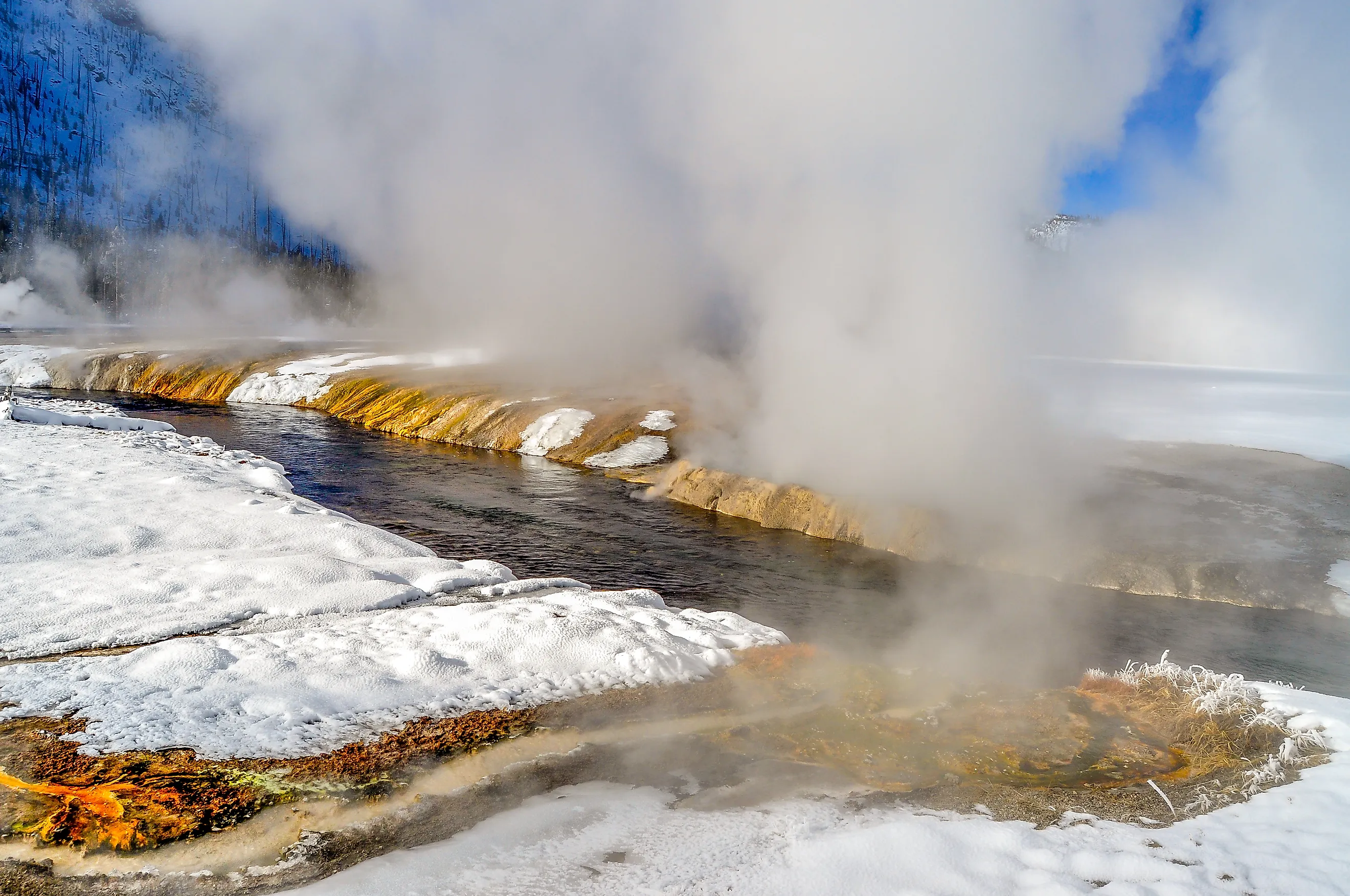
Hot water from springs and geysers drains into the Firehole River as it flows through four geyser basins in Yellowstone National Park, including the Upper Geyser Basin around Old Faithful, and that inflow leaves the Firehole almost always ice-free. At Madison Junction, the Firehole joins the Gibbon River to form the Madison, and trumpeter swans winter on these open stretches too. Much of the park's central bison herd spends the same months in the milder thermal ground along the Firehole and Madison.
The geothermal inflow is strong enough to overheat the river in summer. After daytime temperatures on the park's geothermally warmed rivers peaked between 80°F and 86°F and dead fish turned up in the Firehole, fishing on it was closed entirely on July 15, 2026.
Power Plant Cooling Water Opens Pockets in Midwestern Rivers

On the Wabash River in western Indiana, warm cooling water from Duke Energy's Cayuga Generating Station keeps a stretch of the river ice-free in winter, and the fish that gather there draw bald eagles. According to Duke Energy, those waters hold Indiana's largest midwinter gathering of migratory bald eagles in most years.
Cooling water from the Monticello nuclear plant on the Mississippi, northwest of Minneapolis, normally keeps a similar pocket of river free of ice, and fish there grow used to the warmer water through the winter. When the plant began powering down for repairs on March 24, 2023, the warm flow stopped, and within days dead fish were turning up below it. The kill of at least 230 fish, including bass, channel catfish, carp, and suckers, was traced to the sudden temperature change.
Open Water in a Frozen Landscape
A river stays open through winter when its current runs too fast for frazil pans to lock into a sheet, or when water above freezing keeps arriving faster than the river loses heat to the cold air. Wildlife concentrates in both kinds of open water. Eagles on the Mississippi crowd the turbulent tailwater below each dam, and trumpeter swans winter where springs and geysers keep runways of open water on the Henry's Fork and the Firehole.
Where the open water depends on a dam release or a power plant, it lasts only as long as those operations hold steady. A drought that froze the Henry's Fork at the end of the 1980s killed about a hundred swans and later drove managers to trap and relocate hundreds more, and Monticello's 2023 shutdown erased a warm pocket of the Mississippi that fish had grown used to over the winter.