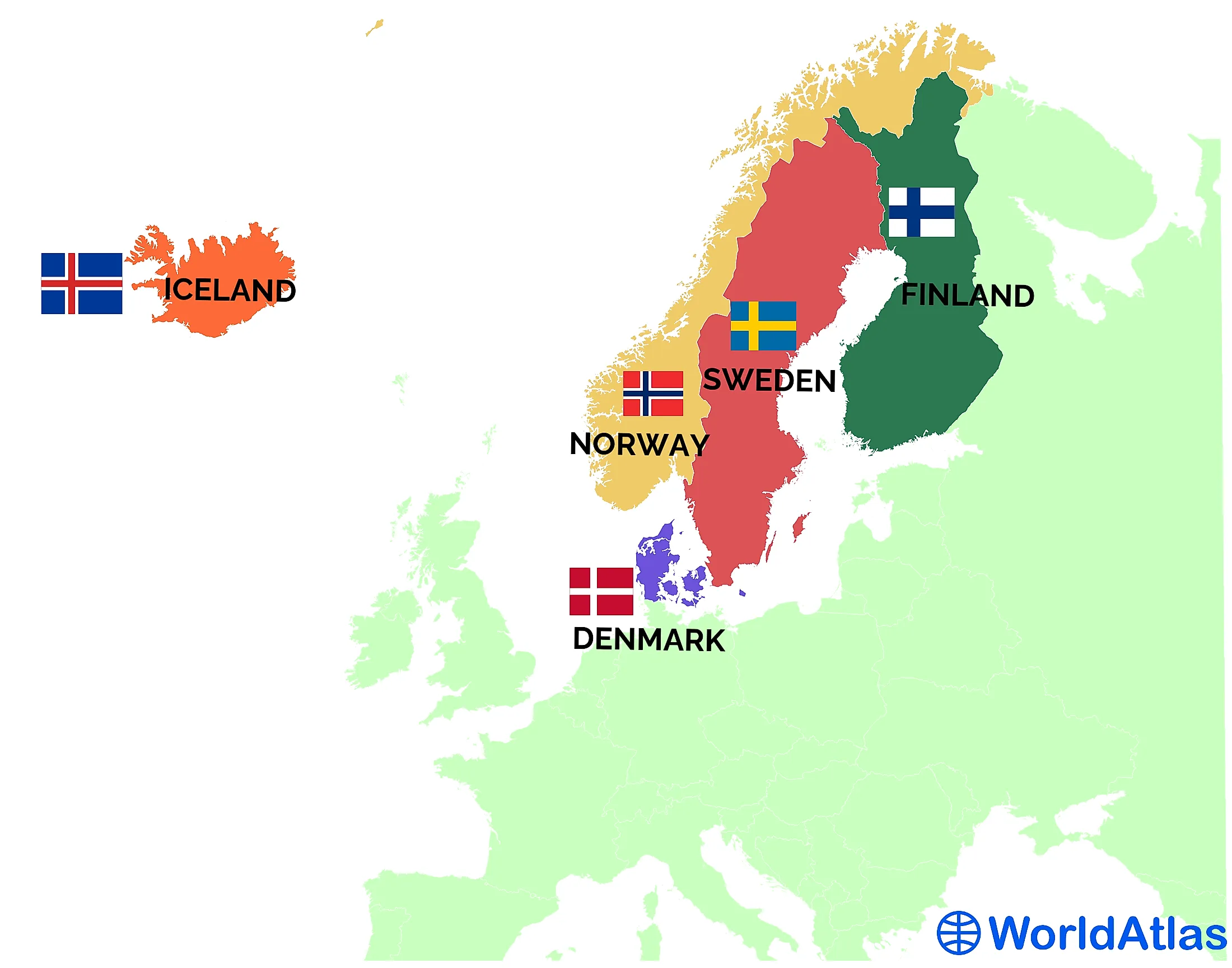
Nordic Countries
- The Nordic Countries are a group of countries in northern Europe.
- There are 5 Nordic countries, Denmark, Sweden, Norway, Finland, and Iceland.
- Denmark, Sweden, and Norway are constitutional monarchies and parliamentary democracies. Finland and Iceland are democratic republics.
- Iceland's parliament, the Althing, is the oldest parliament in the world.
- Sweden is the largest and most populous of the Nordic countries. Iceland is the least populous. Denmark is the smallest.
The Nordic countries are five nations in northern Europe. Denmark, Norway, and Sweden form Scandinavia. Finland and Iceland round out the wider Nordic group. Together the region held about 28.3 million people as of January 2025. All five share close historical and cultural ties. Each country still keeps its own language, government, and character.
Denmark

The Kingdom of Denmark is the southernmost of the Nordic countries. It consists of the Jutland Peninsula and an archipelago of 440 islands. With a land area of about 42,900 square kilometres, Denmark is the smallest of the Nordic countries by area. Most of Denmark's terrain is flat, though there is a hilly area in central Jutland. The country's coastline, measuring a total of 7,300 km, is characterised by its many fjords.
The population of Denmark reached about 6.0 million in 2025. The largest city is the capital, Copenhagen, situated on Denmark's largest island, Zealand. Danish is the country's official language. The Danes are known for living life to the fullest, and also for their love of cycling. About 9 out of 10 Danes own a bicycle.

Denmark is a constitutional monarchy and parliamentary democracy. The country has a parliament called the Folketing, whose members are elected to four-year terms based on proportional representation, where a party's percentage of votes roughly corresponds to its percentage of parliamentary seats.
In addition to its main territory, Denmark also has two overseas territories. The Faroe Islands lie north of the U.K., almost halfway between Iceland and Norway, and are made up of 18 rocky islands. About 54,000 people live on the Faroe Islands. Denmark's other overseas territory is Greenland, the world's largest island, situated east of northern Canada. Contrary to what its name implies, very little of Greenland is arable. In fact, nearly 80% of the island is covered by ice cap and glaciers. Greenland's population is about 56,900. Most Greenlanders are Inuit, related to the Inuit in northern Canada. They speak an Inuit language known as Greenlandic, or Kalaallisut.
Sweden

Officially known as the Kingdom of Sweden, Sweden is situated between Norway and Finland. Its total area of about 450,295 square kilometres makes it the largest of the Nordic countries. About 10% of Sweden is covered by lakes and rivers. The country also has large coniferous forests. Sweden's population was approximately 10.6 million as of 2025, making it the most populous of the Nordic countries. The largest city is the capital, Stockholm. Sweden's official language is Swedish. The Swedish people generally believe in a balanced lifestyle that includes regular exercise, respect for the environment, and a positive outlook.

Sweden's government is a constitutional monarchy and parliamentary democracy. The Swedish monarch is the ceremonial head of state, and the government is headed by a prime minister. The members of the country's parliament, known as the Riksdag, are elected under proportional representation to four-year terms.
Norway

The Kingdom of Norway lies to the west of Sweden. Its western coastline borders the Norwegian Sea. Much of the Norwegian coastline contains fjords. Norway's landscape also includes deep valleys and high mountains. Mainland Norway covers about 323,800 square kilometres, or 385,200 square kilometres including Svalbard and Jan Mayen in the Barents Sea.

Norway's population reached about 5.6 million in 2025. The country's largest city is its capital, Oslo. Norway is governed by a constitutional monarchy, with the Norwegian monarch as the ceremonial head of state, and a government headed by a prime minister and cabinet responsible to the Norwegian parliament, known as the Storting. The members of the Storting are elected to four-year terms. Norway's official language is Norwegian. The Norwegian people are known for being outdoorsy, hardworking, and protective of generous free time compared with most other countries.
Finland

The Republic of Finland sits between Russia to the east and the Gulf of Bothnia to the west. The northern part of Finland also borders Norway to the north and Sweden to the west. Like Sweden, Finland is a country of many lakes and forests. About a quarter of Finland sits above the Arctic Circle, which means winters can be long and dark, though temperatures are somewhat moderated by the currents of the nearby Baltic Sea. Finland's total area is about 338,145 square kilometres.
The population of Finland was about 5.65 million as of 2025. The country's largest city is its capital, Helsinki. In addition to the Finns, Finland is also home to two other notable groups. One is the people of the Åland Islands, which lie in the Gulf of Bothnia between Finland and Sweden. The Ålanders are Swedish speakers. In northern Finland is another group known as the Sami. The Sami also live in the northern parts of Sweden and Norway. They have their own language, though only about half of their total population, estimated at around 80,000 across all three countries, actually speaks it.

Finland is a democratic republic with a president serving as head of state and a prime minister as head of government. Finland's legislature is known as the Eduskunta in Finnish and Riksdagen in Swedish. Its members are each elected by Finnish citizens for terms of four years. Finland has two official national languages: Finnish and Swedish. The Finnish people have a reputation for being honest and punctual. They also love their saunas, so much so that nearly every Finnish house has a sauna in it. The sauna is viewed by Finns as a comfortable place to socialise and relax.
Iceland

Iceland is an island country situated in the North Atlantic Ocean, east of Greenland. The volcanic island country has a total area of about 103,000 square kilometres. About 11% of Iceland is covered by glaciers, including Vatnajökull, the largest glacier in Europe by area. Most of the country's terrain contains waterfalls, geysers, volcanoes, black sand beaches, and lava fields. Just 20% of Iceland is inhabited.

Iceland is the least populous country in northern Europe, with a population of about 395,000 as of 2025. About a third of this population lives in the capital, Reykjavik. The people of Iceland enjoy one of the highest standards of living in the world. Like the Finns, the Icelanders have a reputation for honesty, with very little crime or corruption in the country. They are also known for their love of reading. Icelandic is Iceland's official language. Iceland is a democratic republic. Its head of state is the president, who appoints a prime minister to head the government. Iceland's parliament, the Althing, was founded around 930 AD at Thingvellir and is widely cited as the oldest national parliament in the world.
Nordic Countries At A Glance
| Country | Total Area (km²) | Population (2025) | GDP per capita, nominal (2024 USD) |
|---|---|---|---|
| Denmark | 42,933 | ~5,990,000 | ~$71,200 |
| Sweden | 450,295 | ~10,590,000 | ~$59,300 |
| Norway | 385,207 | ~5,590,000 | ~$90,400 |
| Finland | 338,145 | ~5,640,000 | ~$55,800 |
| Iceland | 103,000 | ~395,000 | ~$92,400 |
Population figures reflect January 2025 estimates from the Nordic Council and national statistics offices. GDP per capita figures are 2024 nominal estimates rounded to the nearest hundred US dollars. Norway's area includes Svalbard and Jan Mayen.
The Nordic Region In Context
The five Nordic countries account for less than 6% of Europe's population yet consistently rank among the world's wealthiest, most equal, and most stable societies. Norway, Iceland, and Denmark sit in the top tier of global GDP per capita, while Finland has been named the world's happiest country for several years running in the United Nations World Happiness Report. The shared welfare model, strong labour protections, and free movement among the Nordics through the long-standing Nordic Passport Union give the region a coherence that goes beyond geography. For travellers and researchers alike, the five nations make a useful unit of study even when each country's history and politics differ sharply.