The Rarest Trees Left In The Wild
The rarest trees left in the wild are prized for many reasons and make them unique. There are the Wollemi Pines, which have an extremely long life, up to 500 to 1,000 years old. There is the Tree Daisy, which was once found in the lowlands of Robinson Crusoe Island. All of these trees have something special about them, and that is why they are so prized and, in some cases, why they are so rare now. With plenty of uniqueness to go around, but maybe not for long, these are the rarest trees left in the wild.
Wollemi Pines

Wollemi pines are tall, coniferous trees with needle-like leaves. They grow to 130 feet in height. A trunk can grow up to three feet in diameter, and it's common to find numerous trunks emerging from a single root base. Wollemi pines reproduce vegetatively and by wind pollination. They are monoecious, with both male and female cones on each tree. They are extremely long-lived, and it is estimated that the wild population trees have specimens between 500 and 1,000 years old. As a member of the 200-million-year-old plant family Araucariaceae, scientists classified the species as extinct until a bushwalker discovered the trees thriving in an isolated canyon on the outskirts of Sydney, Australia. With so few adult trees remaining in the wild, the species is at risk of extinction. The biggest threats to its existence include catastrophic fire events and, in particular, human disturbance. Unauthorized visits to the site risk compromising the fragile wild population and ecosystem like trampling seedlings, damaging exposed roots and fragile soils, and introducing invasive weeds and pathogens or root rot all have a devastating impact.
Tree Daisy-Dendroseris Neriifolia

The Dendroseris neriifolia is one of the world's rarest trees. It is known as a cliffside plant with just one known individual left in the wild. Its chance of survival is dependent of scientists able to collect hundreds of seeds from the lone survivor at its home in Chile's Robinson Crusoe Island. The tree is native to Juan Fernandez Islands, which are a remote chain of volcanic islands about 420 miles from mainland Chile. It was once found in lowland areas of Robinson Crusoe Island, but the tree has had a lot of problems. It has been pushed to the brink by habitat loss, erosion, invasive species, grazing animals, fires and historic forest clearing.
Dragon's Blood Tree

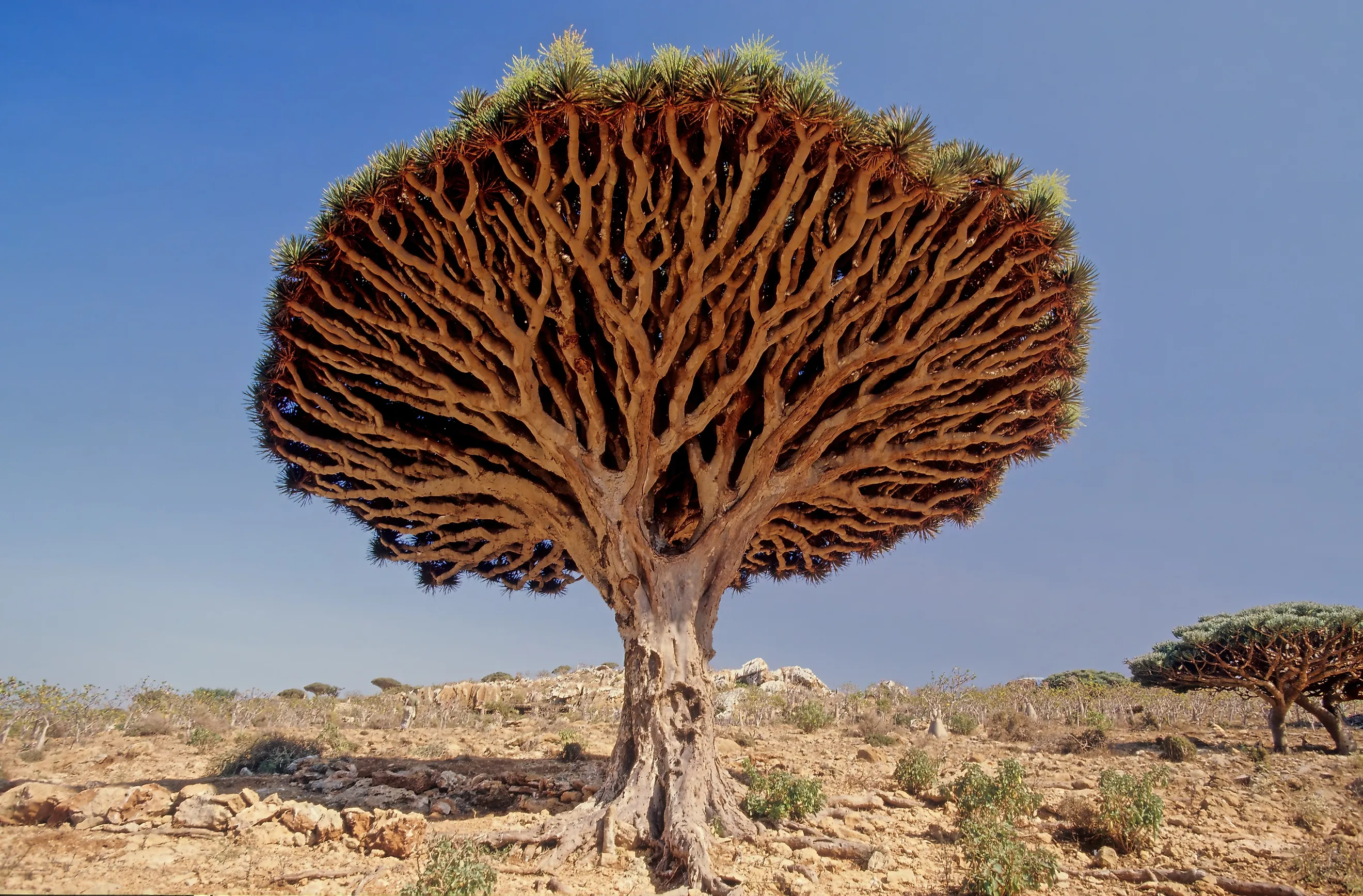
With its umbrella-shaped crown, it may be funny looking but its shape helps the tree absorb moisture from the air and channel it toward its root system. It is named for its crimson sap that it produces. It is native to Yemen. The dragon blood tree does not only stand out for its shape but also for its ecological, medicinal, and cultural value. The name Dracaena comes from the ancient Greek "drakaina" meaning 'female dragon.' The name is related to the red sap of certain species, which people have said looks like dragon's blood. When you cut the branches or trunks of the tree, sap flows out as a liquid and then solidifies into a dark red resin as it dries when exposed to oxygen. It appears as if these trees are bleeding, although it's simply a process of oxidation. The dragon's blood is the result of a natural defense mechanism, where the tree releases its red sap and resin when the bark is damaged. The resin forms a protective barrier over the wound, inhibiting the entry of microorganisms and insects.
Grandidier's baobab

This tree is the largest of Madagascar's baobab species. The tree is noted for its huge, cylindrical trunk, which allows it to store water during dry periods. Its thick trunk has smooth, grey-red bark. In times of heavy rainfall, its trunk can span up to 3 meters across and 30m tall. The branches grow out horizontally from the top of the tree into a wide canopy. The leaves on the tree are green, loosely star-shaped with 10 points and covered in small hairs. It is known as the "mother of the forest." There are eight species of baobab in the world. Six are found only in Madagascar, including the giant baobab in the south-western regions of the island. It is a source of cooking oil and construction materials by Malagasy people. As agricultural land continues to expand across Madagascar, the giant baobab is in danger of disappearing.
Bois Dentelle

The Bois Dentelle tree (also known as "lace wood") is a tree that is native to Mauritius. It can be found up high among the Piton Grand Bassin. The tree is known for its unique leaves, which are shaped like lace or dentelle, hence its name. The tree is also known for its fragrant flowers and their unique and beautiful blooms, which appear in the springtime, typically sometime in April or May. The flowers are white with a hint of pink and have a sweet fragrance, while the leaves are dark green and have a leathery texture. Being a deciduous tree, the Bois Dentelle tree loses its leaves in the fall. Only a handful of these trees can be found in the wild. The tree has been progressively displaced in the cloud forest habitat by commercially viable, non-native invasive species such as the guava tree. The Mauritian government has stepped in to save this natural treasure and has had some success at nursery breeding, but the future of this tree is far from certain.
Taxus Floridana-Florida Yew

The Florida Yew is a rare, evergreen shrub or small tree which generally grows from 10 to 20 feet tall. It is found in the understory on bluffs and ravines in a less-than-4 square mile area of the Florida Panhandle. Most of the approximately 20 known populations of endangered species are within Torreya State Park and the Nature Conservancy's Apalachicola Bluffs and Ravines Preserves. Florida yew is a conifer, which is the same major plant group as pines. It has flat, needle-like leaves arranged in two comb-like ranks on the branches. Plants are male or female. The specimen pictured is a male, which bears small flowers below the leaves. Female plants bear a fleshy cone which doesn't look like a pinecone at all. It is light red, berry-like, and almost surrounds a single seed at its tip. The chemotherapy cancer drug Paclitaxel, or Taxol, was first developed from the bark of the Pacific Yew. Florida yew also contains this compound, but it is too rare to be used as a source. There was concern that over-harvesting of the Pacific yew for this drug would endanger the species. However, there are now alternative methods to more efficiently produce the drug from cultivated Yew.
Three Kings Kaikōmako-Pennantia Baylisiana

This rare multi-trunked small tree bearing very large, broad, glossy curled leaves inhabiting the Three Kings Islands. Leaves 120- 160 mm long, widest towards the tip. Flowers are small, green, in clusters along branches. Fruit purple, 10mm long, containing a single seed. Only one tree occurs in the wild. Initially, Baylisiana and indeed all other Three Kings endemic plants were at serious risk from goats. These were successfully eradicated in 1946. Since then the tree has persisted despite periodic storm and drought damage, which may kill entire trunks. However, being female, the tree was until recently considered functionally extinct. Apparently viable fruits were first found in the wild in 1989, and these, along with fruit cuttings grown plants in New Zealand, provide one source of securing the species. However, until such time as more trees occur in the wild, P. Baylisiana remains seriously at risk of extinction through natural events such as storms or senescence through old age
African Blackwood

Dalbergia melanoxylon, seen in Kruger National Park, South Africa. By Malcolm Manners from Lakeland FL, USA - African BlackwoodUploaded by Tim1357, CC BY 2.0
The African blackwood tree is a member of the rosewood family, with taxonomic classification in the family Leguminosae, genus Dalbergia, species melanoxylon. Its species name refers to the dark color of its heartwood and is derived from the Greek mela, or melanos, which means black. Historically, mpingo which is (scientifically named Dalbergia melanoxylon) is a small, slow-growing hardwood tree native to dry savanna and forest regions of Africa, commonly known as African blackwood. Its dense, dark heartwood is prized globally for crafting precision woodwind instruments like clarinets and oboes. The trees have a scruffy appearance and are frequently multi-stemmed and extensively branched. They grow very slowly and often in very gnarled and twisted shapes. Their boles are very often highly buttressed or fluted, so the full diameter of the log is not available for use due to the deep intrusions of bark and sapwood that often occur. Harvestable size is not reached until an estimated 70 to 100 years. Mature trees are typically between 4.5m and 7.5m high and rarely exceed 0.3 m. (1 foot) in diameter. In some tree databases size listings for African blackwood are often inaccurate, claiming 2 to 3 feet in diameter as normal. Only the rare tree in a highly protected environment has been found to be this large. The yellowish-brown bark on the main stem flakes off in long strips, and its smaller branches bear sharp spines 2-3 cm in length. The tree is semi-deciduous, losing many of its leaves over the dry season in common with most trees of its habitat. The flowers are small, white, sweetly scented and grow in tight clusters. They develop into greyish, papery pods each containing one or two seeds which are wind dispersed. Mpingo grows in an ecoregion of Africa called the miombo woodlands, which stretch across the continent from Angola in the west to Tanzania in the east.
Unusual Looking Trees
The old adage "looks aren't everything" is not necessarily the case with the rarest trees left in the wild. From the Dragon's Blood Tree, to the Tree Daisy and the Lace Wood tree, what these trees have in common is their unusual looks. Their looks gives some indication of why they are rare. The Dragon's Blood Tree whose sap oozes red liquid when cut or wounded. The Three Kings tree that is decidedly female. Whatever makes something beautiful, these trees, whether it is their location or characteristics, have what it takes to set the world on fire.