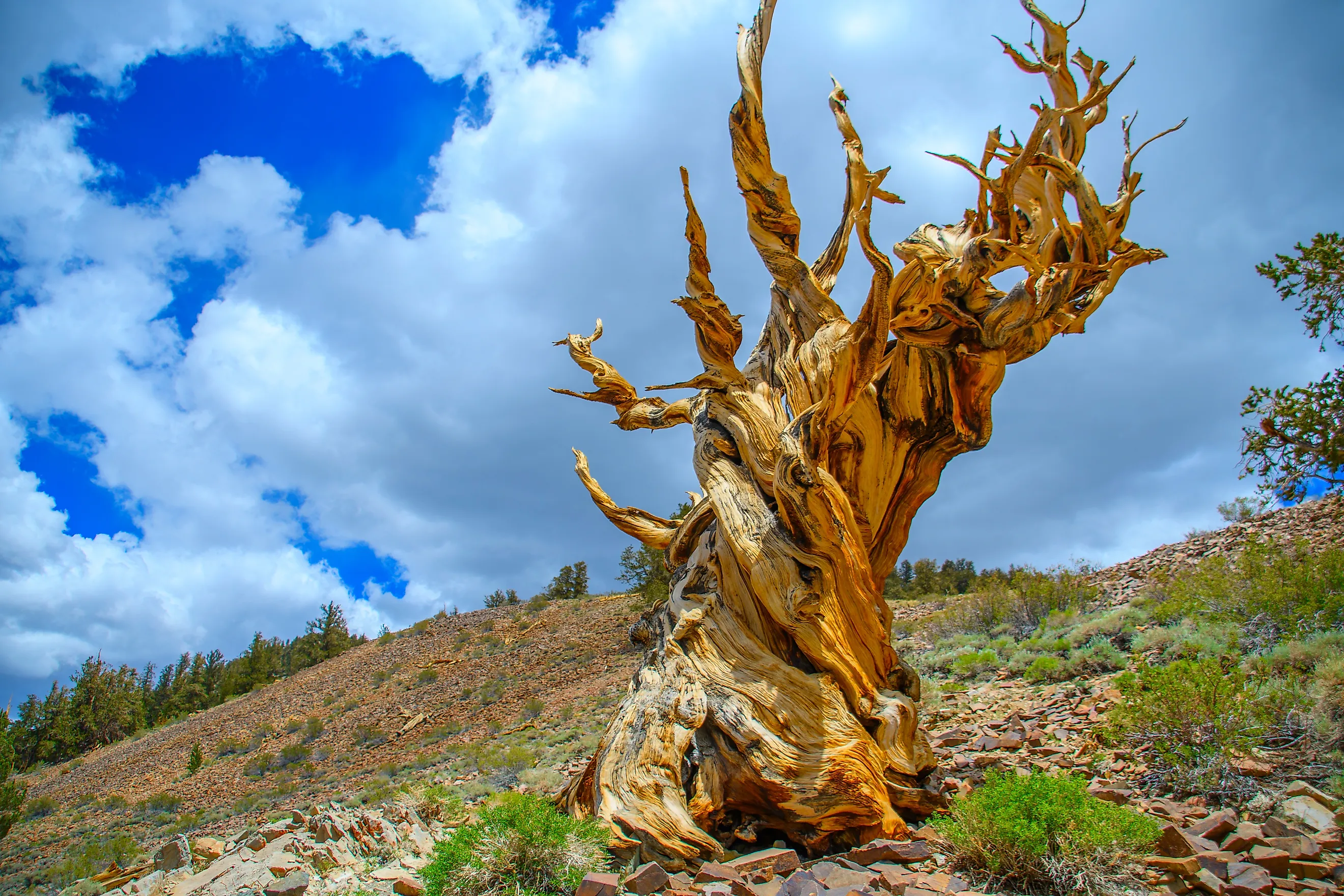
The Trees That Can Live For Thousands Of Years
High in the mountains of the American West, bristlecone pine trees have been standing for thousands of years. They were young when Stonehenge was being built and were already hundreds of years old when most of the Egyptian pyramids were constructed. The oldest known individual non-clonal trees on Earth have survived more than 4,800 years of changing climates and civilizations. These small, gnarly trees grow incredibly slowly in arid environments where few other plants can challenge them for resources.
Which Is The Oldest Tree On Earth?

The oldest individual trees ever discovered are Great Basin Bristlecone pines (Pinus longaeva), which are arid, twisty trees growing in the high mountains of California, Nevada, and Utah.
The oldest confirmed tree is estimated to be around 4,765 to 4,858 years old. It is nicknamed "Methuselah" after the biblical figure who is said to have lived for 969 years, giving him the longest human lifespan in biblical scripture.
This tree's innermost (oldest) rings are very close together and partially eroded, which makes exact dating quite tricky, and is why there are different estimations for the tree's age. The oldest confirmed rings date from around 2490 to 2555 B.C.E. The tree's exact location is kept secret to protect it from potential harm. There may well be older bristlecone pine trees out there that have not been dated.

Scientists once discovered another bristlecone pine, known as "Prometheus," that may have been even older. Unfortunately, it was accidentally cut down by a researcher in 1964 before its true age was understood. Tree-ring analysis suggested it may have been around 4,900 to 5,000 years old. For context, this is around the time the early iterations of Stonehenge were being built.
How Do Scientists Know A Tree's Age?

The most accurate way to determine a tree's age is by counting its rings. Trees grow new wood every year, and trees in countries with clear seasons grow faster in the spring and slower later in the year. This growth cycle creates lighter and darker bands, which appear as rings. Each ring usually represents one year of growth, although exceptionally dry years may not create clear rings, and dramatic weather changes may create false rings. The oldest rings start in the middle, and the most recent rings appear on the outer sides of the trunk.
Dendrochronologists (scientists who study tree rings) use a specialized hollow drill called an increment borer to remove a narrow core from the trunk without having to cut down or seriously damage the tree.

For very old or fragile trees, researchers sometimes estimate age using existing samples, fallen wood, or computer models rather than drilling directly into the living tree.
Why Do Bristlecone Pines Live So Long?

One reason bristlecone pines survive for thousands of years is that they grow where almost nothing else can. Their natural adaptations to their environment help them live long lives. They have evolved to grow very slowly, which results in dense wood that is better at resisting fungi, rot, insects, and erosion.
Their arid, desolate habitat is pretty lonely, so they have less competition for resources, and their isolated environment plus the rocky landscape helps protect them from wildfires. They are good at tolerating droughts. And, shockingly, they may not "senesce," i.e., biologically age, so if no external force kills them, it is possible (although speculative) that they may not naturally die. Their internal architecture includes bodies subdivided into sections, meaning some sections can die without harming the rest of the tree.
Where to See the World's Oldest Trees

To see these ancient trees, head over to Inyo National Forest. Located on the California/Nevada border, this national forest has 165 miles and almost 2 million acres of mountains, forests, lakes, and meadows.
Take the moderate 4.25-mile (6.8 km) Methuselah Loop Trail in the Ancient Bristlecone Pine Forest, which is the oldest known living forest. The loop is around 10,000 feet in elevation and is reached via White Mountain Road, which can be reached from California State Route 168. Before heading off on the hike, drop by the Ancient Bristlecone Pine Forest Visitor Center and pick up a brochure to learn more about the forest.

Here, you can walk past views of Death Valley and see the Methuselah tree, the oldest of the oldest trees. It is not marked, so you will have to guess which one it is. These dry, short, spindly trees almost look like they are reaching their multiple arms up to the sky. They are dramatic, otherworldly trees that would not look out of place on another planet. At the half-mile mark of this hike, there is a bench where you can take a seat and look over the arid, tree-scattered terrain, with the smooth peaks of the Sierra Nevada mountains in the distance.
Other Trees That Can Live for Thousands of Years

Although bristlecone pines hold the longevity record, they are not the only trees that can live for thousands of years. Giant sequoia trees regularly live for more than 2,000 years. Some giant cypress trees in South America are thought to be more than 3,000 years old, although their exact ages remain the subject of debate.

Some trees essentially live for many thousands of years because of cloning. Pando, which in Latin literally means "I spread," looks like an estimated 47,000 individual quaking aspen trunks, but they are all actually genetically identical stems originating from the same seed. While individual trunks live for only around a century, the organism itself may have survived for as long as 14,000 years. You can see these tree clones in Fishlake National Forest in south-central Utah. Several species of yew, cedar, and cypress have individuals estimated to be well over 2,000 years old.
Can Trees Live Forever?

Amazingly, bristlecone pine trees may not naturally die of old age. They can be killed by external forces, such as extreme weather or being cut down, but they may not "senesce," i.e., biologically age and naturally die with no external reason. So could these trees live forever? It's potentially possible, but unlikely. Even if they don't die of old age (and that isn't a definite), they are likely to die from external causes eventually.
The Oldest Trees on Earth
The oldest trees on Earth have survived for nearly 5,000 years. They have survived as empires, civilizations, and countless generations that have come and gone. They are older than Rome, older than Jesus, and stand as a testament to how fascinating the natural world truly is.