11 Prettiest Small Towns In Italy
Some Italian towns sit so high on their cliffs that you reach them only on foot. Civita di Bagnoregio is one, tethered to the world by a single footbridge. Down south in Alberobello, whole streets are lined with cone-roofed stone huts called trulli. In Matera, people carved churches and homes straight into cave walls. On the Amalfi Coast, Positano's pastel houses climb a slope above the sea. Much of this beauty lives in the open, which keeps a visit surprisingly affordable.
Civita di Bagnoregio

With the silhouette of a castle, this little town is one of the country's "tuff towns", sitting atop a mountain made of soft volcanic rock. The town is uniquely beautiful in an eerie way that matches its title, "dying city," given because of the crumbling structure it stands upon. The entry fee of three euros on weekdays and five on weekends supports geological restoration, keeping the town stabilized. Though it only has about a dozen year-round residents, thousands of tourists visit daily during the summer to admire this town that can only be accessed by footbridge. Walking across the bridge only takes about 20 minutes, but it is on a steep incline, and visitors are advised not to make this journey midday during summer.
Once past the footbridge, visitors are greeted with stone buildings, some blanketed with ivy. Though ancient, nothing here is neglected. In fact, everything feels personal, and restaurant owners have stories to share. Life atop a volcano is well preserved, with olive presses operated by donkeys until 1960. Now the donkeys do not operate the machinery, but the same olive presses are still within restaurants that sell fresh Italian food made from crushed olives and garlic cloves. La Cantina di Arianna's homemade pasta sauce can practically be smelled throughout the town alongside the chatter of travelers talking about the bright and authentic tastes.
Alberobello

One of the things that makes Alberobello so special is the stone houses with pyramid-shaped roofs. Known as "Trulli" homes, the houses are bright white, dry-stacked local limestone and are an incredible engineering feat, as they were built without much supporting structure so that the villagers who once lived within them could quickly dismantle them to avoid paying taxes on homes. The structures remain, concentrated within the Rione Monti district, acting as historic landmarks and providing striking backgrounds to photographs.
Most people who visit this small town come to see the one-of-a-kind homes, and there are more intimate ways to explore it than from the outside. The Trullo Sovrano is a two-story trullo built by a family in the 18th century. Centuries later, the home opens its doors to visitors who want to experience this unique way of life, if only for a moment. After seeing the homes from within, see the town from above at The Belvedere Santa Lucia, the best hilltop overlook point of the town.
Orvieto

Within "The Green Heart of Italy", otherwise referred to as the Umbria region, Orvieto is a medieval town with tunnels and caves winding in the earth below the historic buildings. The town sits among olive trees and vineyards, but the most interesting part of town is right at its center, in the medieval quarter. As the oldest part of the city, walking through it is to share an evening with an ancient civilization that sat on the same steps of the cliffside fortress churches and strolled past the same Etruscan Wall, a wall that is as old as the city itself. The Duomo of Orvieto is another historic draw to the town. Built starting in 1290, the church is a marriage of two distinct styles: Gothic and Romanesque. Sculptures and paintings fill the cathedral, including impressive mosaics and the rose window on the church's facade.
Bellagio

Bellagio holds a vast natural park, with its beautiful architecture coming second only to the colorful plants and mountain peaks that surround Lake Como. The Gardens of Villa Melzi d'Eril are one of the best access points for exploring the grounds via wooden bridges that arch over quiet creeks dappled with colorful leaves. Constructed in the early 1800s, the garden is also full of historic marble statues. A chapel overlooks the garden from the southern point, where generations of families have gathered to pray and mourn. The sense of spiritual importance can be felt around the church, adding to the overall calm of the gardens.
The land here rewards a full day of walking. A great place to start is the Park of Villa Serbelloni, one of the most famous overlooks in Europe. Though only 21 hectares (less than a mile) long, this is a place to admire the entirety of the town below as well as Lake Como and the surrounding mountain range. Small hamlets rest along the town's perimeter and can be explored through winding pathways. Starting from the Piazza Mazzini in town, you can venture through Oliverio and Villa Giulia, S. Vito and Church of San Vito, and the historic hamlet of Aureggio all in about 3 hours.
Polignano a Mare

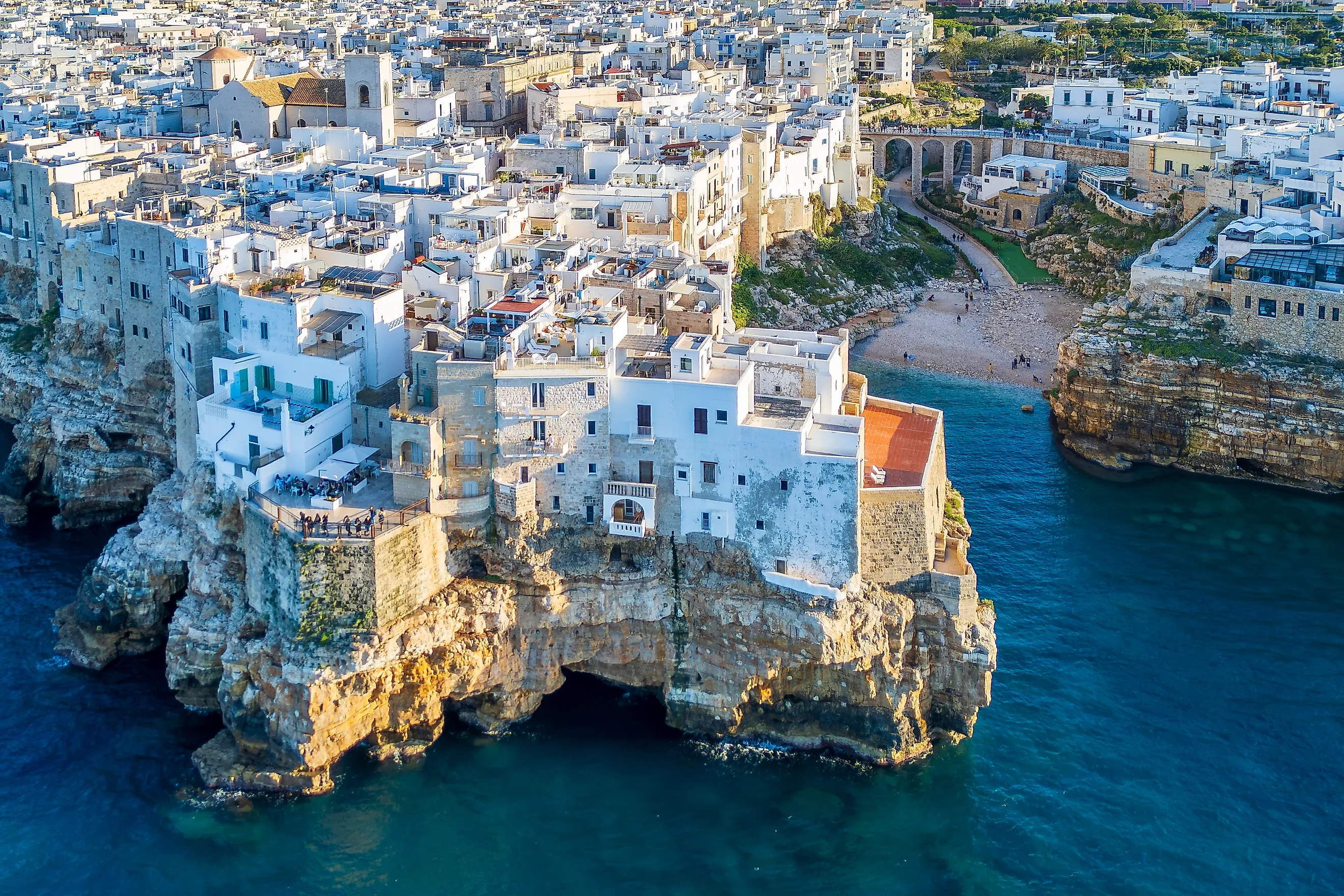
Where an ancient river once flowed, Polignano a Mare now stands, its brick homes merging seamlessly with jagged limestone cliffsides. The Adriatic laps the shore of a small beach at the base of the town. Lama Monachile is a popular beach best suited for strong swimmers due to its quick drop-off. Red Bull hosts an event at this beach, where people dive from terraces atop the white cliffs into the turquoise waters. Those wishing to sunbathe on the beach are advised to arrive early, as the small beach is very popular, especially during peak season. Seacaves are set within the cliffs, only accessible by boat.
Rent Me Charter brings guests aboard sailboats, motor boats, and yachts to see these caves as well as a fuller view of the Polignano coast. So much of life in this coastal town revolves around the cliffs themselves, and this includes eating. The restaurant Grotta Palazzese is within a natural cave, with a terrace that overlooks the sea.
Varenna

Varenna is a fishing village on the shore of Lake Como, which community members have relied on since about 769. So many of the residents' rituals revolve around the lake, even eating breakfast in the morning. Caffè Bistrot serves Italian and continental breakfast right beside the water on Varenna's Riva Grande. Even evening strolls take place along the water at the Passeggiata degli Innamorati, also referred to as "lovers walk" because of its romantic feel.
The walkway leads from the wharf to the village center, cutting between the rocks and the water beneath an archway covered in plants. Along with the water, the land itself is beautiful, especially in its gardens that are rich with life. The Villa Melzi is home to colorful waterfront botanicals, as well as a family chapel and a museum that features exhibits on political history and art.
Pienza

Built at the request of Pope Pius II, this city is a defining example of the Renaissance era. This well-preserved town is one of the earliest examples of humanistic urban planning of the time, becoming the blueprint for many Italian cities that followed. The entire city is full of important history in many different forms, such as the antique furniture at Palazzo Piccolomini. The palace also contains a library full of rare relics, and a rooftop garden with a wide view of the town. The Palazzo Comunale is another architectural gem, this one symbolizing political power. With coats of arms and mullioned windows on the facade, the building feels like a sturdy presence to this day. Now the building functions as the headquarters for the municipal administration. Just outside of this town is the medieval village San Quirico d'Orcia. The village is still fully intact, and can be reached by trekking along the pathway that connects Pienza to it.
San Gimignano

San Gimignano is a living 14th-century Italian art installation. At least, that's what it feels like. This medieval town has been reverently preserved, with 14 of the town's original towers still standing. Once a stop on the road to Rome, travelers have visited this town for hundreds of years. They still do today, admiring many of the same ancient towers. The skyline is gorgeous in itself, with the town's interior being just as absorbing.
Within the heart of the city, the Piazza della Cisterna has been an important part of local culture for centuries. This was once the place of festivals, town gatherings, and markets. The square continues this tradition with a weekly open-air market. Church of San Lorenzo in Ponte is another intimate glimpse into the past. Like a phoenix from ashes, this chapel was likely built from the rubble of an even older church. The architecture is a fine example of the Romanesque style popular in the 1300s, and the walls are filled with ancient art.
Castellina in Chianti

Castellina in Chianti sits atop a hill in a region rolling with vineyards. Many people come here to taste the fruit of the land in one of its many wineries. Each place seems to have a personal story, like Casina di Cornia, an abandoned home turned into a small family vineyard that produces olive oil and wine. Mazza Winery shares a similar feeling of intimacy. Each wine variety is named after a family member who works at the all-organic vineyard. Only a 7-minute drive away, find Castello di Fonterutoli, an ancient-settlement-turned-winery. This estate creates an experience where past and present merge, and medieval walls house wine from the current season's yield.
Matera

As one of the oldest cities in the world, Matera has hosted millennia worth of artists, academics, and everything in between. The handprint of ancient civilizations is seen most clearly in the sacred spaces carved into natural caves now called The Rupestrian Churches. Along with churches, homes and monasteries are also carved into the underground complex. These caves are within the Sassi region, where you can walk the same narrow winding corridors as the citizens who once came here for peace and prayer. There are more vast underground chambers to explore, one being the largest public cistern in the city. Water was once stored here, but the chambers of The Palombaro Lungo are now open to any member of the public who is curious about the blend of ancient engineering and geology.
Positano

The Amalfi Coast hosts many gorgeous little villages such as Positano, one of 13 towns that are built into the cliffside overlooking the sea. The main attraction here are the beaches between the stones of the cliff and the sea. Positano Spiaggia Grande is the most recognizable, being seen in postcards and advertisements. There is good reason for this, as the beach is beautiful and right at the center of town. Here, you are only a short walk away from the shops within the village itself. Though still within walking distance from town, Fornillo Beach is a less populated option for those who want to get away from the busy main shoreline. Arienzo Beach is quieter still, being only reachable by boat. To access the more private beach, catch a shuttle from Lucibello Company's pier in Spiaggia Grande.
Beauty Across Every Region
Italy makes "pretty" almost impossible to miss with towns comprised of cliffside shorelines, ancient fortresses, and rolling valleys ripe with olives and grapes. The beauty of the country is not contained to one aesthetic, as different regions follow various influences while being preserved from different centuries. The 14th-century designs of San Gimignano and the far older engineering of Matera can all be explored in Italy, a timeless land of art and innovation that has been preserved for millennia.