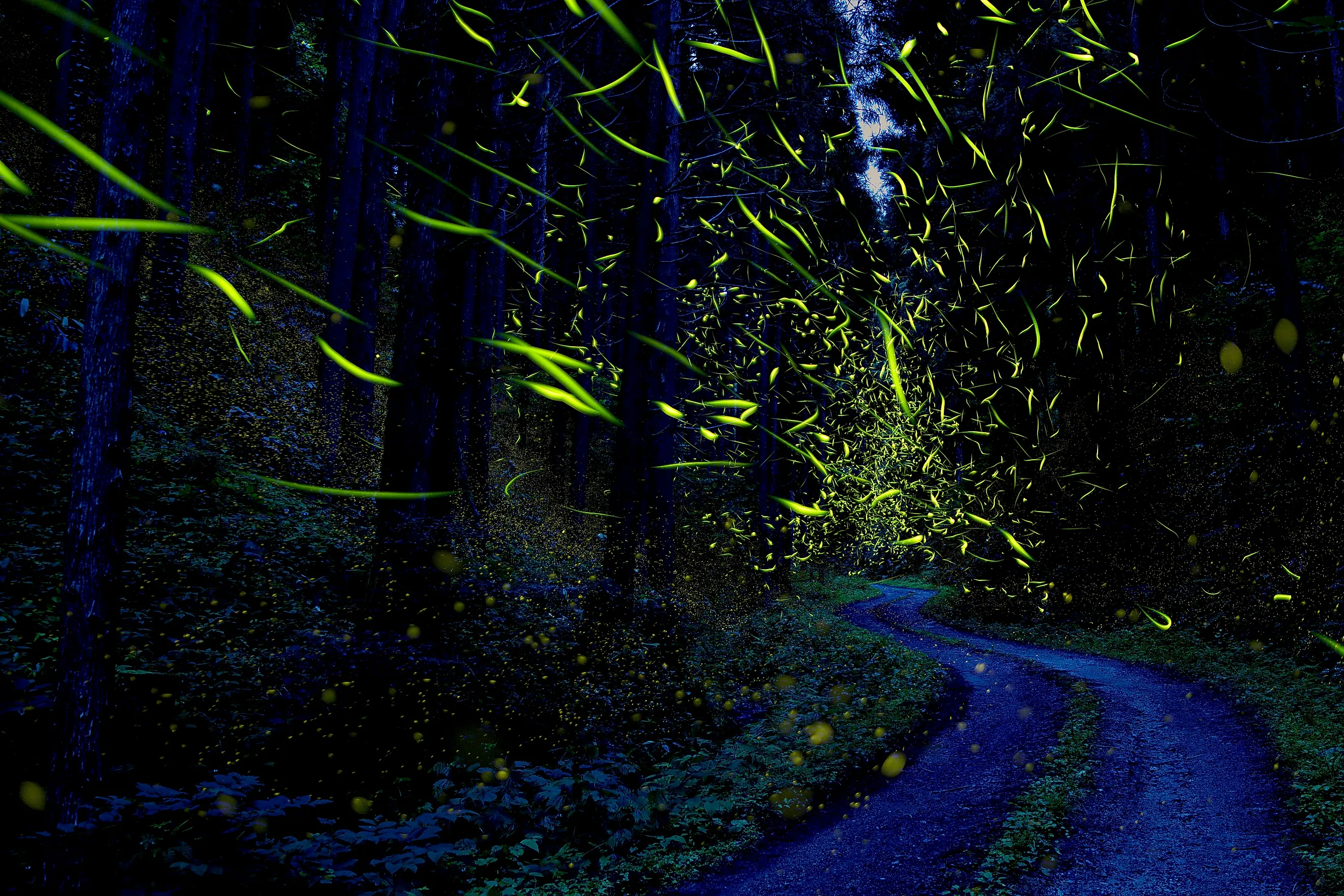
The Forests That Glow In The Dark
Some forests come alive after dark, lit from within by living things that make their own light. The glow is bioluminescence, a cold light that gives off almost no heat. It happens when a molecule called luciferin reacts with oxygen, a reaction sped along by the enzyme luciferase. Fungi, fireflies, and glow worms all run this chemistry in slightly different ways, and each produces a different color. The result turns dark, humid woodlands into some of the strangest night scenes on the planet.

Congaree National Park, United States

For about two weeks between mid-May and early June, the bottomland forest at Congaree National Park, near Columbia, South Carolina, fills with fireflies that flash in unison. The species is Photuris frontalis, one of only three synchronous fireflies in North America. Males pulse their yellow lanterns in tight, rapid single flashes, a courtship signal timed so precisely that the whole forest floor seems to blink at once. The display draws crowds to the park's cypress and hardwood swamps, and demand is high enough that the park controls entry on event nights through a lottery.
West Jaintia Hills Forests, India

Locals in Meghalaya call them electric mushrooms. Scientists gave the species its name only in 2020, when a research team tracked down reports of fungi glowing at night in the bamboo forests of the West Jaintia Hills, in northeast India. The mushroom, Roridomyces phyllostachydis, grows on dead bamboo and was the first of its genus recorded in the country.

Only part of the mushroom lights up. The caps stay a plain beige, while the stalks and the threadlike mycelia buried in the bamboo emit a green glow bright enough to trace along the forest floor. Why the caps stay dark is still unknown.
Glow Worm Tunnel Reserve, Australia

A disused railway tunnel in Wollemi National Park, New South Wales, Australia, has become one of the country's best places to see glow worms. The 387-meter tunnel once carried an oil-shale railway. Now its dark, damp walls hold thousands of bioluminescent fungus gnat larvae, which fix themselves to the roof and sides where no daylight reaches.

Set in the Blue Mountains region, the tunnel stays humid year-round, which suits the larvae. Their light reads as a soft blue-green in the dark. Reaching the tunnel means a walk along the old rail formation and reserve trails before the glow appears overhead.
Ribeira Valley Forests, Brazil

The Ribeira Valley holds the largest intact stretch of Brazil's Atlantic Forest, and it glows better than anywhere else on Earth. Of roughly a hundred bioluminescent mushroom species known worldwide, 27 have been recorded here, the highest concentration found anywhere. The valley sits about three hours from São Paulo, and researchers still turn up new species on night walks through the reserve.

Species such as Mycena chlorophos throw a neon-green light across the forest floor, on leaves, and along decaying logs. The best viewing comes in the warm, rainy months, roughly October through May, when humidity is high and the forest is at its darkest. Damp conditions make the glow easier to pick out.
Waitomo Forest & Caves, New Zealand

At Waitomo, on New Zealand's North Island, the glow worm is a species found nowhere else: Arachnocampa luminosa. It lights the ceilings of the caves and the damp forest around them with a blue-green light. The larvae favor dark, wet surfaces along cave walls, streambanks, and shaded trails.

The light is a lure. Each larva hangs sticky silk threads from its perch and glows to draw insects toward them, then reels in whatever gets caught. Visitors reach the display on underground boat rides and walking paths through the cave system.
Kyushu Fireflies, Japan

Japan's southern island of Kyushu is firefly country. Its warm, wet summers suit both glowing fungi and fireflies, and the Mycena chlorophos here carries the Japanese name yakō-take, the night-illuminating mushroom, glowing from old trees, fallen logs, and the forest floor.
The fireflies draw the bigger crowds. At the Hirabō Firefly Festival in Kihoku, in Kagoshima Prefecture at Kyushu's southern end, three species light the forest at once, the Genji, Heike, and Hime fireflies, a combination rare in Japan. The event runs across a few nights in late spring, with walking trails opened after dark so visitors can watch the fireflies drift over the streams and bamboo.
Cloud Forests, Mexico

In Mexico's cloud forests, the glow comes from Mycena fungi growing on rotting bark. These species emit light around the clock rather than only at night, following an internal circadian rhythm. Fireflies add a second light source at dusk during their mating season. Both show up in the humid highland forests of states such as Veracruz, Hidalgo, and Oaxaca, with viewing best in the warm months from around June to August.
Gabon Rainforest, Africa

Gabon, on the west coast of Central Africa, is more than 80 percent rainforest, and that dense, humid canopy is the kind of habitat bioluminescent fungi favor. Glowing mushrooms grow on rotting logs and fallen leaves here, breaking down dead wood and casting a faint green light where they feed. Africa's glowing fungi are far less studied than those in Brazil or Asia, so much of what happens in these forests at night has yet to be documented.
The Chemistry Behind the Light

The same reaction lies behind every one of these forests, whether the light comes from a fungus in Gabon, a gnat larva at Waitomo, or a firefly in Congaree. Luciferin meets oxygen, luciferase drives the reaction, and the energy leaves as light instead of heat. What differs is the organism and the setting: a Brazilian valley with 27 species of glowing mushroom, a Japanese festival timed to three kinds of firefly, an Australian tunnel that holds its humidity year-round. Each is a reminder of how many ways life has found to make its own light.