The Rattlesnake Found In Only One National Park
The Grand Canyon rattlesnake is pink, and the National Park Service states plainly that it is found nowhere else in the world. Its entire global range sits inside Grand Canyon National Park, which makes it the rare animal that is federally protected not because anyone legislated for it specifically but because it happens to live its whole life on public land. It is one of six rattlesnake species in the park and the only one you cannot see anywhere else on Earth. It is also, depending on which herpetologist you ask, either a subspecies, a full species, or a subspecies of an entirely different species. That is a remarkable amount of uncertainty about an animal that only lives in one canyon.
It Is Genuinely Pink
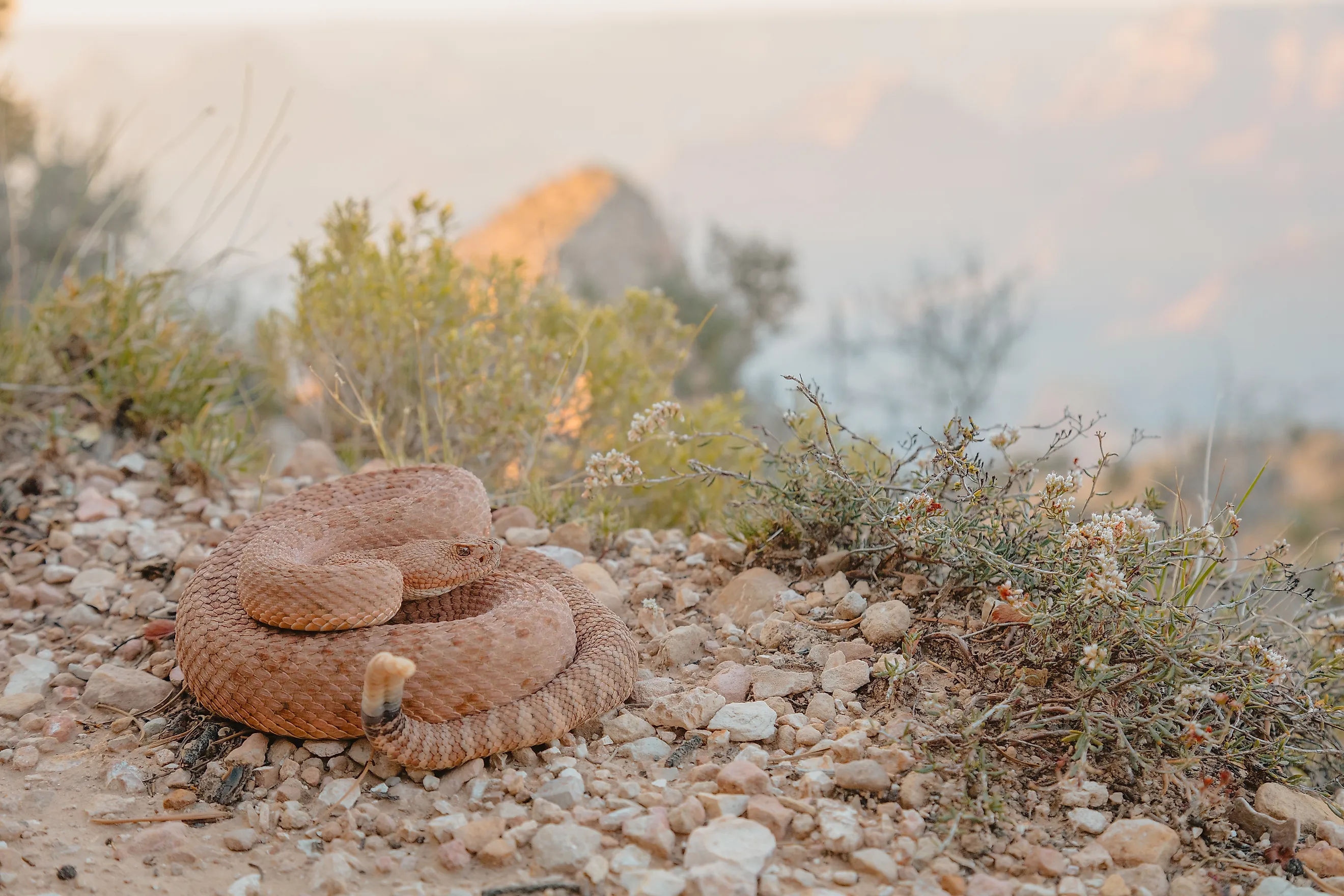
Crotalus oreganus abyssus comes in tan, yellowish or distinctly pink, and the color is not decorative. It matches the reddish rock of the canyon walls closely enough that the snake effectively disappears against them, which is why local outfitters call it the pink rattlesnake and why hikers walk past them without noticing.
The pattern also changes over a lifetime. Juveniles are born with high-contrast blotches outlined in dark brown, and those fade as the animal grows, so mature adults can look almost entirely patternless. A big old one is essentially a length of canyon-colored rope.
Where It Lives, Precisely

The Park Service describes the snake as commonly observed from Lees Ferry down to the vicinity of National Canyon, primarily below the rim. That is a stretch of river corridor rather than anything resembling a region.
Within that corridor it favors riparian habitat on the canyon floor, along with talus slopes and mesquite scrubland, and it turns up on both sides of the Colorado River. Its entire global distribution falls inside a single Arizona county.
Some accounts extend the range slightly into the Paria River drainage and parts of Glen Canyon, so the strictest version of the claim is that it lives in the Grand Canyon and its immediate approaches and nowhere else on the planet.
Protected By Accident Of Address

Here is the detail that makes this animal unusual among American reptiles. Its conservation status is Least Concern, it carries no dedicated federal listing, and it is nonetheless comprehensively protected.
Herpetological accounts describe it as protected federally by proxy of living entirely within a national park. Everything inside the park boundary is shielded from collection, harassment and killing, and because the boundary happens to encompass the snake's whole range, the species gets full protection without anybody having to argue for it.
Most rattlesnakes in America spend their lives crossing a patchwork of private, state and federal land with a different set of rules on each parcel. This one has a single landlord and never leaves the property.
Six Species, One Endemic

Grand Canyon National Park in Arizona holds 41 reptile species, made up of 22 snakes, 18 lizards and a single tortoise, and six of those snakes are rattlesnakes.
Nine rattlesnake species live in the general vicinity of the canyon, and the western rattlesnake alone is represented by two different subspecies inside the park. The Great Basin rattlesnake occupies the North Rim and the country above it, while the Grand Canyon rattlesnake works the corridor below. Two close relatives, stacked vertically, using different parts of the same hole in the ground.
The park also holds the only venomous lizard in the United States, the Gila monster, which brings its count of highly venomous reptiles to seven.
Nobody Agrees What It Is

The taxonomy here is genuinely unsettled, and the disagreement is not a trivial one. It was described by Laurence Klauber in 1930 as Crotalus confluentus abyssus, reclassified as a subspecies of Crotalus viridis in 1936, then moved to Crotalus oreganus in 2001 when that species was split off. Some researchers now argue it should be elevated to a full species as Crotalus abyssus. Others, in the 2017 Annotated Checklist of the Rattlesnakes, place it as a subspecies of the Great Basin rattlesnake instead, as Crotalus lutosus abyssus.
That matters more than it sounds. If it is a full species, it is one of very few rattlesnake species in the world confined to a single protected area. If it is a subspecies, it is a local variant of something widespread. The pink snake in the canyon is identical either way, but the conservation weight attached to it is not.
The Rattle Is A Remarkable Piece Of Machinery
The equipment deserves a moment, because the numbers involved are extraordinary. The muscles that shake a rattlesnake's tail fire up to fifty times per second, which puts them among the fastest known muscles in the animal kingdom. They can sustain that for extended periods without fatiguing, which almost no other vertebrate muscle manages.
The rattle itself is built from interlocking keratin segments, and a new one is added at every shed rather than once a year. Counting the segments therefore tells you about shedding frequency rather than age, which is the most persistent myth about these animals.
It Would Rather You Left

Species accounts consistently describe the Grand Canyon rattlesnake as calm in temperament, and note that its cryptic coloring and unhurried manner frequently let it escape detection altogether.
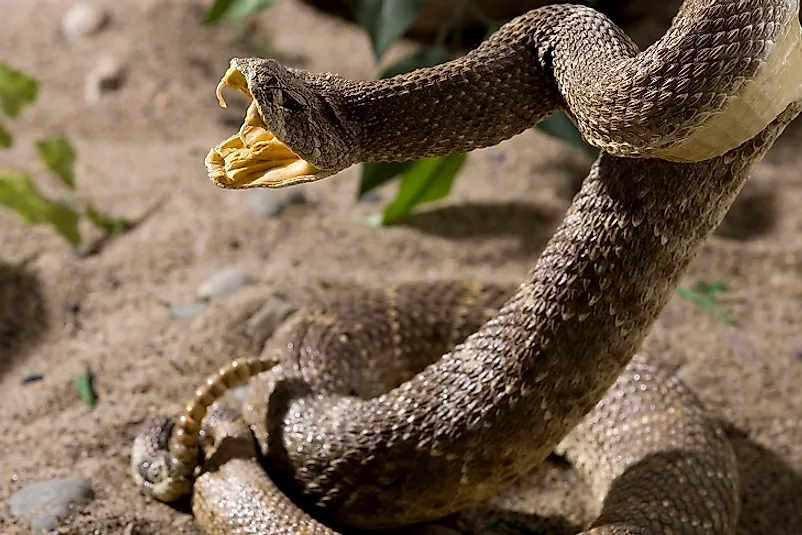
The rattle is a warning system rather than a threat. A snake that rattles is telling a large approaching animal that it is there and would prefer not to be stepped on, which costs it venom and energy it would rather spend on rodents.
Practical guidance in the park is simple. Look at it from a distance, do not approach it for a photograph, and give it room to leave. Most rattlesnake bites in the United States happen when somebody tries to handle, catch or kill the animal.
What It Eats And How It Lives
It is a generalist predator taking whatever is available, which in practice means rodents and lizards. Adults run from about 16 inches up to 54, with most mature animals somewhere in the three-to-four-foot range.
Through winter it goes dormant, becoming almost entirely inactive until the canyon warms again. Summer temperatures on the canyon floor are brutal and winter conditions at the rim are freezing, so an animal living between the two has a considerable annual swing to manage.
Its Venom Is Being Studied
One practical reason researchers care about a snake with a range this small is that rattlesnake venom is a chemical library, and closely related species often turn out to carry quite different compounds.
Work on Crotalus oreganus abyssus venom has isolated and characterized a specific phospholipase A2 enzyme, and that research also resolved a long-standing mix-up in the literature about which species a particular sequence had come from.
Venom research is where a large share of modern drug development starts, so an endemic snake in a single canyon is a genuinely useful thing to have kept alive and protected.
The Short Answer

The rattlesnake found in only one national park is the Grand Canyon rattlesnake, a pink-tinted pit viper living below the rim between Lees Ferry and National Canyon, and the Park Service is unambiguous that it exists nowhere else.
The best thing about it is the accident of jurisdiction. An animal whose entire world sits inside a park boundary gets protection most species have to fight through Congress for, simply because the line on the map was drawn around a canyon rather than around a snake.