The Forests That Are Actually One Single Organism
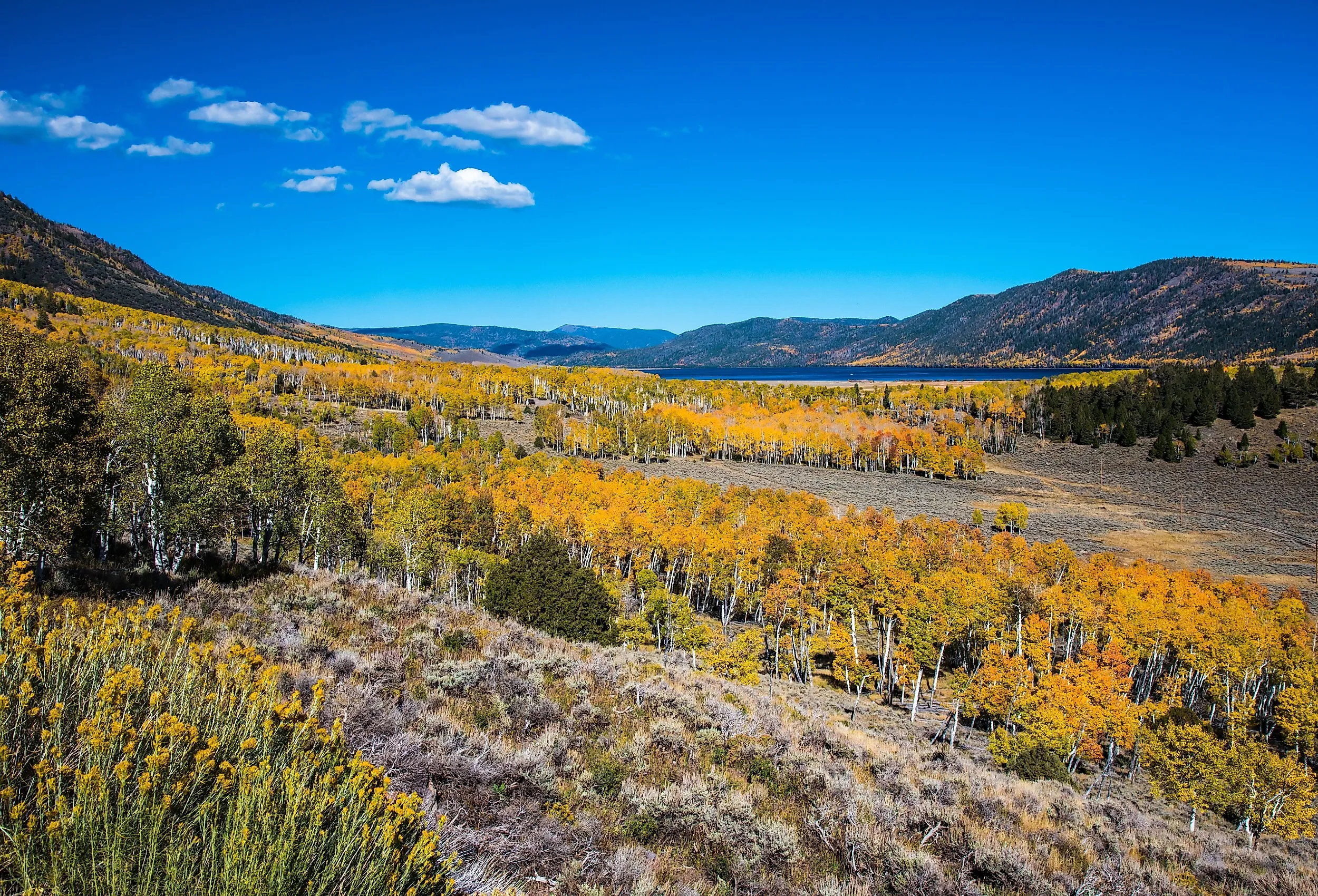
Drive Utah's Fish Lake Scenic Byway (State Highway 25) through the Fishlake National Forest, and the aspen grove crowding the hillside above Fish Lake appears to be thousands of separate white-barked trees. It isn't. Every one of the roughly 47,000 trunks growing there is a clone, sprouting from a single, continuous root system that spreads across more than 106 acres and is estimated to weigh close to 13 million pounds. Scientists call it Pando, Latin for "I spread," and it is one of the world's most massive known clonal plants. It's also struggling to reproduce, and the reasons why tie directly to how national forests, unlike national parks, are managed as working landscapes shared by wildlife and visitors alike.
What Makes Pando One Tree, Not Thousands

Quaking aspen (Populus tremuloides) rarely spreads by seed in the arid Interior West. Instead, a single tree sends out lateral roots that sucker upward into new stems, each one genetically identical to the parent. A grove that looks, from the highway, like a forest of individual trees can be, underground, one plant wearing thousands of trunks. Researchers identified Pando from morphology in the 1970s, and a 2008 study confirmed one clone across 43.6 hectares by genetically testing 209 sampled stems, while newer sequencing shows that somatic mutations create small DNA differences within the organism. That's also how Pando got its name in the first place, a nod to root-based reproduction rather than flowering into a genetically distinct new tree. Aspen clones of this kind exist elsewhere in the national forests of the American West, too, though nothing else confirmed comes close to Pando's scale. Most trees that make headlines for living thousands of years are ancient individuals, like bristlecone pines. Pando is different: it isn't one old tree, it's one old root system running a forest's worth of genetically identical stems.
The Numbers Behind Pando - And the Age Nobody Can Pin Down

The figures are striking: more than 106 acres, upwards of 47,000 stems, and an estimated 13 million pounds. These stats make Pando roughly three times heavier than General Sherman, the giant sequoia usually cited as the world's largest single tree by volume. Age is where the certainty ends. A March 2026 eLife Reviewed Preprint led by Rozenn Pineau estimates Pando's age at roughly 12,000 to 37,000 years from somatic-mutation analyses supported by nearby Fish Lake pollen records. The authors admit this range is broad, as scientists still aren't certain how quickly genetic mutations accumulate in a spreading root system. The new analysis notes that Fish Lake Plateau glaciers remained above Pando's elevation, leaving open the possibility that vegetation persisted at the site during the last glacial period. Sediment cores from nearby Fish Lake contain continuous Populus pollen for approximately the past 15,000 years, but that record establishes local aspen presence rather than Pando's individual age. The reviewed 12,000-to-37,000-year range remains provisional because eLife reviewers judged the age evidence incomplete owing to the study's low-coverage, reduced-representation sequencing.
A Living Organism That's Struggling to Reproduce

Pando's biggest threat isn't old age; it's an inability to grow new trunks. The 2018 PLOS ONE study found mule deer presence strongly associated with failed recruitment at Pando; cattle also use the site seasonally, while researchers recorded no direct elk observations or elk scat within their Pando surveys. Aerial photographs documented roads, a campground, recreational homes, and failed unfenced cuts from 1987 and 1988, while a fenced 1992 cut later produced advanced recruitment. Prescribed burning can stimulate aspen suckering, but Pando experiments found that it did not outperform cutting or shrub removal and that protection from browsing was essential, with fencing alone producing enough regeneration for overstory replacement. With that knowledge, the Forest Service ran a prescribed burn through part of Pando in May 2014 specifically to trigger new shoot growth. Fenced exclosures built to keep browsing animals out have shown real recovery where they hold. Larger and more recent fencing efforts have struggled, with agile deer either breaching weak points or clearing eight-foot barriers outright. The nonprofit Friends of Pando now partners with the Forest Service and local volunteers on restoration work. Paul Rogers, the Utah State University ecologist who led the 2018 study, has said the hard part is protecting one organism while managing wildlife and public land for dozens of other uses simultaneously.
Earth's Other "Biggest Organism": A Fungus Eating an Oregon Forest
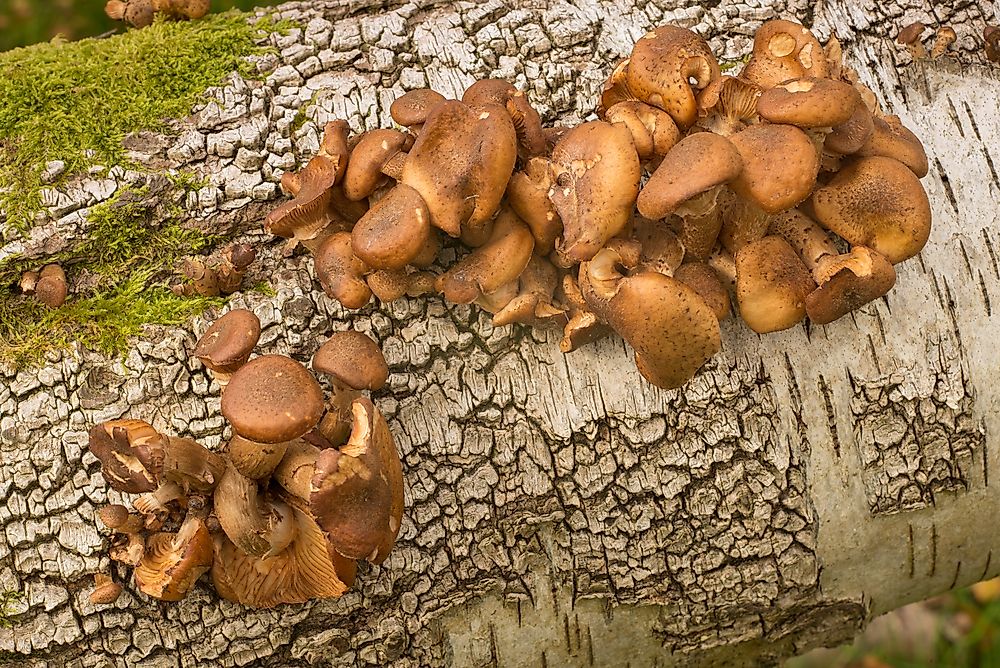
Pando isn't the only contender for the title of world's largest organism, and the confusion between the two is a good lesson in how superlatives work. Deep in the Malheur National Forest in Oregon's Blue Mountains grows a single specimen of the fungus Armillaria ostoyae, nicknamed the Humongous Fungus. Forest Service employee Greg Whipple first flagged unusual patches of dead and dying conifers there in 1988, mapping what he then estimated at about 400 acres. A 2003 study by a Forest Service research team that included plant pathologist Catherine Parks confirmed a single fungal individual spreading root-rot disease across 2,384 acres, an area of nearly four square miles. Forest Service estimates place the Malheur fungal genet at roughly 1,900 to 8,650 years old and 7,567 to 35,000 tons, with both ranges derived indirectly from assumptions about spread rate and biomass. On current Forest Service estimates, the Oregon fungus exceeds Pando in both mapped area and estimated biomass, while Pando remains the largest known aspen clone. One persistent misconception is worth clearing up: despite viral photos claiming to show it as a single towering mushroom, the fungus mostly stays out of sight. What actually surfaces are scattered clusters of honey-colored mushrooms at the base of infected trees, fed by black, bootlace-like strands spreading underground.
Beyond Forests: Other Single Organisms Wearing Disguises
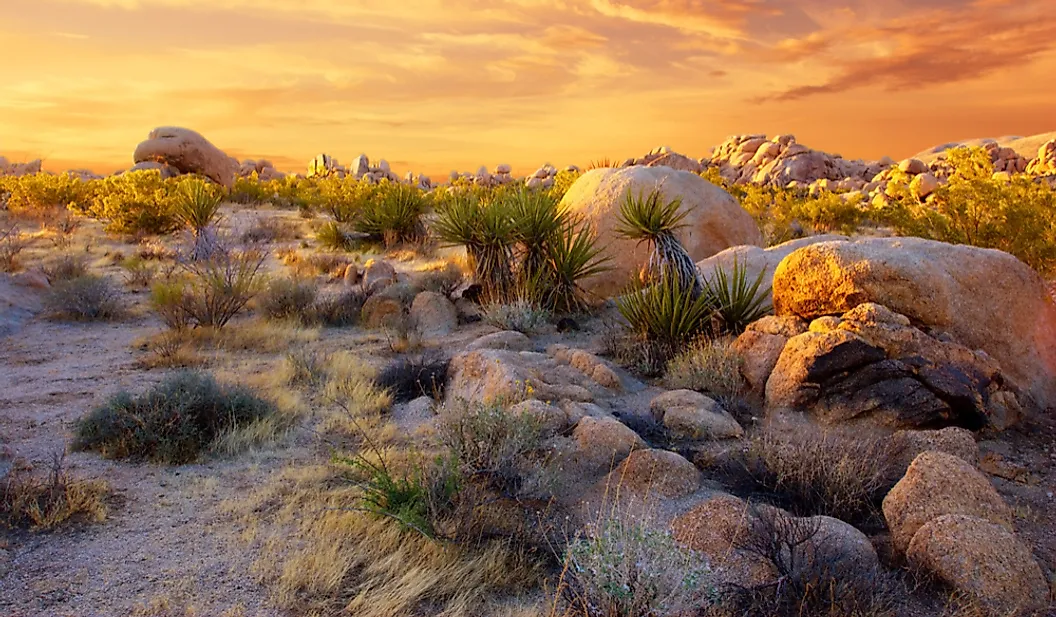
Pando consists of many aspen stems belonging to one genet, whereas the Humongous Fungus is one fungal genet spreading through soil and the roots of many separate trees. In California's Mojave Desert near Lucerne Valley, a ring-shaped creosote bush colony called King Clone has been dated to roughly 11,700 years old. Growth-ring measurements and radiocarbon dating both point to that figure, making it one of the oldest known living things on Earth. It is a low-desert shrub ring within California's protected 488-acre King Clone Ecological Reserve, where hiking and wildlife viewing are permitted, but facilities are absent. In Pennsylvania, the Hoverter and Sholl Box Huckleberry Natural Area protects a single colony of box huckleberry shrubs estimated at 1,200 to 1,300 years old. The site is a 10-acre patch of Tuscarora State Forest near New Bloomfield. Neither is a "single-organism forest," but both show that what looks like a patch of many plants is sometimes, underground, just one very old, very prolific individual.
Still Spreading, Still Worth the Detour

Pando may look like a forest of separate trees from State Highway 25, but its future depends on decisions that reach far below its canopy. In this working national forest, recreation, grazing, timber, watersheds, wildlife, and conservation all compete for space. That makes deer management and effective fencing as important to Pando’s survival as rainfall. Visitors can walk through the grove, fish and camp at Fish Lake, or follow the byway through one of Utah’s biggest national forests. Yet Pando’s most important growth is easy to overlook: young stems thrive where browsing is controlled, while much of the clone still awaits its next generation.