Where is the Oldest Tree in the World?
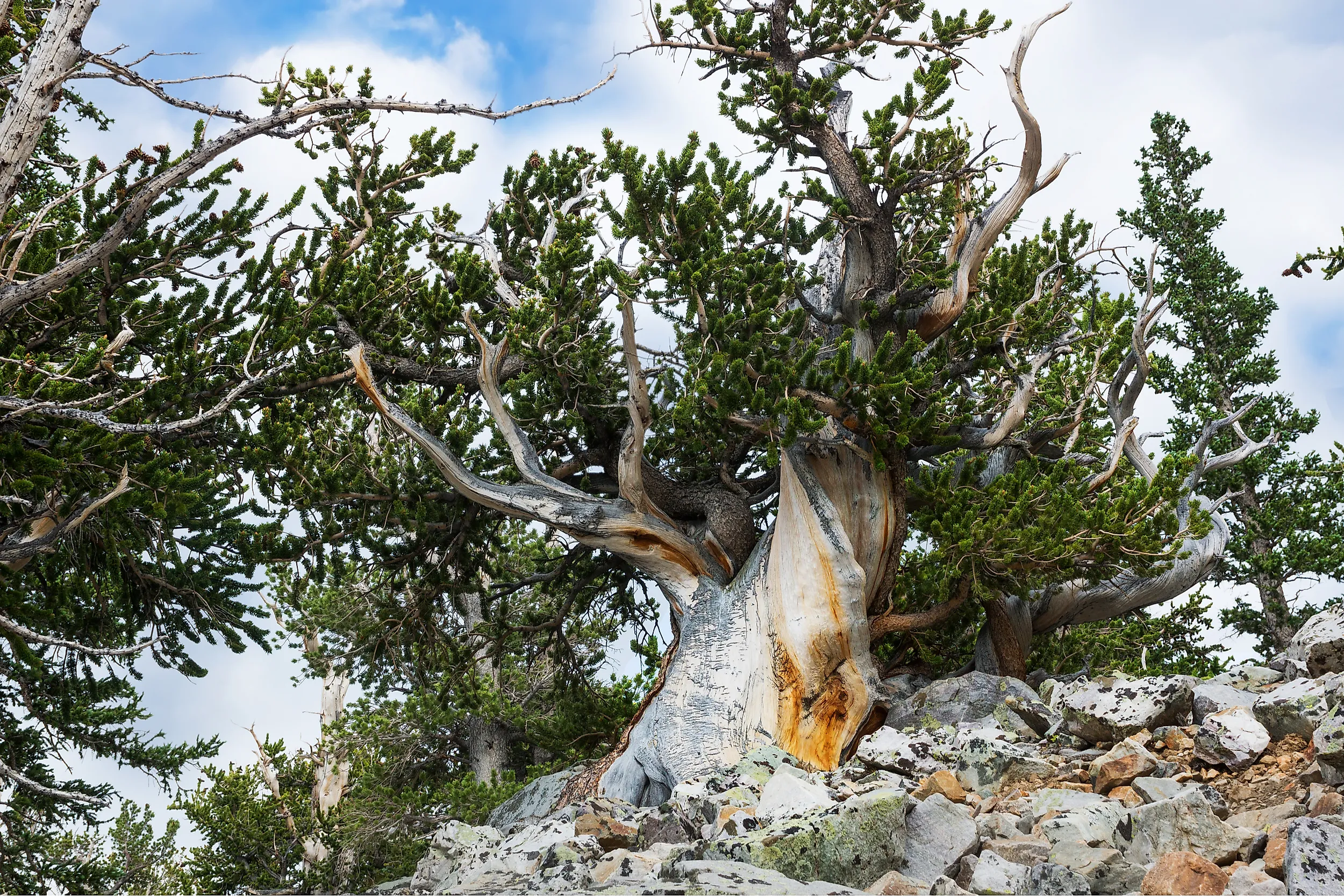
The oldest individual trees on Earth grow in the White Mountains of eastern California, a dry, wind-scoured range on the California-Nevada border. They are Great Basin bristlecone pines, and the oldest firmly documented living example has stood for more than 4,850 years. An unnamed specimen in the same range has been dated to just over 5,000 years, though that figure is disputed. Either way, these pines were already several centuries old when work began on the Great Pyramid of Giza around 2560 BCE. The answer shifts once clonal trees enter the picture, but among single, individual trees, the record belongs to California.
The Bristlecone Pines Of The White Mountains

The Great Basin bristlecone pine (Pinus longaeva) holds the record for the oldest verified individual tree, and the species grows only in the high country of California, Nevada, and Utah. The best-known specimen is Methuselah, sampled in 1957 by dendrochronologist Edmund Schulman in the Ancient Bristlecone Pine Forest of the White Mountains. It is now estimated at more than 4,850 years old, with a germination date around 2833 BCE, and the US Forest Service keeps its exact location secret to protect it from vandalism.
A second, unnamed bristlecone from the same area was later crossdated at just over 5,000 years and is sometimes listed as the oldest living tree on Earth. That claim is shaky. The original core was never relocated after the researcher who measured it died in 2013, and no independent team has since confirmed the age, so many scientists still treat Methuselah as the oldest tree that is fully documented. A third famous pine, Prometheus, was older still, with at least 4,862 growth rings, but it no longer stands. A graduate student cut it down on Wheeler Peak in Nevada in 1964 while taking a sample, in what remains one of the field's most cautionary stories. The site now lies within Great Basin National Park.
Bristlecones reach these ages precisely because their lives are hard. They grow slowly on cold, arid, windswept slopes above 10,000 feet, producing dense, resin-rich wood that resists insects, fungi, and rot. Even after a tree dies, its trunk can stand for thousands of years.
A Chilean Challenger: The Patagonian Cypress

The strongest challenge to California's record comes from southern Chile. The Patagonian cypress (Fitzroya cupressoides), known locally as the alerce, is the largest tree species in South America, typically reaching 40 to 60 meters (130 to 200 feet) and occasionally more than 70 meters, with trunks up to 5 meters across. The genus was named after Robert FitzRoy, the captain of HMS Beagle. Heavy logging since the colonial era stripped most of the old growth, and Chile declared the species a national monument in 1976.
One alerce in Alerce Costero National Park, called Gran Abuelo, or great-grandfather, was ring-dated to about 3,622 years in 1993, which already placed it among the oldest trees on the planet. In 2022, scientist Jonathan Barichivich estimated it could be roughly 5,484 years old, which would make it older than any bristlecone. That number is contested, because the tree's trunk is too wide for a borer to reach the center, so the estimate relies on a partial core combined with a statistical model rather than a complete ring count.
California's Giant Sequoias

The giant sequoia (Sequoiadendron giganteum) grows along the western slopes of California's Sierra Nevada. The species includes the largest single-stem tree on Earth by volume, the General Sherman Tree, which stands about 275 feet tall, measures roughly 36 feet across at its base, and contains some 52,500 cubic feet of wood. Size and age are not the same thing, though. General Sherman is around 2,200 years old, and giant sequoias are not the tallest trees either, since coast redwoods grow taller.
The oldest known giant sequoias run to roughly 3,200 years, well short of the bristlecones. One cored specimen has been dated at about 3,266 years, and the President Tree in Sequoia National Park is estimated at over 3,200. These trees owe their age to thick, fire-resistant bark and the protected groves they grow in rather than to the extreme conditions that age a bristlecone.
When "Oldest" Depends On The Definition
Everything above concerns individual, non-clonal trees, each grown from a single seed. Clonal trees play by different rules and reach far greater ages. A clonal tree regenerates new trunks and roots from one continuous organism, so the visible trunk can be young while the root system is ancient. Old Tjikko, a Norway spruce in Sweden, has a root system carbon-dated to roughly 9,560 years, even though its trunk is only a few centuries old.
The extreme case is Pando, a quaking aspen colony in Utah's Fishlake National Forest. Pando is a single organism of more than 40,000 genetically identical stems sharing one root system across about 106 acres, and its age is estimated in the thousands of years, with some figures running far higher and none easy to prove. Olive trees blur the line too: a specimen in Mouriscas, Portugal, has been radiocarbon-dated to around 3,350 years, although olives are notoriously hard to date because their heartwood rots away.
How Scientists Measure A Tree's Age
The standard method is dendrochronology, the dating of trees by their annual growth rings. Most trees add one ring per year, so a count gives a direct age, and a hollow tool called an increment borer lets researchers pull a thin core without killing the tree. The rings also record drought, fire, and climate, which is why bristlecone wood has been used to build a continuous environmental record stretching back more than 9,000 years. Rings do not work for clonal trees, whose old wood has long since decayed, so those ages come from radiocarbon dating of root material instead. When a trunk is too wide to core fully, as with Gran Abuelo, scientists turn to statistical models, and the resulting estimates carry more uncertainty.
The Ten Oldest Individual Trees
| Rank | Species | Estimated age (years) | Location |
|---|---|---|---|
| 1 | Great Basin bristlecone pine (unnamed, disputed) | 5,070 | White Mountains, California, USA |
| 2 | Great Basin bristlecone pine (Prometheus, felled 1964) | 4,900 | Wheeler Peak, Nevada, USA |
| 3 | Great Basin bristlecone pine (Methuselah) | 4,850 | White Mountains, Inyo County, California, USA |
| 4 | Patagonian cypress (Gran Abuelo) | 3,650 | Alerce Costero National Park, Los Rios, Chile |
| 5 | European olive tree | 3,350 | Mouriscas, Abrantes, Portugal |
| 6 | Giant sequoia | 3,266 | Sierra Nevada, California, USA |
| 7 | Giant sequoia | 3,220 | Sierra Nevada, California, USA |
| 8 | Giant sequoia | 3,200 | Sierra Nevada, California, USA |
| 9 | Giant sequoia | 3,075 | Sierra Nevada, California, USA |
| 10 | Giant sequoia | 3,033 | Sierra Nevada, California, USA |
Where The Record Stands
For a single, seed-grown tree whose age can be counted ring by ring, the oldest on Earth is a Great Basin bristlecone pine in the White Mountains of eastern California, with Methuselah the clearest documented case and an unnamed neighbor possibly older. Chile's Gran Abuelo could overtake them if its modeled age holds up. And if the definition opens to clonal organisms, the contest moves to a Swedish spruce and a Utah aspen grove whose true ages no ring count can settle.