The County With The Longest Coastline
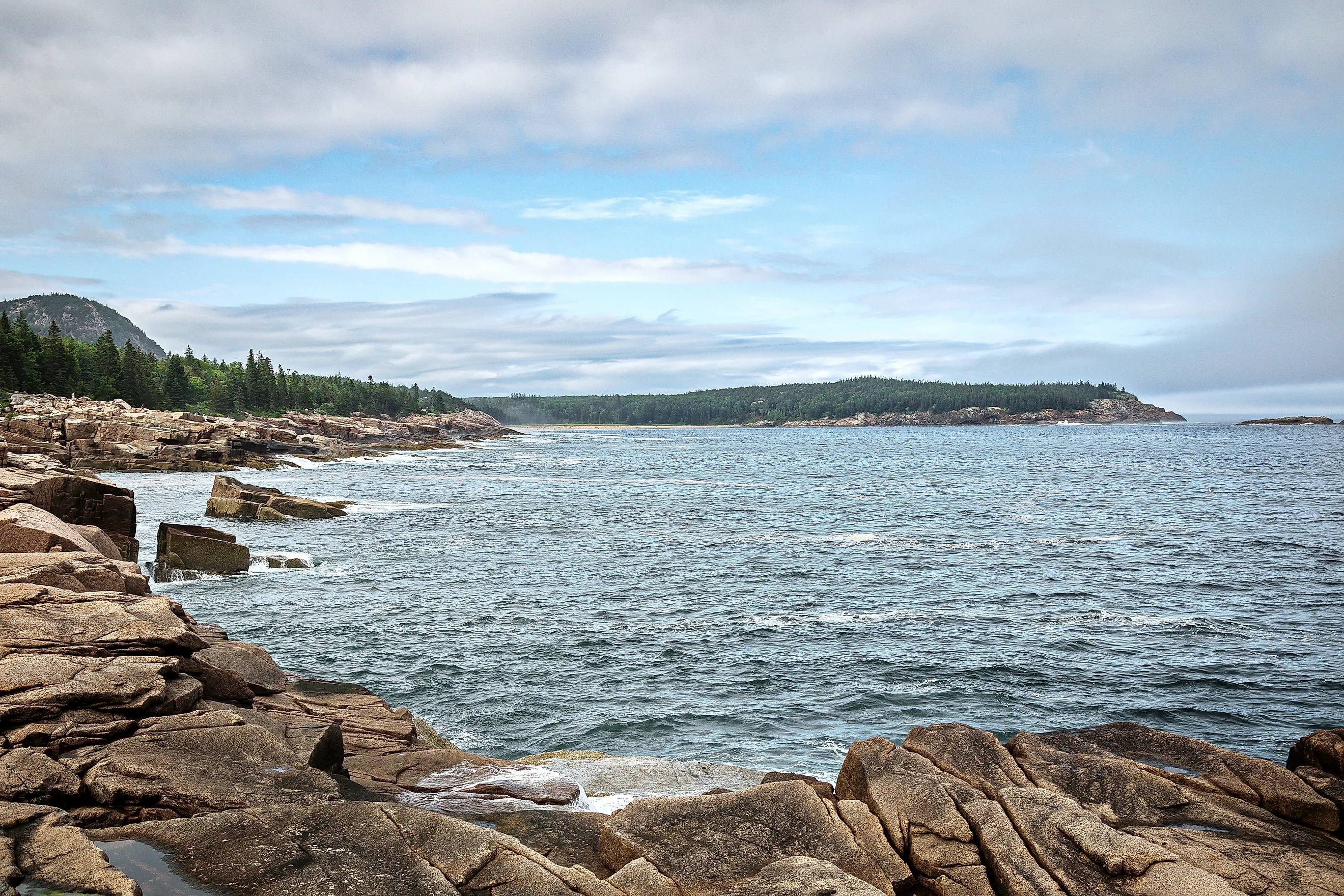
Hancock County, Maine, has the longest coastline of any county in America, stretching for 952.1 miles, according to the county's official hazard mitigation plan. Its coastline is so long due to a flooded mountain range, which gives it a highly bumpy Atlantic coastline, along with many islands. This rugged coastline is what gives Maine its status as the state with the 4th-longest shoreline at 3,478 miles. The actual answer for why Hancock County has the longest shoreline is quite complicated and delves into definitions of counties and the coastline paradox.
Criteria

First, this story is only considering counties, which are used by 48 states, but are not used by two states with long coastlines: Alaska and Louisiana.
Alaska is organized by boroughs, while Louisiana uses parishes. These both originate from the state's history. Louisiana was organized around parishes due to its history as a predominantly Catholic colony first under the French, then the Spanish, and it kept this administrative design despite efforts to change it to counties. In the case of Alaska, its constitutional delegates in 1955 chose boroughs over counties to limit overlapping taxation and ensure maximum control at the local level.
Alaska has the longest coastline in the US, with a shoreline of 33,904 miles, and the borough with the largest coastline is the North Slope Borough, which contains its northernmost land and its coastline with the Arctic Ocean. This borough stretches across more than 8,000 miles of the Arctic Ocean. However, because it is not a county, it is not considered for this list.
Another issue to consider is how one measures a coastline in the first place. For example, if one measures with a larger scale, the overall length of the coastline will be smaller, as it only accounts for the overall straight line of the coast. However, when measuring on a smaller scale, one will account for the curves and bumps in the coastline, making it much longer than normal. This issue of measurement is known as the coastline paradox and was first noticed in the 1950s by English mathematician Lewis Fry Richardson.
This is why Maine has such a long coastline, as it accounts for its rocky shores, with many turns and inlets, and why it has a longer coastline than California, as California's coast is far straighter than Maine's.
History

As the largest state in New England, Maine was quite difficult to settle, in part due to its cold winters. There are many alleged early explorers in Maine, such as the Norse explorer Leif Eriksson, who came to North America in 1000. The British established a small colony at Popham in 1607, but it only lasted a year.
By 1637, the British had established a shipyard, which would be used to transport fish, fur, lumber, and other goods for England's Navy. In 1658, the colonists voted to merge with the more prosperous Massachusetts Colony. It would remain under Massachusetts until 1820.
Hancock County is the fourth oldest of all the counties in Maine, dating back to 1789. At the time of its incorporation, eight of its 34 towns had been organized, and most of them were contiguous. The county was named after John Hancock, a leader in the American Revolution who famously signed his name on the Declaration of Independence larger than anyone else, leading to the phrase Hancock for a signature.
Maine was ultimately added to the Union in 1820 as a free state to counterbalance the admission of Missouri as a slave state through an agreement called the Missouri Compromise, which aimed to balance the interests of slave and free states.
Ellsworth is the current county seat of Hancock, established in 1763, but it wasn't fully incorporated until 1800. Much like the county itself, it was named after a Revolutionary War figure: Oliver Ellsworth, a United States senator and chief justice of the United States. He also received 11 electoral votes in the 1796 presidential election. Ellsworth would later become a large economic hub for sawmills, gristmills, shipbuilding, and many other industries. Today it is the gateway to Hancock County's largest coastal attraction and the only national park in Maine, Acadia National Park.
Acadia National Park

This national park gets 4 million visitors annually who come to see its rocky coastline and diverse geology, which was formed through volcanic activity and ice.
Volcanic eruptions from more than 500 million years ago covered the land with volcanic ash, and a subsequent collision of the mini-continent Avalonia with North America formed granite platforms, which were then covered with ash. Over time, the sediment and ash wore away, exposing the granite formations, such as Cadillac Mountain, which stands 1,530 feet above Mount Desert Island.
Throughout Acadia National Park, one can discover rare environments such as tidepools, formed by seawater flowing into rock depressions, or hiking out to birding locations within the Schoodic Peninsula. Coastal hikes will reveal the beauty of this rocky shoreline, such as the Compass Harbor Trail leading to a view of Frenchman Bay or the 2.2-mile Ocean Path Trail that goes by the Atlantic Ocean, granite slabs, and other viewpoints.
Bird watching itself is one of the most popular activities here, as it has more than 20 species of warblers, making it a prized destination for birders. Another common bird here is the loon, which can be found in Jordan Pond among other spots. These birds have an unusual song that many have described as eerie and delightful at the same time.
The complex question of coastlines
When Lewis Fry Richardson uncovered the coastline paradox, he did so while testing out a theory that nations with long enough shared borders would inevitably go to war. What he discovered instead has challenged how we measure coastlines, as there are still debates over whether to measure at large or smaller scales. Hancock County itself may appear small, but its twisting, rocky shoreline that goes around Acadia National Park showcases how land and oceans often don't obey straight lines and easy answers. Add in the further complexity of Alaska's lack of counties, and the question of which county has the longest coastline is a complex one, as Hancock County clearly demonstrates.