The State Parks Built Around A Gorge
Imagine following a long, steep trail that gradually descends into a river gorge, while all around you is the constant hum of waterfalls. You look up from the gorge floor and see caves carved into the rocks, and maybe a bridge connecting one side of the gorge to the other. That's just a taste of the many views you can see at these state parks built around a gorge.
Watkins Glen State Park

Watkins Glen State Park was forged by the waters of Glen Creek as it dropped towards Seneca Lake, which is part of the larger network of New York lakes called the Finger Lakes. The park has often earned top spots for best state parks in New York due to just how beautiful its gorge is, which was formed by a stream that flows downward.
This stream produces 19 waterfalls visible by the Gorge Trail. It was formed by Seneca Lake itself, as water flows downhill, cutting into the sedimentary rock, leaving behind the gorge, which is 400 feet deep at its maximum. This gorge is relatively young geologically speaking, as Seneca Lake itself only formed 10,000 years ago with the end of the last ice age filling up a trough with glacial water.
Hocking Hills State Park

Located in Logan, Ohio, Hocking Hills State Park was born out of sandstone dating back more than 350 million years ago, which was gradually eroded by streams, creating gorges and rock formations, including caves such as Old Man's Cave and the Whispering Cave.
Old Man's Creek flows through Black Hand Sandstone, creating Upper and Lower Falls. The Upper Falls enter a pothole known as the Devil's Bathtub. One of the most interesting features on the gorge walls is honeycomb patterns, formed through sand being cemented by iron oxide, leaving behind riblike patterns.
The water didn't just create gorges; it also crafted unusually shaped rock formations, like the Rock House. Located in the middle of a cliff, it was hollowed out in the middle, creating a kind of house with a ceiling, windows, and a long tunnel. Some have described it as looking similar to Gothic churches with its arched windows and openings.
Clifty Falls State Park

Located within the town of Madison, Indiana, Clifty Falls State Park is made up of 444-million-year-old shale and limestone that was reshaped by the Clifty Creek, leaving behind four waterfalls and the Clifty Canyon.
Clifty Falls stretches from close to the shores of the Ohio River to two miles to the north, and today is retreating upstream by one quarter of an inch every year. Along the canyon floor, one can find fossilized remains of marine animals from back when a shallow inland sea covered southern Indiana, including squids and brachiopods. The waterfalls themselves are the most sought-after sites in the park, with hikers attempting to see all of them in a single day via the Four Falls Hike.
Natural Bridge State Resort Park

The Natural Bridge State Resort Park is surrounded by the Daniel Boone National Forest, and is next to the Red River Gorge Geologoical Area in Kentucky. This gorge is made up of sandstone that built up 340 million years ago, but was eroded by the Red River, creating steep cliffs that have made this region a favorite among climbers and fishers in the Red River.
As for the Natural Bridge State Resort Park, it gives one a great vantage point of the gorge at a 78-foot-long by 65-foot-high natural bridge. One can hike to the top of this bridge, which was formed by water breaking away the exposed rock at the bottom.
Cummins Falls State Park

Moving south to Tennessee, Cummins Falls State Park is a small park at 282 acres, which gives special focus to its primary feature: its waterfall and gorge. The 75-foot-tall Cummins Falls falls down into a pool. Visitors often wade out directly into the pool and can see the gorge above them as well.
The gorge is made up of sedimentary rocks from the Cumberland Plateau, including sandstone and limestone. Many hikers begin their journey hiking down the gorge on a 1- or 1.5-mile trail down to the base of the waterfall, which has a small swimming hole. Visitors have often pointed out that the gorge itself is very rugged, featuring loose rocks and steep sections, requiring careful attention to those descending it. In addition, the gorge is known for flash floods, meaning one needs a permit to access the base of the waterfall.
Gorges State Park

This North Carolina state park sits at a crossroads in more ways than one. For one, it sits at a tri-state border between North Carolina, South Carolina, and Georgia. Secondly, it is in the Blue Ridge Escarpment, where five open streams flow into the Atlantic Ocean. As these streams start to flow down more than 2,000 feet in elevation, they create several gorges and waterfalls.
There are 26 waterfalls in this park, accessible via a number of trails, such as the strenuous Rainbow Falls Trail and Bearwallow Falls Trail. Along the gorge walls, one can see rare species of moss such as the dark green Carolina star moss or Pringle's aquatic moss. In addition to the waterfalls, Gorges State Park straddles an ancient fault line called the Brevard Fault Zone, which contains rocks crafted under extreme pressure, including marble.
Tallulah Gorge State Park

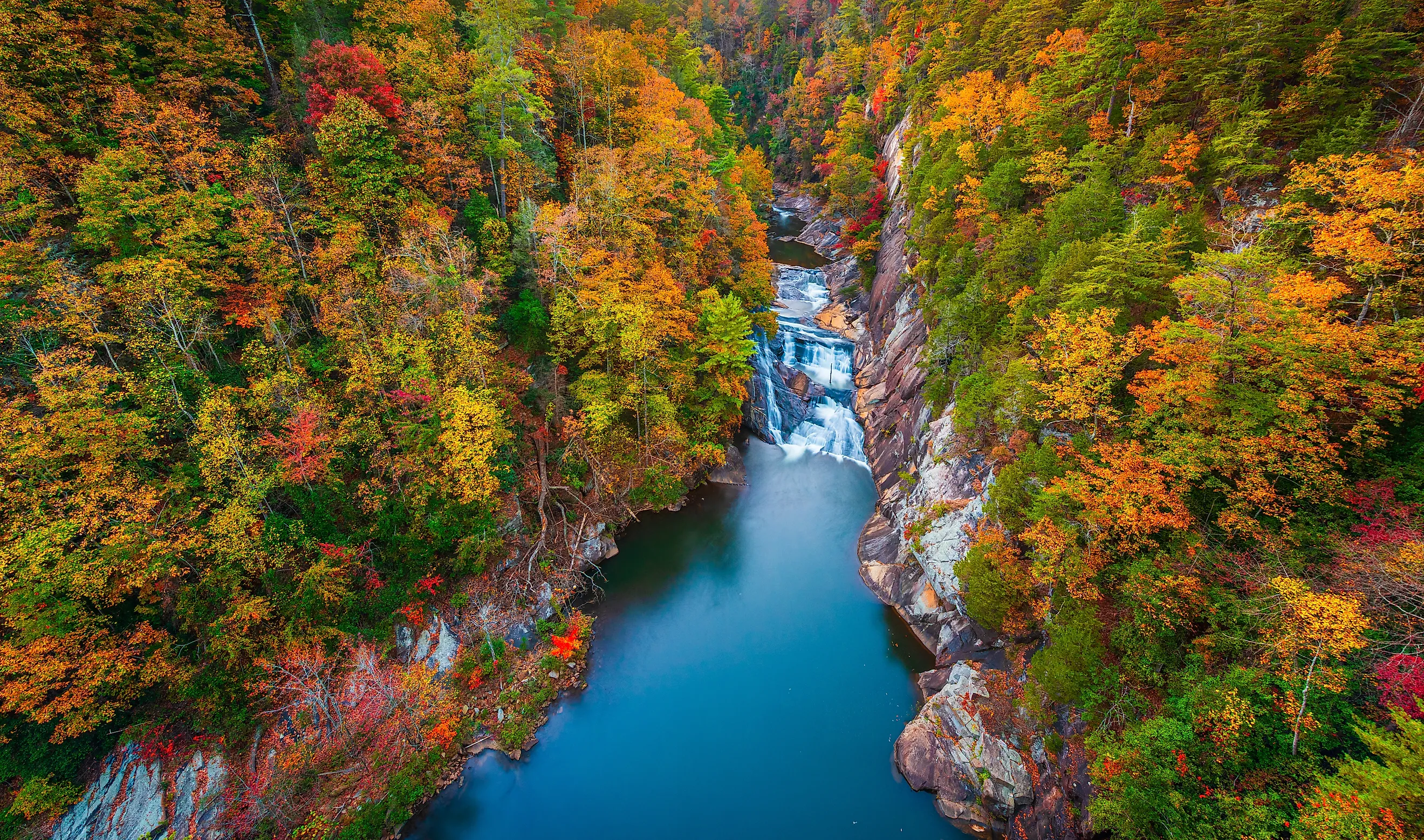
The Tallulah Gorge State Park is the largest gorge on this list, at two miles long and close to 1,000 feet deep. Located in Georgia, it takes a lot of courage to cross over its swinging bridge, with the gorge's river 80 feet below your feet, but some walkers have made their own path through tightrope walking. The towers used by tightrope walker Karl Wallenda in 1970 to cross the gorge are still in place.
This land was once an island that existed off the coastline of Laurentia, a continent consisting of North America and Greenland. It would later be shoved together with all the continents to form Pangea. During the Pleistocene, a few million years ago, the Tallulah River cut backwards until it reached erosion-resistant quartzite, which prevented meandering. As a result, the river was forced to cut right down into the quartzite, making a deep-walled gorge. Waterfalls contributed to this process, as the large amounts of water pooling caused further collapse of rocks.
Please mind the gorge gap

All of these gorges listed above were formed by flowing water and often are still wet and filled with loose rocks. As a result, navigating them can be dangerous, and some require a permit to go to the bottom of, such as Tallulah Gorge or the base of the waterfall in Cummins Falls.
These gorges were all made through the steady process of flowing water breaking and washing away rock, and if you're not careful, you could easily get "eroded" as well. Thankfully, by following local rules, getting the right permits, staying on trails, and hiking together, one can avoid most incidents. Just make sure when walking near, around, or in gorges, to mind the gap.