Towns Losing Ground to the Rising Sea
In too many towns built on the edge of the sea, the ground is literally disappearing underneath what used to be a solid foundation. Shishmaref, a village on an Alaskan barrier island, is experiencing increased coastal erosion and flooding due to rising seas. In Tuktoyaktuk, the west shore is retreating by an average of between 0.3 and 3 meters per year as sea levels rise. This leaves residents with very few choices. They can build defensive walls or pack up and abandon their homes. In the following towns, these options are not always appealing.
Isle de Jean Charles, Louisiana

About 98% of Isle de Jean Charles has vanished into the Gulf of Mexico, also known as the Gulf of America, over the last 60 years. All that remains of this once thriving town is a strip of land that is just a quarter-mile wide and two miles long. Over these six decades, high tides and hurricanes have sliced away at the town, destroying rice fields and pastures. It did not help that thousands of miles of channels were dug through the surrounding wetlands for oil and gas extraction. The seawater keeps rising unabated, fueled by ongoing climate change. At the same time, the remaining oak trees are dying because the saltwater kills their roots. The island community once numbered around 300, and only about 26 remain. These diehards are part of the Biloxi-Chitimacha-Choctaw tribe, many of whom moved to a newly built site 40 miles away. They were able to do this thanks to a $48 million fund provided by the federal government in 2016.
Those who stayed behind refuse to leave even though their single access road continues to sink deeper underwater whenever the tide comes in. While they dig in their heels, the Gulf Coast is experiencing a 25% loss of wetlands and ongoing erosion. In 2022, Isle de Jean Charles was not included in the U.S. Army Corps of Engineers' plan to build a new levee system. The Army Corps reiterated at the time that those still living in what was left of the town needed to move. Since 2022, 34 families have moved to the new site, called New Isle. Others have since moved elsewhere in Louisiana. Those who still choose to cling to the strip of land left are called the first official climate refugees in the U.S. Whether they will be convinced to move before the last ground gives way beneath them remains to be seen.
Tangier, Virginia

Scientists believe Tangier Island, home to the town of Tangier in Virginia, could be underwater before the next century. Tangier Island is one of the last inhabited islands in Chesapeake Bay, and today sits only three feet above sea level. Since 1850, around two-thirds of the island's landmass has been lost due to rising sea levels and erosion. The water levels in the bay continue to rise a quarter of an inch per year, which is already disastrous for the town of Tangier. Tangier is facing a double threat with rising seas and the land sinking at least 2 millimeters a year as the Earth's crust continues to settle from the last ice age. More than sixty percent of the dry land is gone, and fewer than 400 permanent residents remain. Storms and high tides see front yards and streets fill with water from the bay. This has prompted people to lift their houses onto wooden pilings and build walls to stop the water from destroying their homes.
Unfortunately, this is not enough, and the government has estimated that without significant investment in protective infrastructure, the town will have to be permanently evacuated in just a few decades. The destruction of Tangier due to rising sea levels would be devastating not only for those who still live here but also for the nesting birds who inhabit the marshes and the crabs who hide in the underwater grasses. Sadly, many Tangier residents refuse to believe that climate change, resulting in warmer seas and rising water levels, exists. Visitors can even buy T-shirts in Tangier that read 'I refuse to be a climate change refugee.' This could prove to be a deadly belief come the next 50 years.
Shishmaref, Alaska

Just looking at photos of Shishmaref online can make one feel uneasy about how close the local community's homes are to the lapping waters of the Chukchi Sea, north of the Bering Strait. Once again, a finger can be pointed at climate change as part of the reason for rising sea levels, erosion, and flooding that result in a loss of the ice and land that are supposed to keep Shishmaref intact. There are around 600 people who live here, some of whom have been permanent residents since the 1970s. Throughout the decades, residents have voted yes at least twice when deciding whether to relocate. But they have yet to be moved to another location. There is currently still no money to fund the move, and most simply do not want to move. They do not want to leave the place where they can hunt and fish every day, and the vast majority do not want to spend time thinking or worrying about climate change. For now, reinforced sea walls are balancing life in Shishmaref on a precarious point. But, since the island consists mainly of permafrost, the erosion from the seawater and the warming temperatures mean that it is entirely possible for the entire island of Sarichef Island, upon which Shishmaref is located, to disappear by 2040.
Kivalina, Alaska

Things look even more dire for Kivalina, which was once predicted not to last past 2025. This tiny village sits between the Chukchi Sea and Kivalina River at the end of an 8-mile-long barrier island. Chunks of ice driven by wind, as well as erosion, have resulted in a plan to relocate the entire village at least 2.5 miles away. Over the past few decades, indigenous Inuit people in the single-story cabins on Kivalina have looked to the sea and to hunting for subsistence. But, as the strip of land they inhabit becomes increasingly narrower, it is clear that they have no choice but to move. A massive storm in 2011 already resulted in an emergency evacuation. Even though the inhabitants are still holding on in 2026, they will not be able to for much longer. A defensive rock wall helps protect the barrier island from the sea. But the thick winter ice that formed here early in the fall, which protected the town from sea storms, now forms much later due to an ongoing increase in global temperatures. The ice also melts far earlier, leaving the shoreline exposed to the massive incoming waves. Storms have already washed away large sections of the shoreline, and the lack of winter ice protection is threatening the airstrip, school, and infrastructure. Kivalina residents have also voted to move, but again, a lack of funding is leaving them stranded behind the temporary seawall.
Taholah, Washington

The Quinault Indian Nation has been proactive about protecting its Taholah home in Washington for more than ten years. Taholah sits at the point where the Quinault River empties itself into the Pacific Ocean. The shore features giant boulders that help protect against the relentless waves eating at the landmass, but they cannot stop all of the damage. The tribe has tried to move its several villages away from the rising Pacific. Their homes, yards, and streets flooded repeatedly during these efforts, as the tide is high during winter. The king tides also still threaten to completely flood the entire village of around 800 residents. And, if that was not bad enough, the village is also under threat of tsunamis and storm surges. Fortunately, the town's master plan to relocate the lower village to higher ground is still ongoing. The multi-million dollar process involves moving residential homes, the school, and the senior center away from the encroaching ocean. If the town completes this project fast enough, everyone may be out of harm's way when the next inevitable storm permanently destroys the lower half of the town.
Tuktoyaktuk, Canada

Canadian towns are not exempt from the destruction caused by rising seas. The remote town of Tuktoyaktuk is seeing its west shore washed away at an average of between 0.3 and 3 meters per year. When massive storms hit the area, the shore can retreat up to 5 meters in just a few days. As such, scientists have estimated that the northernmost area of this town will have to be abandoned by 2050 because it will no longer be accessible by road. This will be devastating since it is the only place in the Arctic connected to the mainland of Canada by road. Climate change-driven erosion is severely affecting Tuk Island, the natural breakwater that is still protecting the harbor. When this island eventually disappears into the water, the Arctic storms that follow will decimate the entire town. The sea level rise already sits between 2.4 and 3.25 millimeters per year. It does not help matters that climate change is affecting the Arctic four times more than the average rate around the world. Here too, the permafrost is thawing, destabilizing the foundation people live on. Less sea ice means bigger waves hitting the shores with more force. While some measures have been taken, such as armoured rock along the coast, the most likely permanent outcome is a relocation for those in harm's way. To mitigate the impact of having to do this all at once, the government and Tuktoyaktuk residents are already moving houses from the eroding peninsula and relocating them further inland to higher ground.
Fairbourne, Wales

In 2014, the residents of the low-lying town of Fairbourne in northern Wales learned that their local council would only be protecting their homes from rising sea levels until 2054. These residents instantly became the UK's first climate refugees. And the impact of this decision extended to house prices being slashed overnight and young homeowners rethinking their decision to stay over the short term. The long-term plan, conjured up by the council, is to 'decommission' the town. This does not include relocating homes and businesses. It simply means houses and other structures, along with the roads and everything else that makes Fairbourne what it is, will be dismantled. When the sea reclaims the area, it will once again become the marshland it once was. But residents are not taking this lying down. They are demanding to know why there is no compensation from the council or even assistance to help them relocate. The Fairbourne locals are part of millions of people who will be affected by rising sea levels in the near future, and it is concerning that no concrete plans are in place to mitigate the inevitable consequences. In the meantime, all the Fairbourne residents can do is hope that the concrete sea walls will continue to protect their homes a little bit longer.
Timbulsloko, Indonesia

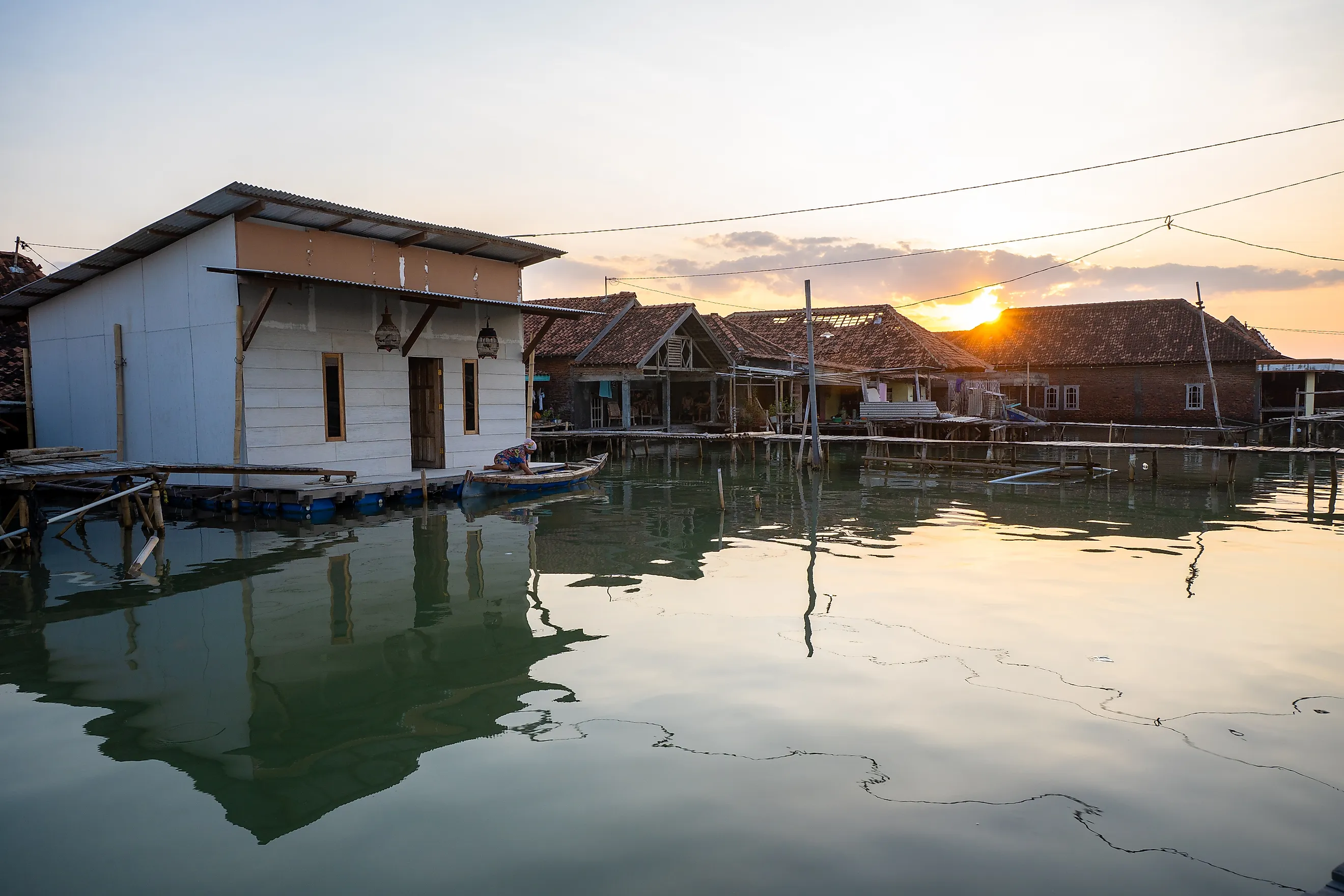
Timbulsloko has already been out of time for several years when it comes to escaping rising sea levels. In 2023, several news outlets reported that this Javan coastal village in Indonesia's Demak region is being submerged by the ocean. But more than 200 people stayed anyway. Where they once traversed rice paddies, they now have boardwalks and canoes to get by. Those who stayed also continue to modify their houses to keep the water out. At the same time, many of Timbulsloko's buildings are completely underwater, including the mosque. Eventually, all the other structures still standing will suffer the same fate. The town's coastline is being devastated by a rise in sea levels, groundwater extraction, and severe erosion. Things started getting worse in the 1990s, when mangroves were cut down to make space for fishing ponds, leaving the coastline unprotected. Recent data shows that the town is sinking at a rate of up to 20 centimeters every year. Scientists and researchers believe that while parts of northern Jakarta could fall below sea level by 2050, the villagers of Timbulsloko and other villages on the coast will not have that long. Those who still refuse to leave are continuously raising their floors and adding wooden decks. Even so, it is widely believed that the town has less than five years before it is completely destroyed by seawater.
A Fragile Future For Coastal Towns
These stories are more than just a dramatic read. It is a sobering reminder that climate change exists and is worsening in real time. The sinking streets of Timbulsloko and the eroding coastlines across Alaska, Canada, and Wales are undeniable proof of rising sea levels caused mainly by climate change. While some communities are finding some success in adapting, others have to uproot themselves and relocate. Unfortunately, in most cases, the rising tides will not be kept at bay, and people will find themselves literally losing the ground beneath their feet not too long from now.