The Hottest Capital Cities In The World
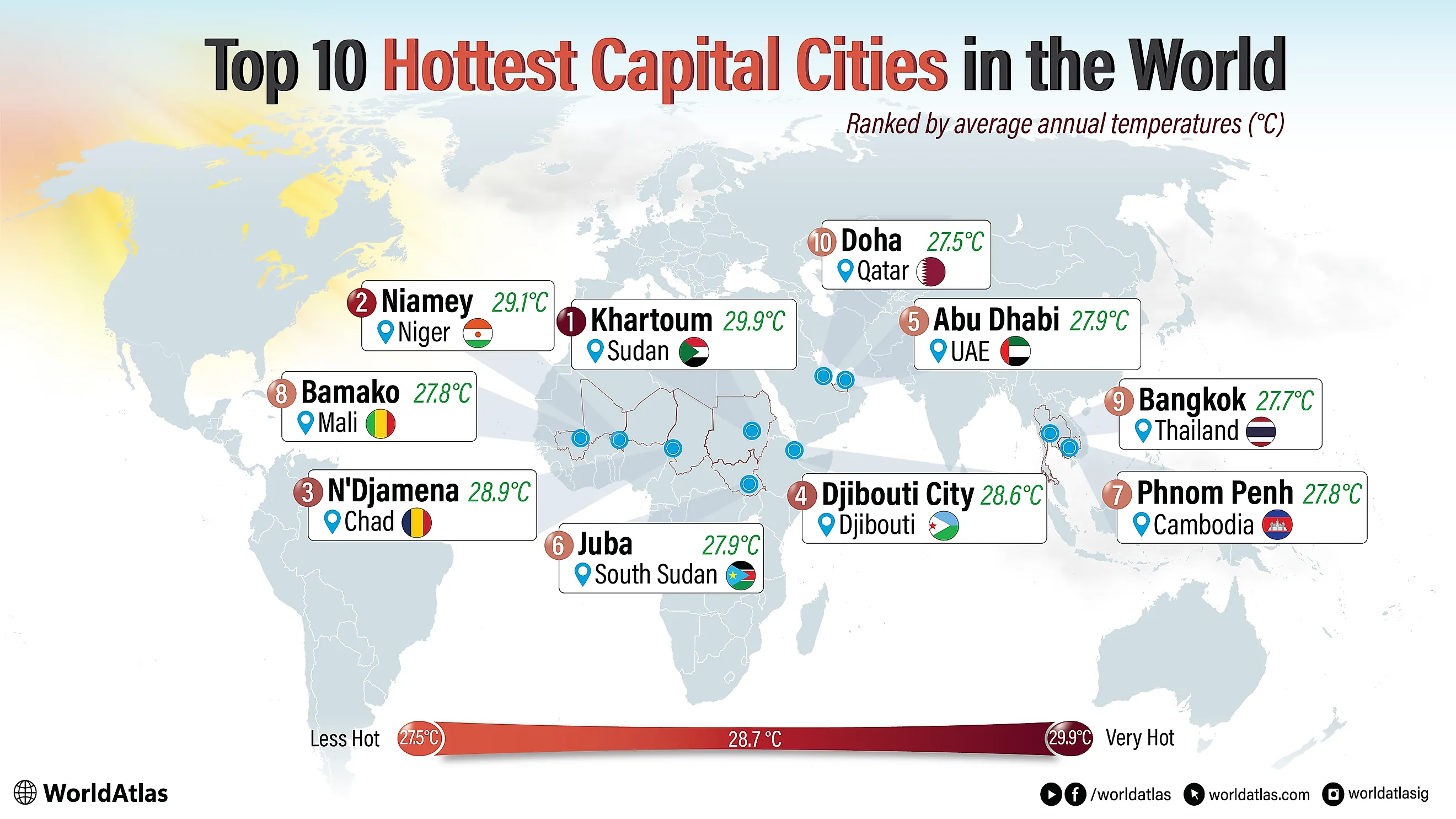
The hottest capitals experience year-round temperatures that are persistently high, with annual averages often exceeding 27 degrees Celsius (80.6 degrees Fahrenheit). Among them, Khartoum stands out as the world's hottest capital city. It has an annual mean temperature approaching 30 degrees Celsius (86 degrees Fahrenheit), making it the warmest national capital on Earth. Niamey, N’Djamena, Djibouti City, Abu Dhabi, and Juba follow, completing the list of the 5 hottest capital cities in the world.
In addition to high temperatures, many of these capitals also experience intense solar radiation, prolonged dry seasons, high humidity, or limited nighttime cooling, depending on their geographic location. This article explores the world's hottest capital cities and explains why they experience such extreme heat.
The Hottest Capital Cities In The World By Average Annual Temperature
| Rank | Capital City | Country | Average Annual Temperature |
|---|---|---|---|
| 1 | Khartoum | Sudan | 29.9°C (85.8°F) |
| 2 | Niamey | Niger | 29.1°C (84.4°F) |
| 3 | N’Djamena | Chad | 28.9°C (84.0°F) |
| 4 | Djibouti City | Djibouti | 28.6°C (83.5°F) |
| 5 | Abu Dhabi | United Arab Emirates | 27.9°C (82.2°F) |
| 6 | Juba | South Sudan | 27.9°C (82.2°F) |
| 7 | Phnom Penh | Cambodia | 27.8°C (82.0°F) |
| 8 | Bamako | Mali | 27.8°C (82.0°F) |
| 9 | Bangkok | Thailand | 27.7°C (81.9°F) |
| 10 | Doha | Qatar | 27.5°C (81.5°F) |
1. Khartoum, Sudan — 29.9°C (85.8°F)

Khartoum is the capital and largest city of Sudan, home to nearly two million people. It is also the world's hottest capital city, with an average annual temperature of 29.9°C (85.8°F). The extreme climate is due to a mix of reasons, including the city’s location in a hot desert climate, according to the Köppen Climate Classification. This climate features dry, hot weather, which is characteristic of Saharan and Sahelian desert regions. To this end, the city also gets minimal rainfall and cloud cover, with just 70 mm (2.8 inches) of precipitation a year. The dry environment further intensifies the heat, and the average monthly temperature doesn't fall below 22.7°C (72.8°F) throughout the year.
Surprisingly, even with the predominantly dry environment, Khartoum is located at the confluence of the White Nile and the Blue Nile. Thus, the city has long riverbanks stretching along its eastern, northern, and western sides. Despite sitting at the confluence of these bodies of water, the river system provides little cooling effect due to high ambient temperatures and low evaporation relief. However, it does offer a reprieve for activities like swimming and kayaking, which can help during hotter days.
2. Niamey, Niger — 29.1°C (84.4°F)

Niamey is the capital and largest city of Niger, with a population of over 1.6 million according to recent estimates. It is one of the hottest capital cities in the world, recording an average annual temperature of 29.1°C (84.4°F). The city’s extreme heat is primarily due to its location in the Sahel region of West Africa, similar to Khartoum. Here, hot desert and semi-arid climates prevail much of the year. Niamey experiences long, intensely hot dry seasons, minimal cloud cover, and minimal rainfall outside of a short monsoon period.
The city’s inland location and low latitude contribute to consistently high solar exposure, while the absence of nearby mountains or large bodies of water limits natural cooling. Daytime temperatures frequently exceed 40°C (104°F) during the hottest months, and nighttime cooling is often limited. The average temperature in the hottest month, May, is 34.3°C (93.7°F), underscoring how sustained heat defines daily life in the city.
Niamey sits along the Niger River, which provides essential water resources and some localized relief. Still, like many hot-climate capitals, the river does little to offset the overall ambient heat. Residents have adapted through architectural design, adjusted daily schedules, and relied on shaded public spaces to cope with the city’s extreme and persistent temperatures.
3. N’Djamena, Chad — 28.9 °C (84.0°F)

N’Djamena is the third-hottest capital city in the world and the capital of Chad. Located between Sudan and Niger, N’Djamena faces many of the same environmental conditions, resulting in an average annual temperature of 28.9°C (84.0°F). Its location near the edge of the Sahara Desert, coupled with its hot, semi-arid climate, leads to summer temperatures averaging 33.8°C (92.9°F) in May. Temperatures begin to drop slightly by July due to the rainy season, but the average still remains above 25°C. Additionally, the flat, open terrain in the region traps warm air, reducing natural cooling.
Along with being one of the hottest capital cities, N’Djamena is also Chad's largest city, with a population of around 800,000. The city lies at the confluence of the Chari and Logone rivers near Lake Chad, which supports agriculture and daily water use but offers little relief from the overall heat. Annual rainfall averages around 450 mm (17.7 inches), most of which falls during a short wet season, leaving long periods of dry, oppressive conditions.
4. Djibouti City, Djibouti — 28.6°C (83.5°F)

Djibouti City is the capital city of the Republic of Djibouti and the largest, home to over 70% of the country’s population. This urban hub has nearly 800,000 residents and is located in the coastal Djibouti Region on the Gulf of Tadjoura. While it has a vast coastline, Djibouti City lies in a hot desert climate (BWh), with hot, dry summers and warm winters. To this end, the city has an average annual temperature of 28.6°C (83.5°F), making it the fourth-hottest capital in the world. The temperatures remain warm for most of the year, and even the coldest month, January, averages 23.7 °C (74.6 °F). Due to the nearby Red Sea and Gulf of Aden, which also remain hot, the city is also one of the most humid capitals, with humidity levels crossing 70% in the winter months.
Located near 11° north latitude, Djibouti City sits within a zone of intense year-round solar exposure. Rainfall averages just 281 mm (11.1 inches) per year, leaving long dry periods. Daily life often shifts to early mornings and late evenings, while thick-walled buildings and shaded streets help reduce direct exposure to heat.
5. Abu Dhabi, United Arab Emirates — 27.9°C (82.2°F)

Abu Dhabi is the capital of the United Arab Emirates and is located on the southern coast of the Persian Gulf. The city lies at a low elevation and has a hot desert climate, resulting in year-round high temperatures. The average annual temperature is around 27.9°C (82.2°F), and peak averages reach as high as 35.3°C (95.5°F) during warmer months like August. Rainfall is very limited, averaging about 42 mm (1.7 inches) per year, and often falls during short winter showers.
Humidity plays a major role in the heat in Abu Dhabi. Sea surface temperatures in the Persian Gulf remain warm year-round, limiting nighttime cooling. Clear skies and intense solar radiation further raise surface temperatures. Moreover, heatwaves are common, and in extreme cases, temperatures can cross 40°C (104°F). During these times, outdoor activity during midday is often avoided. With a bustling population of over two million, urban life relies heavily on air conditioning, shaded walkways, covered transit stops, and indoor public spaces.
6. Juba, South Sudan — 27.9°C (82.2°F)

The capital and largest city of South Sudan, Juba, is the sixth-hottest capital in the world. This city of around 520,000 people has a mean annual temperature of 27.9°C (82.2°F), the same as Abu Dhabi. However, both cities have vastly different climates. As Juba is located near the equator in a tropical climate zone (Aw), it experiences hot temperatures year-round, with a pronounced wet season. Average temperatures remain relatively stable, dipping only to about 25.4°C (77.7°F) in the coolest month, August, and rising to around 31.6°C (88.9°F) in February, the hottest month. Thus, the variability is less than 7°C (13°F) around the average, indicating warm weather throughout the year.
The tropical climate is also defined by significant rainfall, with Juba receiving roughly 1,048 mm (41.3 inches) of precipitation annually. This rainfall, combined with high humidity, often pushes perceived temperatures well above the actual readings. Additionally, the city’s flat surrounding terrain limits airflow and heat dispersion, intensifying daytime heat and contributing to persistently warm nights, particularly during the wet season.
7. Phnom Penh, Cambodia — 27.8°C (82.0°F)

Phnom Penh is the seventh-hottest capital city in the world, with an average annual temperature of 27.8°C (82.0°F). It is located in southern Cambodia and is the country’s largest city, with over two million residents. The consistently warm conditions are largely due to the city’s location in a tropical monsoon climate, which brings high temperatures and humidity for most of the year, especially during the wet season. As a result, average temperatures generally remain above 26°C (78.8°F), with very little seasonal variation.
The city receives about 1,432 mm (56.4 inches) of rainfall each year, most of it during the monsoon months. While rainfall can briefly cool daytime temperatures, it also raises humidity levels, making the heat feel more intense. Phnom Penh’s low elevation and flat terrain limit natural cooling, particularly at night. Dense urban development further traps heat, leading to warm evenings and early mornings throughout much of the year.
8. Bamako, Mali — 27.8°C (82.0°F)

Bamako is the capital and largest city of Mali, with a population of over four million people. The city has an average annual temperature of 27.8°C (82.0°F), placing it among the hottest capital cities in the world. Bamako lies within a hot semi-arid steppe climate, where heat dominates most of the year. Rainfall is limited, averaging about 815 mm (32.1 inches) annually. The dry season is long and intense, with clear skies and strong sun exposure contributing to persistently high temperatures. Daytime heat often builds quickly by late morning and remains strong through the afternoon hours.
The coolest month in Bamako is August, when average temperatures drop slightly to around 25.1°C (77.2°F). Even during this period, conditions remain warm and humid. The Niger River runs through the city and provides an important water source, but it offers little cooling relief. Low tree cover and flat terrain allow heat to build during the day, while warm nights provide minimal temperature relief.
9. Bangkok, Thailand — 27.7°C (81.9°F)

Bangkok is the capital of Thailand and one of the hottest capitals in the world. This bustling metropolis, known for its tourism, sits in a tropical climate with minimal elevation above sea level. To this end, summers are hot and humid, while winters are also humid with milder temperatures. Combining these factors, the city has an average annual temperature of 27.7°C (81.9°F), with the average staying above 25°C (77°F) throughout the year. Humidity also remains above 60%, and the city gets around 1,207 mm (47.5 inches) of rainfall each year.
In addition to the hot and humid climate, Bangkok's high urban density, with skyscrapers and concrete buildings, creates an urban heat island effect. Thus, heat is trapped, making it feel much warmer than it actually is. While being one of the hottest capitals in the world, Bangkok is still home to over 11 million people according to estimates, with millions of tourists each year. Most stay indoors during the day, wear lightweight clothing, and carry fans when needed to stay cool.
10. Doha, Qatar — 27.5°C (81.5°F)

Doha is the capital and largest city of Qatar and ranks among the world's hottest capital cities. The city has an average annual temperature of 27.5°C (81.5°F), driven by its desert climate and coastal location along the Persian Gulf. Rainfall is minimal, with only about 62 mm (2.4 inches) of precipitation recorded each year. Clear skies dominate most months, allowing intense sunlight to heat the ground and urban surfaces for long stretches of the year.
Temperatures vary seasonally but remain high overall. January is the coolest month, with average temperatures around 17.7°C (63.9°F). Summer heat peaks in July, when average temperatures reach about 35.4°C (95.7°F), and daytime highs often climb even higher. Warm sea surface temperatures in the Persian Gulf increase humidity, especially during summer, and reduce nighttime cooling. As a result, evenings often remain hot and uncomfortable.
Doha is a low-lying city with little natural shade, which adds to heat buildup during the day. Rapid urban growth and dense development further intensify heat retention. More than 80 percent of Qatar’s population lives in Doha or its surrounding metropolitan area, and air-conditioned buildings, covered walkways, and limited outdoor activity during peak daylight hours heavily shape daily life.
The Hottest Capital Cities In The World
These are the ten hottest capital cities in the world, ranked by mean annual temperature. The hottest is Khartoum, Sudan, with an average temperature of 29.9°C (85.8°F), making it one of the most extreme year-round climates. Moreover, major population centers and tourist spots such as Doha and Bangkok also experience hot temperatures year-round, with some cities facing high humidity while others experience extremely dry conditions. This shows how resilient people are in using urban infrastructure and smart techniques to get through extreme weather.