Italy's 11 Best Retirement Towns Ranked
Retiring abroad usually starts with a fantasy of a cappuccino in a sunlit piazza, a slow stroll past historic buildings, and a daily view that brings the postcards to life. Italy delivers in spades, but the real concerns for anyone actually making the move are more practical. They come down to whether a hospital is nearby, whether there is a place for aging parents or a spouse who eventually needs more care than a spare bedroom can offer, and whether there is society once the honeymoon phase wears off. This list narrows down 11 Italian towns, all with populations under 50,000, that pair the obvious romance of hill towns, lakeside resorts, and whitewashed coastal villages with the unglamorous essentials of a functioning public hospital or clinic within reach, at least one staffed retirement or nursing facility, and a community life built around more than tourism. The towns run the length of the country, from the Umbrian hills to the Sicilian coast, so wherever the pull toward Italy is strongest, geographically or emotionally, you'll find a likely fit here.
1. Orvieto, Umbria

Orvieto sits on a plateau of volcanic tuff roughly 1,000 feet (300 meters) above the Umbrian countryside, with the kind of skyline view that makes new arrivals stop mid-sentence. The Orvieto Cathedral, with its striped marble facade and Luca Signorelli frescoes, anchors the main piazza. History buffs will enjoy the medieval tunnels of Orvieto Underground beneath the city, regularly open for tours. For retirees, the practical case matches the scenic one. The Ospedale Santa Maria della Stella, a full-service public hospital with an emergency department, sits on the edge of town in the Ciconia district. On the residential care side, the Residenza Protetta San Giorgio operates under Umbria's regional health authority and accepts non-self-sufficient seniors from the surrounding area. Orvieto is also a direct stop on the Rome-Florence rail line, putting Rome about 75 miles (120 km) and 70 minutes away by train, useful for touring, visiting family, or specialist appointments in the capital. The town's location in the Apennine foothills means cooler summers than the Roman lowlands, and a walkable historic core keeps daily errands manageable without a car.
2. Cortona, Tuscany

Cortona owes some of its modern fame to Under the Tuscan Sun, but the Etruscan hill town was drawing residents long before Frances Mayes bought a villa here. The MAEC (Museo dell'Accademia Etrusca), housed in the 13th-century Palazzo Casali, holds one of Tuscany's better Etruscan collections, while the Gothic church of San Domenico and the fortress of Fortezza del Girifalco above town round out an afternoon of sightseeing. Healthcare runs through the Ospedale della Fratta (Ospedale Santa Margherita), a public hospital with an emergency room located in Cortona's own municipal territory rather than a neighboring town, a genuine advantage for a hill town this size. For residential elder care, the municipally run Centro Residenziale Camilla Sernini in the Camucia district provides both day services and full residential care, and the historic Istituto Santa Caterina in the old center has operated as a home for elderly women since the early 20th century. Cortona's English-speaking expat community, drawn partly by the film's afterglow, means new arrivals are rarely the only foreigners at the weekly market. The town sits along the Apennine chain that forms the spine of the Italian Peninsula, with views stretching across the Val di Chiana on clear days.
3. Pienza, Tuscany

Pienza is tiny, home to roughly 2,000 residents, and that is very much its appeal. Pope Pius II rebuilt his birth village in the 1450s as a model Renaissance town, and UNESCO listed the entire historic center as a World Heritage Site in 1996. The Palazzo Piccolomini, the pope's residence overlooking the Val d'Orcia, and the adjoining Pienza Cathedral on Piazza Pio II are obvious stops, both within a five-minute walk of anywhere in town. What Pienza lacks in scale it makes up for in proximity to services: the RSA Caravaggio retirement and care facility operates directly within Pienza itself, a rarity for a town this small. For hospital care, residents rely on the Ospedale Valdichiana at Nottola, near Montepulciano, about 9 miles (15 km) away, a full public hospital with an emergency department that underwent a multi-year expansion completed in 2024. Community life centers on the produce and pecorino cheese market held weekly in the main piazza, a much-loved local institution. The surrounding Val d'Orcia countryside, dotted with cypress-lined roads, is protected as a UNESCO cultural landscape, which keeps development pressure on the town itself relatively low.
4. Sirmione, Lombardy

Sirmione occupies a narrow peninsula jutting into Lake Garda, Italy's largest lake, and has been a resort town since Roman times. The moated Scaliger Castle guards the peninsula's entrance, while the Roman ruins at Grotte di Catullo, spread across the tip of the point with lake views on three sides, are among the best-preserved Roman villa remains in northern Italy. Sirmione's other calling card is its thermal water: the Terme di Sirmione spa draws on naturally heated sulphurous springs that have been used for therapeutic bathing since the 19th century, a genuine draw for retirees managing joint pain or arthritis. On the healthcare side, the town has an in-town retirement facility, Villa Oceano, along with a longstanding arrangement connecting Sirmione's senior services to the larger casa di riposo in nearby Desenzano del Garda. The regional hospital, part of the Azienda Socio Sanitaria Territoriale del Garda, is in Desenzano, about 4 miles (6 km) away. Sirmione sits within Italy's broader Lake District, and the mild lake-moderated climate makes both summers and winters gentler than inland Lombardy.
5. Stresa, Piedmont

Stresa built its reputation as a Belle Époque resort on the shores of Lake Maggiore, and the town still moves at the unhurried pace that made it a favorite of Ernest Hemingway, who set part of A Farewell to Arms here. Boats leave the lakefront regularly for the Borromean Islands, with Isola Bella and its Baroque palace gardens the most visited. The Alpinia Botanical Garden, reachable by car up Mount Mottarone, offers alpine views back down over the water. Elder care within Stresa itself is handled by a long-established religious order, the Congregazione delle Suore di San Giovanni Battista, which runs a residential facility for seniors in the town center. For hospital-level care, residents use the Ospedale Castelli in Verbania, a full public hospital with an emergency department roughly 9 miles (15 km) up the lakeshore. Stresa's international profile, reinforced by an annual classical music festival each summer, means a well-established community of foreign residents, particularly British and German retirees who have wintered here for decades. The town belongs to Italy's northern Lake District, where the Alps shelter a surprisingly mild, almost Mediterranean microclimate.
6. Ostuni, Puglia

Ostuni's nickname, the White City, comes from the whitewashed limewash covering nearly every building in its hilltop old town, a tradition originally meant to reflect heat and, according to ancient local lore, discourage plague. The Ostuni Cathedral, with its unusual rose window and curved Gothic facade, sits at the highest point of the historic center, and the Museum of Preclassical Civilizations of Southern Murgia displays "Delia," a 25,000-year-old female skeleton found nearby, one of the oldest known burials in Europe. Ostuni already has a well-established foreign retiree community, particularly British and German, built up over several decades of countryside villa purchases. Healthcare improved substantially in 2025, when the town's civic hospital reopened its newly renovated emergency department and was renamed the Ospedale Papa Francesco. For residential elder care, the RSA e Centro Diurno Mediterranea, just outside town amid a working pine forest, and the RSSA Pinto Cerasino in the historic center both operate under regional accreditation. Ostuni sits about 5 miles (8 km) inland from the Adriatic coast, close enough for regular beach visits without the summer crowding of the shoreline towns themselves.
7. Alberobello, Puglia

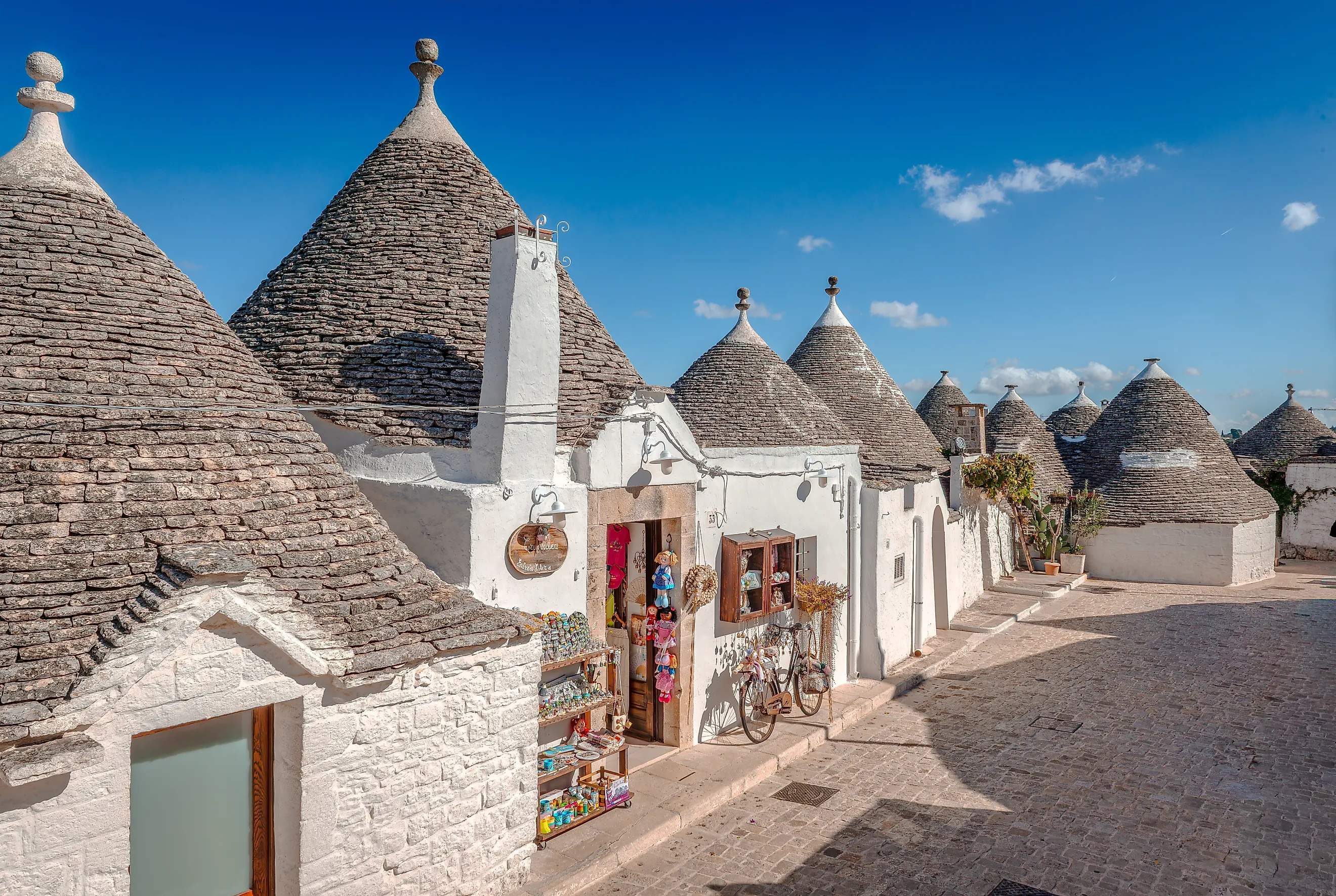
Alberobello is built almost entirely of trulli, the conical-roofed limestone houses unique to this corner of Puglia, and UNESCO listed the Rione Monti trullo district as a World Heritage Site in 1996. The Trullo Sovrano, the only two-story trullo ever built, functions as a small museum, and the trullo-style Church of Sant'Antonio, completed in 1926, is an actual working parish. For a town of roughly 10,000, Alberobello has more than one option for residential elder care within its own borders, including the centrally located Casa di Riposo Il Sogno and the Consorzio San Raffaele facility, both offering day and residential programs. There is no full hospital in Alberobello itself. The nearest, the Presidio Ospedaliero Valle d'Itria in Martina Franca, is about 8 miles (13 km) away and includes a 24-hour emergency department. Community life in Alberobello runs through the parish and the town's several trattorias, where the trullo architecture keeps interiors naturally cool through Puglia's hot summers. The town lies inland from the Adriatic Sea, in the rolling Itria Valley shared with nearby Locorotondo and Martina Franca.
8. Cefalù, Sicily

Cefalù wraps around a natural harbor beneath a dramatic limestone headland known as La Rocca, with a medieval town center that has changed very little since the Normans built its cathedral in the 12th century. The Cefalù Cathedral, with Byzantine mosaics rivaling those of Palermo's Cappella Palatina, dominates the skyline. The Lavatoio Medievale, a medieval public washhouse fed by a natural spring, and the Museo Mandralisca, home to a celebrated 15th-century portrait by Antonello da Messina, fill out a walkable afternoon. Unlike many small Sicilian towns, Cefalù has its own major hospital: the Fondazione Istituto San Raffaele Giglio, a modern, well-regarded public-private hospital with a full emergency department, sits just outside the historic center. For residential care, the Opera Pia Salvatore Genchi Collotti, a three-story facility in the old town accessible by elevator, has provided elder housing for over a century. Cefalù faces the Tyrrhenian Sea and sits within sight of Mount Etna on especially clear days, and its beach, right beside the old town walls, is walkable without a car, a welcome convenience for retirees who no longer want to drive.
9. Taormina, Sicily

Taormina sits on a clifftop terrace above the Ionian coast, with Mount Etna smoking quietly in the background from nearly every vantage point in town. The Teatro Antico di Taormina, a Greek theater later expanded by the Romans, still hosts summer performances with Etna as a natural backdrop. Corso Umberto, the pedestrianized main street, and the gardens of the Villa Comunale give the town its unhurried, café-terrace rhythm. Taormina runs its own municipal casa di riposo, a residential facility for seniors located in the Contrada Sant'Antonio district just outside the old town, and the community has organized elder day programs through several cooperative providers over the years. On the medical side, Taormina has an advantage most small Sicilian towns lack: its own public hospital, the Ospedale San Vincenzo, with a full range of specialist departments and 24-hour emergency care, located in the Contrada Sirina district. The town's cable car connects the upper old town to the Isola Bella beach below, useful for retirees who want sea access without the steep walk. Taormina's international profile, reinforced by decades as a stop for European and American travelers, means English is spoken more widely here than in most Sicilian towns this size.
10. Gaeta, Lazio

Gaeta occupies a rocky promontory on the Tyrrhenian coast roughly halfway between Rome and Naples, with a fortified old town that has served as a strategic port since Roman times. The Aragonese-Angevin Castle looms over the harbor, the Montagna Spaccata sanctuary, built around a chasm local legend attributes to the earthquake at Christ's crucifixion, draws visitors down a stairway carved into the cliff, and the long curve of Serapo Beach gives the town a genuine seaside resort feel outside the historic center. Gaeta runs an active centro sociale anziani (senior social center) through the municipality, with free membership for residents and a regular calendar of cultural and recreational programming, a meaningful hedge against the isolation that can catch up with retirees abroad. Hospital care runs through the Ospedale Dono Svizzero in nearby Formia, a 24-hour public hospital about 5 miles (8 km) away that completed a major emergency department renovation in 2024. Gaeta does not have a large dedicated retirement facility within its own borders, and prospective retirees needing residential elder care should plan on options in Formia or the wider Latina province, a gap worth weighing against the town's undeniable coastal charm.
11. Sorrento, Campania

Sorrento sits on a cliff above the Gulf of Naples, with Mount Vesuvius visible across the water and the Amalfi Coast a short drive south. Piazza Tasso, the town's social hub, connects to Via San Cesareo, Sorrento's pedestrianized main shopping street, while the 14th-century Chiostro di San Francesco offers a quiet cloister just steps from the crowds, and the Museo Correale di Terranova houses a well-regarded collection of Neapolitan paintings and decorative arts in a historic villa. Sorrento is unusual among smaller Italian towns in having its own full public hospital directly in town: the Presidio Ospedaliero Santa Maria della Misericordia, on Corso Italia, provides emergency care, internal medicine, orthopedics, and a range of other specialties. For residential elder care, the Soggiorno Sant'Antonio, run under the Archdiocese of Sorrento's pastoral health services and operating on the same site since the early 20th century, offers meals, religious services, and organized activities alongside residential care. The gardens of the Villa Comunale, perched directly above the water, house the Sorrento Lift, a pair of public elevators that drop down to the Marina Piccola waterfront in under a minute, a genuine help for residents who no longer want to manage the steep switchback stairs. Sorrento's train connection to Naples and the Circumvesuviana line make easy day trips to Pompeii or Naples without a car.
Choosing Italy's Next Chapter
No single town on this list gets everything right. The hill towns of Tuscany and Umbria offer scenery and a slower pace but sometimes mean a drive to the nearest hospital. The coastal and lake towns tend to have better in-town medical infrastructure but come with higher property costs and heavier summer tourist traffic. What all 11 share is a combination that matters more than postcard views once the move is real: a working healthcare system within reach, at least one staffed option for elder care, and a community that exists independently of the tourist season. For anyone seriously weighing a retirement in Italy, that combination, more than any single piazza or church facade, is the detail worth checking first.