Five Classic Americana Downtowns In Pennsylvania

In Indiana, Pennsylvania, a crosswalk signal on Philadelphia Street tells pedestrians when to walk in the voice of hometown actor Jimmy Stewart, courtesy of impressionist Rich Little. That's classic Americana, Pennsylvania style: a courthouse clock tower, a single-screen movie house, a diner, and blocks of brick storefronts run by locals.
Wellsboro still lights up Main Street with gas lamps. Bedford grew up on the Lincoln Highway, the first road to cross the country. Lewisburg has shown movies at its Art Deco theater since 1941, and Franklin has filled Liberty Street for Applefest every October since 1983.
Here are five downtowns worth the drive.
Indiana

On May 20, 1983, Hollywood legend Jimmy Stewart came home to Indiana to unveil a statue of himself on the lawn of the Indiana County Courthouse. It was the actor's 75th birthday, and the celebrations included a flyover by Air Force jets and a phone call from President Ronald Reagan.
Sculptor Malcolm Alexander's nine-foot bronze was not finished in time, so a fiberglass copy stood in for the ceremony, and nobody, including Stewart, seemed to have minded. A nearby sundial marks the former site of J.M. Stewart and Sons Hardware, the family store where Stewart worked as a boy and where his father, Alex, later displayed his son's Academy Award.
The Jimmy Stewart Museum on the third floor of the Indiana Public Library building is another slice of small-town Americana worth seeing. Stewart only agreed to the idea on the condition that the museum be modest in size and located downtown, where it would help local merchants.
It does a good job of explaining his Hollywood career and his service as a bomber pilot in World War II, and its 50-seat vintage theater screens his films daily. Just outside, at Ninth and Philadelphia street, is the talking crosswalk.
A few blocks east, the Old Indiana County Courthouse was dedicated in December 1870. Built of red brick and stone in the Second Empire Italianate style, with a mansard roof and a gold-leaf clock tower, it can be seen in the distance on the cover of Life magazine for its September 24, 1945 issue, behind a returning Colonel Stewart whose father had hung a "Welcome, Jim" banner from the tower.
The court held its last session there in November 1970, and the building is now the headquarters of First Commonwealth Bank.
Independent businesses along Philadelphia Street include The Coney, a restaurant and bar, The Artists Hand Gallery and Espresso Bar, which shows work by Indiana County artists, and Nap's Cucina Mia, a family-owned restaurant with a 70-year heritage.
A good time to visit is during the It's a Wonderful Life Festival, named for Stewart's 1946 film.
Wellsboro

The Wellsboro Diner has been serving meals at the corner of Main Street and East Avenue since April 1939, when it opened as Schanacker's Diner. It is a Sterling dining car number 388, built in 1938 by the J.B. Judkins Company of Merrimac, Massachusetts, and it still has its original pale green porcelain walls, arched ceiling, red stained-glass window trim, and a glass countertop that doubles as the dessert case.
It has never left the corner it was set down on, which is unusual for a diner of its vintage. The only real change came in 1994, when the back of the car was joined to an older house behind it to add a dining room.
Gas-lit lampposts line Main Street in Wellsboro, and the red neon rooftop sign of the Penn Wells Hotel is the other after-dark landmark. The four-story brick building went up in 1869 and opened as the Cone House. A fire in March 1906 took off its top floor, leaving it three stories for the next two decades.
In 1925, sixty local business leaders formed the Wellsboro Hotel Company to rescue it, and the restored hotel reopened the following year under its current name. A bus service running from New York's Waldorf-Astoria brought Groucho Marx to stay in 1928.
Next door, the Arcadia Theatre was built in 1921 for silent pictures and showed its first talkie, a film with synchornized dialogue, in 1929, said to be the first small town north of the Mason-Dixon Line to do so. It now runs new films on four screens.
Across the street, Dunham's Department Store dates to 1905 when Roy and Fannie Dunham bought into a small grocery store. Still owned and run by the Dunham family, it now fills three storefronts and includes Cafe 1905, with a furniture store and a hardware store around the corner.
Other independent downtown businesses include Pop's Culture Shoppe, which sells comic books and board games, From My Shelf Books and Gifts, and The Native Bagel.
The Green, the town square on Main Street, has a fountain with bronze figures of Wynken, Blynken, and Nod, the three children who sailed off in a wooden shoe in Eugene Field's 1889 titular poem. It was given to the town in 1938, the same year as the first Pennsylvania State Laurel Festival, which still brings a parade and craft fair to The Green each June.
Dickens of a Christmas, a Charles Dickens-inspired street market, closes Main Street to traffic on the first Saturday of December.
Bedford

The Lincoln Highway, the first automobile road to cross the United States from coast to coast, runs through Bedford as Pitt Street. The town was already old when the highway came through, starting as the British Fort Bedford in 1758.
Espy House, built in 1766, served as George Washington's headquarters in 1794, when he led troops west to put down the Whiskey Rebellion, an uprising against a federal tax on whiskey.
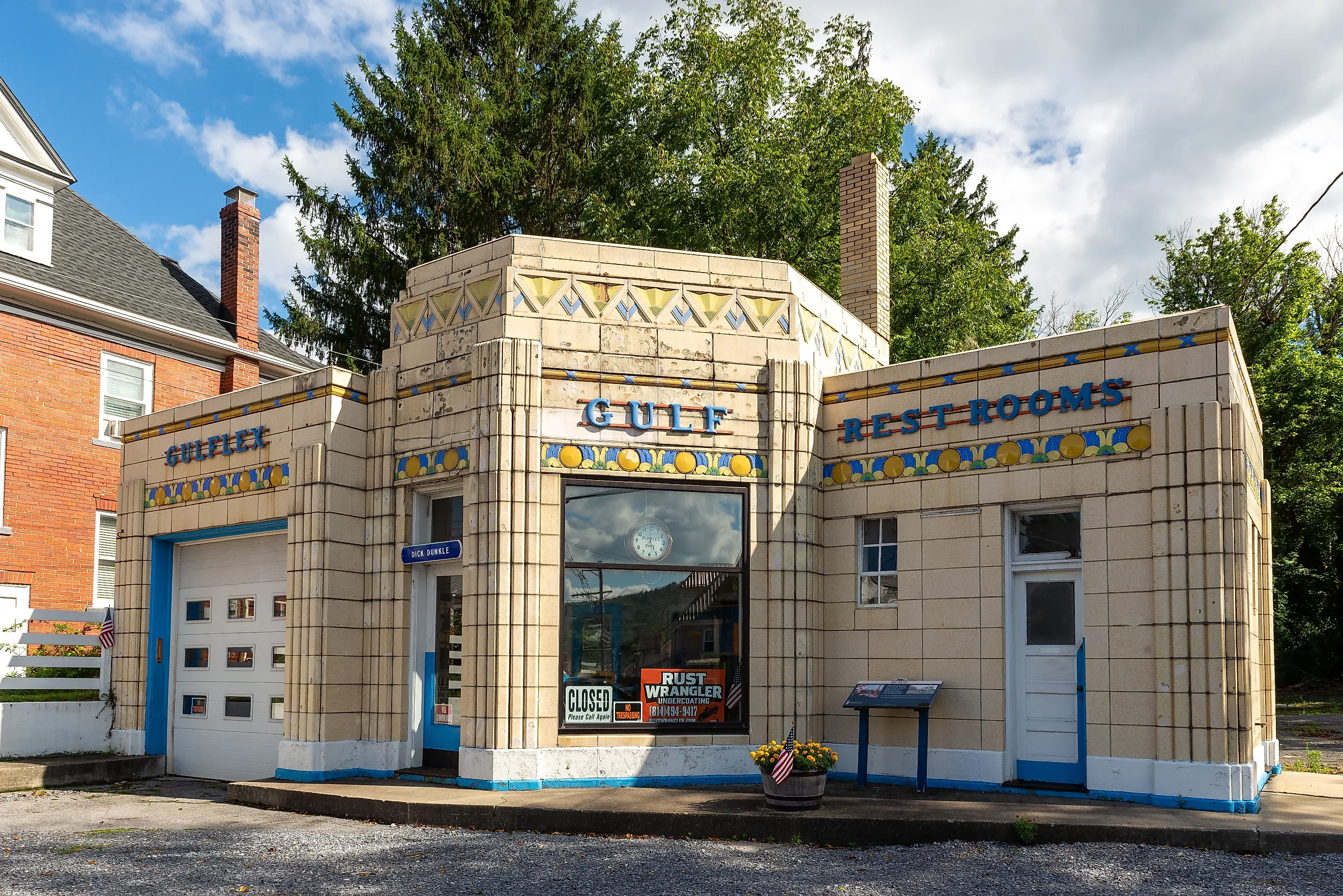
Early motorists had a few landmarks to enjoy. Dunkle's Gulf is a former Art Deco service station that opened in 1933 as Gulf Oil's showpiece between Pittsburgh and Philadelphia. It's classic Americana through and through, faced in terra-cotta tiles with stylized foliage and chevrons, and run by the Dunkle family for 90 years until 2023.
Half a mile west, at the entrance to the Bedford County Fairgrounds, the Coffee Pot is an 18-foot-tall novelty lunch stand in the shape of its name. Built in 1927, it was moved to its current site and restored in 2004, and it makes for an ideal selfie spot.
Check out Bedford Candies, which has been making chocolates in town since 1929, and the Golden Eagle Inn, around since 1794, with 16 guest rooms, a restaurant, and a pub.
The old town square on Juliana Street, just off Pitt, is also worth a look. Opened in 1829, the red brick, Greek Revival Bedford County Courthouse is one of the oldest Pennsylvania courthouses still in use. Nearby Founders Crossing occupies a former five-and-dime store from 1890, since repurposed as a market for more than 120 artisans and antique dealers.
Lewisburg

Cast-iron lampposts, each topped with three glass globes, are the first thing most people notice on Market Street in Lewisburg. The first were installed in 1912, when Market Street was paved in brick. When Westinghouse later stopped making them, the borough had a foundry in nearby Watsontown cast a mold from an original so that the replacements would match.
These attractive lampposts now line streets throughout Lewisburg's historic district. The brick storefronts behind them mostly went up between 1825 and 1870, when Lewisburg was a center of regional commerce on the West Branch of the Susquehanna River.
The exception is the Campus Theatre, the town's only Art Deco building. It opened on January 17, 1941 with Jack Benny and Fred Allen in Love Thy Neighbor, and its orange glazed terra-cotta façade with its blue bison relief was designed to reflect the colors and mascot of Bucknell University, whose campus is less than a mile away.
Built by the Stiefel brothers to a design by Philadelphia theater architect David Supowitz, it stayed in the family until 2001, when a Bucknell film professor bought it and turned it over to a nonprofit. The university bought the building in 2006 and a $2.5 million restoration followed in 2011 where it remains a single-screen cinema, run largely by volunteers.
Independent businesses on and around Market Street include Mondragon Books, Brushstrokes, an art gallery and art supply store, Elizabeth's An American Bistro, Brendan's Towne Tavern, and the Bull Run Tap House.
The Lewisburg Hotel, in business since 1834, is presently being renovated by its new owners.
Franklin

When oil was struck at nearby Titusville in 1859, the money that followed replaced Franklin's wooden storefronts with brick ones. It also financed the Venango County Courthouse, an Italianate building put up on Liberty Street between 1867 and 1869 to a design by the Philadelphia firm of Sloan & Hutton, its two uneven towers built to hold a bell and a clock.
The town's original street plan is older still. Conducted by Andrew Ellicott, who completed the survey of Washington, D.C., the 1795 survey established Liberty Street as the main thoroughfare, along with two public greens, now Bandstand Park and Fountain Park.
The American Planning Association named Liberty Street one of its 'Great Streets in America' in 2010, and a façade grant program the city started in 1980 has restored more than 60 storefronts, and six alleys have been turned into pedestrian walkways.
The oil rush brought an unlikely resident, too. In the spring of 1864, John Wilkes Booth, the actor who would go on to shoot Abraham Lincoln, took part-time lodgings in a Buffalo Street boarding house while running an oil venture on the Allegheny.
Two of the street's attractions exist because residents bought empty stores. The Barrow-Civic Theatre began as the Kayton Theater in 1946 and had become an out-of-business sporting goods store by the time the Franklin Civic Operetta Association bought it in 1989, and hundreds of volunteers helped turn it into a 500-seat playhouse.
DeBence Antique Music World, also on Liberty Street, opened in 1994 after a volunteer committee raised $1.2 million to keep Jake and Elizabeth DeBence's collection in town.
Liberty Street's independent businesses include Trails to Ales Brewery, set in a 19th-century brick building with its original tin ceiling. Iron Furnace Coffee, which contains a record shop, the restaurants Bella Cucina and Leonardo's, and The Olive Vault.
Applefest, started by the Franklin Area Chamber of Commerce in 1983, takes over Liberty Street and both parks on the first weekend of October, brings in more than 100,000 visitors, and ends with an antique and classic car show.
Five Americana Downtowns To Visit in PA
All five of these Pennsylvania towns are county seats, which goes a long way to explaining why their downtowns have lasted. A courthouse brings lawyers, clerks, and jurors to the same few blocks every weekday, and the diners, hotels, and theaters that opened to serve them are all still there.
What makes them so Americana is the fact that they're still used for what they were built for.