10 Northern California Towns With A Slower Pace Of Life
The gold ran out, the trains stopped pushing, the mills went quiet, and the towns stayed. That is the thread running through Northern California's smallest places. Each one boomed for a reason that has long since faded, and what remains is a Main Street built for a crowd that no longer arrives. The redwood coast still smells of salt and sawdust, the Sierra foothills still keep their 1850s brick fronts, and the Cascade rail towns still hear a whistle come through the canyon at night. These ten California towns trade the rush they were built on for the slower life that outlasted it.
Mendocino

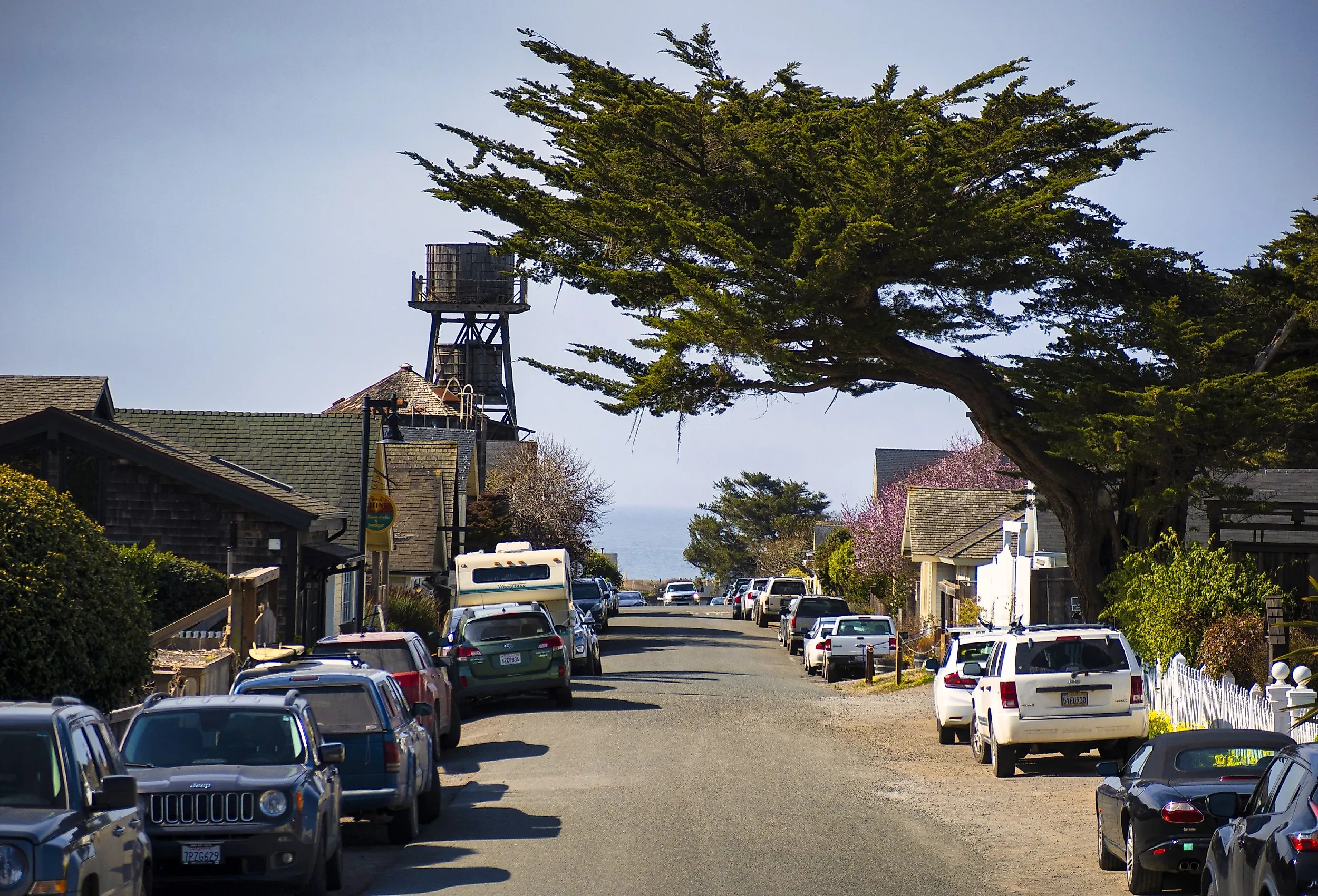
The white clapboard and steep gables on the headland look transplanted from a Maine fishing village, and that is no accident. Mendocino was settled in the 1850s largely by New Englanders who came west for the redwood timber and built the only town they knew how to build. Hollywood noticed the resemblance long ago and has used the village to stand in for the East Coast in film after film, including the long run of Murder, She Wrote. The water tower silhouettes and saltbox cottages are the genuine article, not a set.
Mendocino Headlands State Park wraps the village on three sides, with footpaths along the bluffs where gray whales pass close to shore on their way through the Pacific in winter and spring. A few miles south at Van Damme State Park stands the pygmy forest, where poor, acidic soil has dwarfed mature cypress and pine to waist height, some of them more than a century old. Back in town, the blocks fill with galleries, bookshops, and the Mendocino Chocolate Company, and a walk from one end to the other takes about ten minutes.
Ferndale

Dairy money built Ferndale. Scandinavian and Swiss-Italian farmers grew prosperous on the rich bottomland of the Eel River delta in the late 1800s, and they spent their profits on the ornate Victorian storefronts and homes that locals nicknamed "butterfat palaces." The whole main street survived, which is why Ferndale is a state historic landmark and why the town reads like a preserved snapshot of 1890s Humboldt County.
The Golden Gait Mercantile still operates as an old-fashioned general store, its shelves stocked the way they were generations ago. Two blocks off Main Street, Russ Park protects a hundred acres of forest and bird habitat on a ridge above town, with trails that climb into second-growth redwoods. The Pacific beaches at the mouth of the Eel sit a short drive west, and the Lost Coast headlands begin just beyond, which leaves Ferndale poised between farm country, forest, and shoreline.
Arcata

A university keeps Arcata younger and more restless than its size suggests. Cal Poly Humboldt sits on the hill above the central plaza, and its students give the redwood-curtain town a bookish, activist streak that shows up in the cafes and co-ops around the square. The Arcata Plaza anchors the grid, ringed by 19th-century commercial buildings that now hold restaurants and shops rather than the saloons and outfitters of the lumber era.
The town's most unusual feature is the Arcata Marsh and Wildlife Sanctuary, a wastewater-treatment system rebuilt as a working wetland in the late 1970s, now a stop on the Pacific Flyway where birders log hundreds of species. The Arcata Community Forest, the first city-owned forest in the country, rises just behind downtown with miles of trail through the redwoods. For something stranger, Cafe Mokka runs a set of private Finnish-style hot tubs and saunas in a garden near the plaza, a holdover from the town's countercultural decades.
Weaverville

The oddest detail in Weaverville is the spiral staircases. Several of the brick buildings on Main Street wear ornate exterior iron stairways that curl from the sidewalk to the second floor, a solution from the 1860s for buildings whose upper and lower stories had different owners. The town held more than 10,000 people at the height of the Gold Rush and now holds around 3,600, the seat of a Trinity County so rural it has no incorporated cities and, famously, no traffic signals at all.
Weaverville's signal piece of history is the Joss House, a Taoist temple left by the thousands of Chinese miners who worked the surrounding diggings. The current building dates to 1874, raised after fire destroyed its predecessors, and it is the oldest continuously used Chinese temple in California, complete with carved altars and the artifacts of a community most mining towns simply erased. The J.J. Jackson Museum next door keeps the stamp mills and blacksmith tools, while the Trinity Alps Wilderness, the state's second largest, begins at the edge of town for hikers heading up toward its lakes.
Mount Shasta

The volcano runs the town. The 14,179-foot peak rises behind the post office and the high school football field, close enough that it sets the light and the weather, and despite the city's modest 3,600-foot elevation it can pull down nearly 100 inches of snow in a winter. The settlement grew up as a stage and rail stop called Sisson in the 1880s, took the mountain's name in the 1920s, and has organized itself around the peak ever since.
That gravitational pull is partly spiritual. For more than a century the mountain has drawn seekers convinced it shelters a hidden civilization, and the result is a downtown where metaphysical bookshops sit between hardware stores and climbers share cafe tables with people in town for a retreat. The Sisson Museum, housed in the old fish hatchery, lays out the area's logging and mountaineering past, and Sisson Meadow gives a quiet green walk a block off the main street. Trailheads for the climb up Shasta start just outside town for those who want the mountain up close.
Dunsmuir

Dunsmuir exists because steam engines could not climb the grade alone. The Central Pacific reached this narrow stretch of the upper Sacramento River canyon in the 1880s and based its helper locomotives here, the engines that pushed northbound trains over the mountains, so the settlement was first called Pusher. A visiting Canadian coal baron named Alexander Dunsmuir offered the town a brass fountain if it would take his name instead; it agreed, the fountain still stands, and he reportedly never came back.
When Interstate 5 bypassed the commercial core in 1961, it froze the downtown in its 1920s form, which is much of the appeal now. The town leans on its water, snowmelt filtered through Shasta's volcanic rock and clean enough that the slogan is "Home of the Best Water on Earth." Just north of town, a short trail leads behind Hedge Creek Falls into a lava-rock alcove framing a view of Mount Shasta. The Amtrak Coast Starlight still stops here, the only stop in the county, and freight trains still work the canyon, which is exactly what the railfans come to hear.
Nevada City

Broad Street is the draw, a National Historic Landmark district of 19th-century buildings climbing a Sierra foothill slope, gas lamps and balconied facades intact from the days when this was one of the richest hydraulic-mining centers in the state. The hard-rock money is long gone, but the town kept its architecture and added an arts scene dense for its size, with a restored 1860s theater, music venues, and a calendar of festivals that fills the narrow streets.
The South Yuba River runs just below town, with swimming holes and the trails of South Yuba River State Park, and the Tahoe National Forest spreads east toward the crest. Down on the main grid, the storefronts hold galleries, bookshops, and farm-to-table kitchens, and The Stone House, a stout 1857 building of locally quarried rock, anchors the downtown as both a piece of mining-era construction and a working event and dining space.
Sutter Creek

Sutter Creek began as a single tent. Miners pitched it near the creek so they would have somewhere dry to gather on rainy Sundays when they could not make it to Jackson or Drytown, and the camp that grew around it eventually took the name of John Sutter, the landholder whose Coloma sawmill had set off the whole Gold Rush. Leland Stanford got his start here too, sinking money into the local Lincoln Mine that nearly broke him before it struck the lode that funded his railroad fortune.
The balconied Main Street that Sunset magazine once called the prettiest in the state survived because the deep-rock mines kept the town alive into the 1940s. The standout is the Knight Foundry, built in 1873 and the last water-powered foundry and machine shop in the country, its belt-driven machinery still in place and running on demonstration days. The Monteverde Store, opened in 1896 and preserved as a museum with its original stock on the shelves, shows what a Gold Country general store actually carried.
Murphys

The Murphys Historic Hotel has hosted guests since 1856, and its registers carry names like Mark Twain and Ulysses Grant from the years when this Calaveras County camp was a stop on the way to the big trees. Today the town has reinvented itself as a wine destination, the tasting rooms of the Sierra Foothills appellation lining the same Main Street where miners once spent their gold, a quieter and cheaper alternative to the valley floors to the west.
The setting still does the heavy lifting. Calaveras Big Trees State Park, a short drive up the highway, protects two groves of giant sequoias, including the stump of the "Discovery Tree" that first brought the species to wide attention in the 1850s. Closer in, Mercer Caverns drops visitors below the foothills on guided walks past stalactites and flowstone, a cool limestone counterweight to an afternoon spent among the tasting rooms.
Calistoga

Calistoga was built on hot water, not wine. The geothermal springs at the head of the Napa Valley drew a resort developer in the 1860s who meant it to be a spa town, and that identity has held even as vineyards took over the valley below. The volcanic-ash mud baths at places like Dr. Wilkinson's and the mineral pools at Indian Springs are the genuine draw here, the slow, soak-in-the-morning rhythm that separates the north end of the valley from the busier towns south of it.
The geology keeps surfacing. The Petrified Forest west of town preserves redwoods turned to stone by a volcanic eruption roughly three million years ago, and the Old Faithful Geyser of California erupts on a regular schedule nearby, both reminders of the heat still close beneath the surface. The wineries are here too, the Tuscan-style castle of Castello di Amorosa among them, but in Calistoga they share the bill with the springs rather than running the whole show.
The Towns the Boom Left Behind
What links a redwood-coast dairy town, a Trinity County temple, and a Sierra foundry is the shape of their histories: a fast rise on timber or gold or steam, then a long settling once the reason for the rush moved on. The quiet in these places is not a marketing pose but the actual aftermath of an economy that left, and the towns that adapted, to fishing, to wine, to spring water, to simply preserving what they had, are the ones still standing on their original streets. They reward the visitor willing to match their pace rather than push against it.