9 Offbeat Florida Towns To Visit
In Key West, the Fort East Martello Museum keeps Robert the Doll sealed behind glass, the 1904 toy blamed for decades of bad luck and often named as the model for Chucky. Up on the Gulf coast, Crystal River fills with manatees on the first cold snap of winter. Tarpon Springs still sends sponge boats out from its Greek docks, and a collapsed sinkhole outside Williston hides a spring you can dive year round. None of these nine towns leads with a theme park. Each is built around a single strange thing instead, the kind of detail that defines a place far more than a beach ever could.
St. Augustine

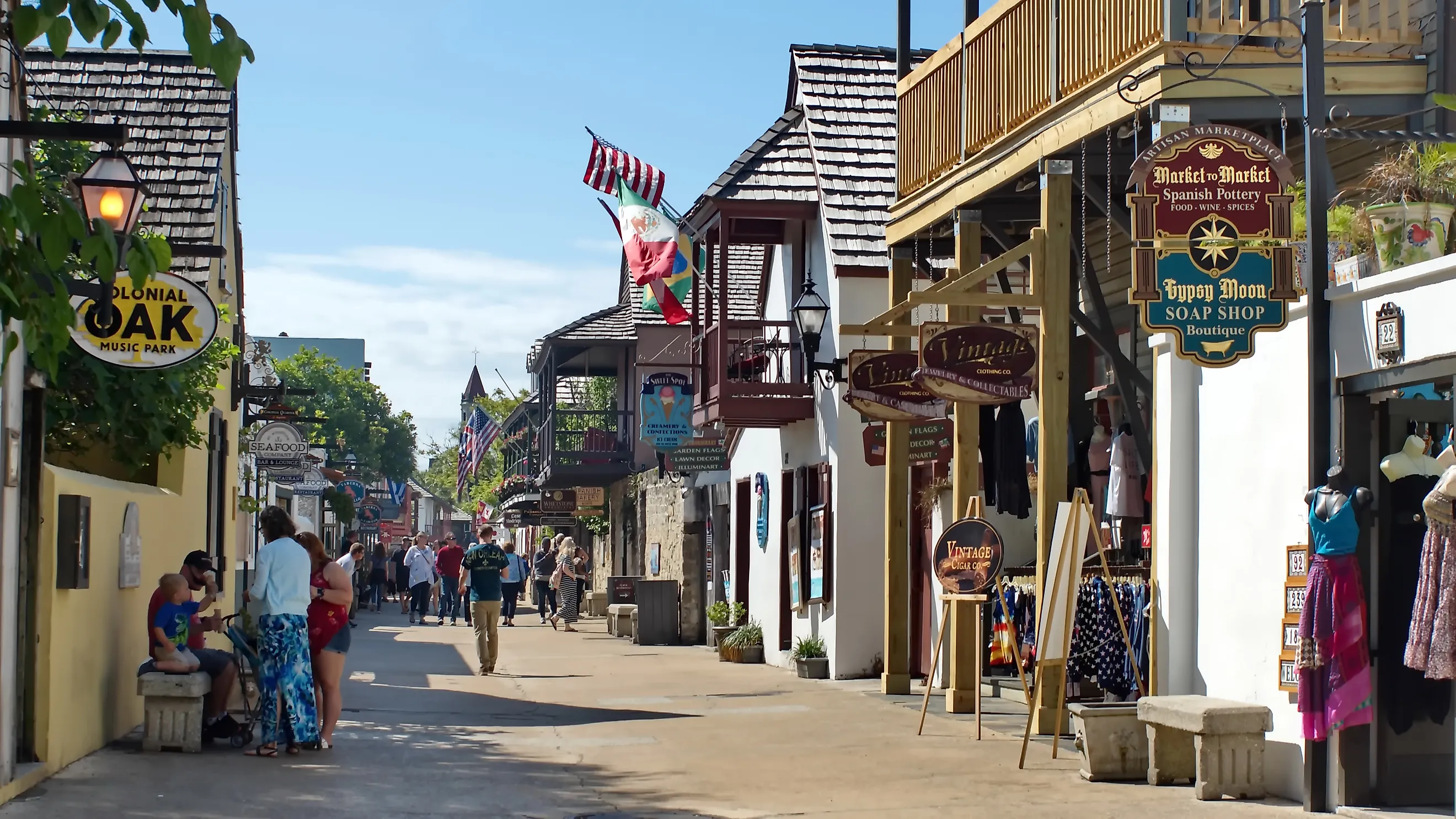
Pedro Menéndez de Avilés came ashore here on September 8, 1565, which makes St. Augustine the oldest continuously occupied European-founded settlement in what is now the continental United States. The Spanish forts get the headlines, but the town has quietly become a capital of the macabre. The St. Augustine Pirate & Treasure Museum on Castillo Drive displays Captain Thomas Tew's treasure chest and one of the few authentic Jolly Roger flags left anywhere. A few blocks over on St. George Street, the Medieval Torture Museum lays out reconstructed execution devices in unsettling detail. The former Ponce de Leon Hotel, built in the 1880s by Standard Oil magnate Henry Flagler and now the centerpiece of Flagler College, turns up on most local ghost tours, as do the Old Jail and the Spanish Military Hospital, which both run lantern walks after dark.
Crystal River

Every winter, hundreds of West Indian manatees crowd into the 72-degree spring water around Crystal River, one of the largest cold-weather gatherings of the animals anywhere in the country. They arrive when the Gulf of Mexico chills, roughly November through March, and pack into Three Sisters Springs inside the Crystal River National Wildlife Refuge, where a boardwalk rings the pool and the only way into the water beside them is to swim in from the bay, usually on a guided snorkel trip. This is the one place in the United States where swimming with wild manatees is federally allowed. Bird's Underwater on Kings Bay Drive is one of the longest-running manatee tour operators in town. Crystal River holds something far older, too: the Crystal River Archaeological State Park preserves a pre-Columbian ceremonial and burial complex that stayed in use for roughly 1,600 years, beginning around 500 BCE.
Tarpon Springs

In 1905, a Greek immigrant named John Cocoris brought deep-water sponge-diving methods to Tarpon Springs and began recruiting divers from the Dodecanese Islands, and the town has organized itself around that trade ever since. The Sponge Docks along Dodecanese Boulevard still hold working boats, sponge shops, and Greek bakeries, and the town is often called the most Greek place in America, with more residents of Greek descent per capita than any other US city. St. Nicholas Greek Orthodox Cathedral, finished in 1943 and modeled on Hagia Sophia in Constantinople, anchors that community. Every January 6 it leads the largest Epiphany celebration in the Western Hemisphere, when an archbishop tosses a wooden cross into Spring Bayou and a crowd of teenage boys dives to retrieve it. The custom has repeated here since 1906.
Williston

A wooden stairway drops through a natural limestone arch into Devil's Den, a prehistoric spring at the bottom of a collapsed karst sinkhole just outside Williston. Divers and snorkelers come for the clear water, the ancient fish fossils set into the rock, and the shaft of light that falls through the opening overhead. Nearby, Blue Grotto is one of the largest clear-water diving caverns in the state, dropping to about 100 feet, with an air bell partway down where divers can surface and talk inside the cave. On the surface, Cedar Lakes Woods and Gardens fills a former limestone quarry with koi ponds, footbridges, and terraced paths across about 20 acres.
Key West

Key West marks the end of the road, the southernmost incorporated city in the continental United States. Its strangest resident lives at the Fort East Martello Museum: Robert the Doll, the sailor-suited toy given to artist Robert Eugene Otto around 1904 and long blamed for a trail of misfortune and frequently cited as the inspiration for the Chucky films, a link that has never actually been confirmed. The Hemingway Home and Museum on Whitehead Street preserves the 1851 house where Ernest Hemingway wrote "To Have and Have Not" and "The Snows of Kilimanjaro," and where around 60 cats still roam, many of them six-toed descendants of his own. At the corner of Whitehead and South streets, the Southernmost Point buoy marks the spot 90 miles from Cuba, usually with a line of people waiting to photograph it.
Estero

On New Year's Day 1894, a physician named Cyrus Teed led an advance party of followers out of Chicago to the banks of the Estero River south of Fort Myers, where he meant to build a "New Jerusalem" for ten million people. Teed, who renamed himself Koresh, taught that the entire universe sits inside a hollow Earth and that humanity lives on its concave inner surface, a doctrine he called Cellular Cosmogony. His Koreshan Unity practiced communal living and celibacy, ran its own bakery, sawmill, and printing house, and was governed largely by a council of seven women. In 1897, members even ran a long surveying device called the rectilineator along the beach at Naples to "prove" the curve of the inner Earth. The colony, which never grew past about 250 members, faded after Teed died in 1908, and its last four members deeded the land to the state in 1961. Today the Koreshan State Park in Estero preserves eleven of the original buildings, an art hall holding a model of their inside-out universe, and a quiet trail along the river.
Dade City

Just north of Tampa, Dade City keeps a field of decommissioned Volkswagens, a salvage yard where Beetles, Buses, Karmann Ghias, and Things sit in rows and draw VW restorers hunting for parts. The Pioneer Florida Museum and Village fills out the town's past with a 19th-century Methodist church, a one-room schoolhouse, a working blacksmith shop, and an old train depot moved onto the grounds. Come October, Scream-A-Geddon turns a site just outside town into one of the state's biggest haunted attractions, with several themed haunted houses and an outdoor scare zone.
DeFuniak Springs

DeFuniak Springs grew up around a lake that is almost perfectly round. Lake DeFuniak, about 40 acres of spring-fed water at the center of the Panhandle town, is promoted locally as one of only two naturally circular lakes in the world, a claim that owes more to civic pride than to geology, and Circle Drive loops the entire shoreline past roughly 200 historic homes. The town became a cultural hub in 1885, when the Florida Chautauqua Assembly chose it as a winter home and filled the lakeshore with lectures, concerts, and visiting speakers for the next forty years. The Walton-DeFuniak Library, open since 1887, is the oldest library in Florida still operating in its original building, and it keeps an unlikely collection of European weapons and armor, including medieval maces and pikes, assembled in Scotland in the late 1800s by a professor at the local Palmer College. The restored Chautauqua Hall of Brotherhood and the old L&N railroad depot, now the county heritage museum, round out the historic district.
Siesta Key

The sand on Siesta Beach is almost pure quartz, about 99 percent, carried down off the Appalachian Mountains over millions of years, and it stays cool underfoot even on the hottest afternoons. That sand has put the beach at the top of Dr. Beach's national rankings more than once. Every November, the Crystal Classic draws master sand sculptors from around the world to build enormous works out of it. Behind the public beach, Siesta Key Village keeps a walkable cluster of shops and restaurants, and on Sunday evenings a drum circle has gathered near the water since the late 1990s, still pulling a crowd at sunset.
Built Around One Strange Thing
What these nine towns share is a refusal to be ordinary. Some of the strangeness is geological: the quartz sand at Siesta Key, the collapsed sinkhole at Williston, the round lake at DeFuniak Springs. Some of it is biological, like the manatees that take over Crystal River each winter. The rest is human: the Spanish forts and ghost tours of St. Augustine, the Greek sponge divers of Tarpon Springs, the hollow-Earth utopians who settled Estero, the Volkswagen graveyard at Dade City, and the haunted doll behind glass in Key West. Theme parks and resort beaches will always be the state's headline act. These towns are the stranger story underneath.