8 Switzerland Towns Where Time Stands Still
Switzerland’s alpine mountain ranges have preserved towns whose historic centers changed gradually over centuries rather than through rapid redevelopment. The same mountains that reinforced Switzerland’s neutrality and separation from much of Europe during both world wars have also protected many communities from large-scale transformation.
This terrain has allowed traditional architecture, such as the medieval city ramparts of Murten, local customs, like the cheesemaking process of Gruyères' namesake cheese, and centuries-old car-free streetscapes of Zermatt to remain central to daily life. In these eight Swiss towns, time stands still.
Gruyères

Gruyères is a medieval village of the Gruyère region in the foothills of the Swiss Alps. According to local legend, it was founded in 400 B.C. by the Vandal King Gruerius, who saw a crane fly over the red evening sky and decided that would be the location he would build his town. The coat of arms of Gruyères depicts a crane on a red background. The region of Gruyère has been known for its cheese production since the 12th century.
La Masion du Gruyère is located at the foot of the village. Every morning, visitors can observe cheesemakers at work, heating milk in the copper kettle, stirring it, and shaping it into loaves. At the end of the observations, visitors are given the chance to taste Gruyère cheeses aged six, eight, and 10 months.
The Château de Gruyères is a medieval castle that has stood since the 13th century. The castle was once home to the leading noble families in western Switzerland in the Middle Ages, the counts of Gruyère. It now operates as a museum, covering eight centuries of regional architecture, history, and culture. Lake Gruyère, the longest reservoir in Switzerland, is accessible from Gruyères, creating many outdoor opportunities such as hiking and water sports.
Grindelwald

Grindelwald is one of Switzerland’s premier mountaineering, summer, and winter resorts. It began to gain popularity when the first hotel, the Schwarzer Adler, opened in 1820. Wealthy travelers from Britain, Germany, and France arrived by train and horse-drawn carriages with the intention of climbing popular mountains like the Eiger.
But you do not have to be a mountaineer to enjoy Grindelwald. The Firstbahn takes passengers on a cable car ride 2,168 meters above sea level to Grindelwald-First, a mountain summit most popular in the summers and winters. At the top, visitors can walk 45 meters out from the mountain on a cliff walk, whizz down the mountain from an 800-meter-long zipline, and ski or snowboard in the winter months. From Grindelwald-First, the hike to Lake Bachalpsee takes only an hour. The lake's clear waters reflect the imposing mountain in the distance.
Grindelwald is home to the highest railway station in Europe, Jungfraujoch, at 3,454 meters above sea level. In addition to panoramic mountain views and permanently glaciated terrain, there are several stores, such as Lindt Swiss Chocolate Heaven, which offers a wide range of chocolates, customizable gifts, and other chocolate products.
Chur

As Switzerland’s oldest town, Chur’s history spans back 13,000 years, with evidence of permanent settlements in the Bronze and Iron ages. In the Middle Ages, Chur was ruled by its bishops, who became princes of the Holy Roman Empire in 1170. The Rätisches Museum provides further insight into Chur’s expansive history, highlighting it through archaeological, cultural, and folk art objects spanning prehistoric times to the early 20th century.
The Obertor, a tower section of the medieval fortification of Chur, serves as both a historical landmark and the town's entrance. It stands out from the adjoining terraced buildings with its lighter exterior and archway paintings that depict old views of the town. The Guildhall of the Vine Growers is a 15th-century restaurant housed inside a former guild house for local winemakers. Patrons can enjoy authentic Swiss cuisine on two rooftop terraces during the summer and a small lounge with a fireplace in the winter.
Zermatt

Zermatt’s biggest lure was once its biggest heel. For centuries, Zermatt was a remote, agrarian settlement. Local inhabitants primarily engaged in farming, herding, and basic trade, with the main economies being subsistence agriculture and pastoralism. However, life was challenged due to the harsh alpine environment. In the mid-19th century, when alpinism was popularized, many climbers flocked towards the unclimbed peaks of the Alps, including the Matterhorn, which frames Zermatt’s skyline.
Avid hikers can get closer views of the Matterhorn by trekking along the Matterhorn Glacier Trail, which takes people along the rocky glacial landscape. Learn more about the deeper context of the Matterhorn, including its first ascent, and the development of Zermatt from a village of mountain farmers to an alpine resort at the Matterhorn Museum.
Whymper Stube is centrally located in town, serving traditional Swiss cuisine like fondue and raclette, which is paired with regional wines. The restaurant is named after the first ascent of the Matterhorn led by Edward Whymper.
Murten

Murten’s origins date back to the Middle Ages, when it was an important border town between various territories. It formed alliances with nearby towns such as Freiburg and Bern. Murten played a crucial role in the Burgundian Wars, particularly during the Battle of Murten, when the town was successfully defended. This can partially be attributed to the town’s ring wall, which gives it a rectangular layout and is still standing today. From the fortified walls, visitors can take in views of the town and of Lake Murten.
Due to Lake Murten’s shallow depth, the water warms quickly in the summer, making the many beaches and campsites popular between spring and autumn. Aside from swimming and water sports, the generally flat terrain surrounding the lake is suitable for cycling and hiking.
The Museum of Murten is one of the oldest museums in the canton of Fribourg. It has been housed inside the old town mill since 1978. Exhibits document 6,000 years of history, covering topics such as life and work in medieval Murten, Murten under the rule of Bern and Fribourg, and the lead-up to modern Murten. Sample Nidelkuchen, a traditional cream cake, a signature Murten delicacy, available at local bakeries such as Aebersold Bakery.
Stein am Rhein

Stein am Rhein began as a small fishing village at the lower end of Lake Constance. The town developed into a commercial center in the 11th century when Emperor Henry II moved St. George’s Abbey from its original location in Singen to Stein am Rhein. He granted the abbots extensive rights over trade in Stein am Rhein, which led to the town’s economic growth by the 15th century.
St. George’s Abbey still stands today and is one of the best-preserved medieval monastery complexes in Switzerland. It now operates as a museum, offering tours of the former monks' quarters, the abbots' houses, and a garden planted with medicinal plants. For coffee paired with French and Italian cuisine, visit Bistrot Tavolino, open for breakfast, lunch, and dinner.
Stein am Rhein is a useful stop on a Rhine-region itinerary that can include the Rhine Falls near Schaffhausen. At the falls, boats from the northern shore take visitors to the middle rock, where they can disembark and ascend stairs to a viewing platform where several hundred cubic meters of water flow over the falls every second.
Thun

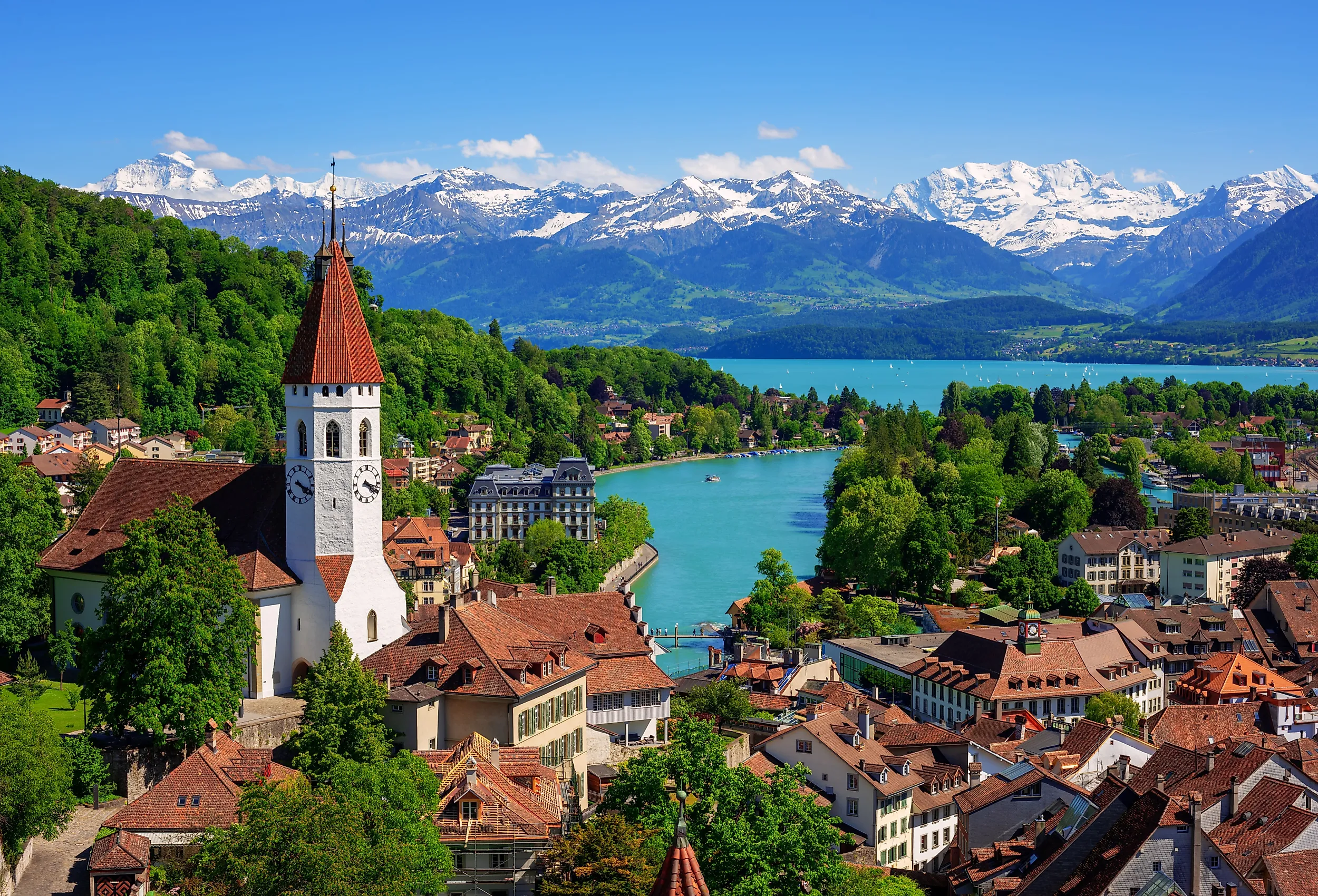
Evidence of the first settlement of Thun dates back to the Neolithic Period. The town played a significant role as the primary gateway to the Bernese Oberland until a century ago, when Interlaken was created by railroads. In the 5,000 years Thun has been inhabited, it has been conquered by the Romans, Burgundians, and Germans. However, the town is defined more by its medieval German period than anything else. This is evident from the 12th-century Thun Castle perched atop a hill above Lake Thun. The castle operates as a museum that houses one of the best-preserved representative halls of the High Middle Ages in Switzerland.
Down at Lake Thun, visitors can swim, recreate on the water, and enjoy the atmosphere reminiscent of the Mediterranean. At the Kunstmuseum Thun, there are over 7,000 works of Swiss classic modern art, Swiss pop art works, and pieces by regional artists. Additionally, the museum hosts an exhibition program of four to five temporary exhibits that highlight new themes and trends of contemporary art.
Solothurn

Solothurn originated as a Celtic and Roman stronghold, as it was situated in a strategic position at the approach to the Rhine River from the southwest. The dukes of Zähringen gained jurisdiction of the town in 1127 and grew around the remains of the Roman fort and a house of secular canons. When the last duke of Zähringen died in 1218, Solothurn became a free imperial city, taking the canons under its own protection.
The Cathedral of St. Ursus is a church built between 1762 and 1773. The cathedral’s tower stands 66 meters high, with the top accessible via 249 steps, offering those who climb it distinct views of the town and the countryside extending into the horizon. Museum Altes Zeughaus Solothurn is both a museum and a historic building. The old armory comprises four floors of weapons, military equipment, and army supplies, as well as 400 suits of armor.
Zeitglockenturm is the oldest landmark in Solothurn, standing in the center of Old Town since the 13th century. Unlike standard town clocks, the Zeitglockenturm is an astronomical clock that not only displays the time but also the day, month, and year.
Preserved History in These Swiss Towns
The Alps may define the landscape of Switzerland, but these towns show how deeply the country’s history is woven into everyday life. Between alpine lakes, mountain passes, and preserved old quarters, each town reflects a different part of Switzerland’s cultural and historical development. In Gruyères, traditions tied to cheesemaking still shape the town centuries later, while places like Chur retain medieval streets and fortifications that connect the present to the past.
Together, these eight towns demonstrate how Switzerland’s geography helped preserve regional identities and historic character over time, creating places where history remains visible today.