10 Most Charming Mountain Towns in Europe
Seven thousand years of salt extraction at Hallstatt. A wooden footbridge at Lucerne, standing since the 1300s. A winter cod migration at Reine that's been arriving since before Norway was Norway. None of the places below was built for tourism, and each still does the work it was built for.
Annecy, France

Lake Annecy is one of the cleanest large lakes in Europe, fed by alpine springs and ringed by the limestone peaks of the Bauges and Aravis ranges. The town of about 130,000 wraps around the lake's northern tip in France, threaded by canals from the Thiou. The Palais de l'Isle, a triangular 12th-century stone building, sits midstream like a ship at anchor and has served as a courthouse, mint, and prison. The Annecy International Animation Film Festival, held in June, draws the global animation industry to town for a week. Le Semnoz, the ski area just above, doubles as a summer hiking ridge with views toward Mont Blanc.
Berchtesgaden, Germany

The Watzmann massif rises 2,713 meters directly above the town, ranking as the third-highest peak entirely within Germany after the Zugspitze and the Hochwanner. Berchtesgaden itself sits in a narrow valley near the Austrian border, with the deep-green Königssee lake just to the south. St. Bartholomä, the small onion-domed pilgrimage chapel on the Königssee's western shore, is reachable only by electric boat, a rule in place since 1909 to protect the water. The Berchtesgaden salt mine has been worked continuously since 1517 and runs guided tours that include wooden miners' slides down into the working chambers. World War II history runs through the area too: the U.S. 101st Airborne reached the town in May 1945, and the Obersalzberg complex above Berchtesgaden is now home to both the Eagle's Nest (Kehlsteinhaus) and the separate Dokumentation Obersalzberg museum.
Bled, Slovenia

Lake Bled has two things almost no other lake on earth has at once: a small island with a church on it, and a medieval castle on a cliff above the shore. The castle, first mentioned in writing in 1011, sits on a 130-meter rock face on the lake's north side, and the Pilgrimage Church of the Assumption rises from the only natural island in Slovenia. Pletna boats, the flat-bottomed wooden craft rowed by licensed local boatmen, are the only way to reach the island, and tradition holds that a groom must carry his bride up the 99 steps to the church for luck. Six kilometers north, the Vintgar Gorge boardwalk runs about 1.6 kilometers along the Radovna river and ends at the 16-meter Šum waterfall. The castle, the island, and the gorge give Bled an outsize role in Slovenian tourism that a country of 2.1 million people has been trying to spread to other destinations.
Hallstatt, Austria

Hallstatt's salt mine in Austria is the oldest still in operation anywhere in the world, with extraction documented across roughly 7,000 years and an entire Iron Age archaeological culture (the Hallstatt culture, roughly 800 to 450 BC) named after the village. The houses stack up the lakeshore so tightly that several were historically reachable only by boat, and a single road runs along the bottom of the cliffs above the Hallstätter See. The Dachstein Ice Cave on Krippenstein, reached by cable car, holds frozen formations year-round. The 5 Fingers viewing platform, also on Krippenstein, juts out over a 400-meter drop toward the Dachstein glacier. UNESCO listed the entire Hallstatt-Dachstein/Salzkammergut region as a World Heritage Site in 1997, citing the archaeological depth at the mine.
Lourdes, France

Lourdes draws an estimated four to six million visitors a year, making it the largest Roman Catholic pilgrimage site in France by a wide margin. The reason traces back to February 1858, when a 14-year-old miller's daughter named Bernadette Soubirous reported the first of 18 apparitions of the Virgin Mary at the Massabielle grotto on the edge of town. During the ninth apparition, on February 25, she was told to drink from and wash in a spring that did not yet exist; the water that emerged from the ground that day still flows from taps and baths at the Sanctuary of Our Lady of Lourdes. The town itself sits in the Hautes-Pyrénées at the gateway to the Pyrenees, with a medieval Château fort on a rocky outcrop and the Pic du Jer funicular climbing to a 950-meter summit. The Pic du Jer railway has been running since 1900.
Lucerne, Switzerland

The Chapel Bridge in Switzerland, a wooden covered footbridge across the Reuss River, was built around 1360 and is the oldest surviving wooden bridge in Europe. A 1993 fire destroyed most of the original painted ceiling panels, and the reconstruction completed the following year reused what could be salvaged of the 17th-century paintings. The Lion of Lucerne, carved into a cliff face by Bertel Thorvaldsen in 1820-21, commemorates the roughly 760 Swiss Guards killed defending the Tuileries in Paris on August 10, 1792. Mount Pilatus rises southwest of the city to 2,128 meters and is reached by the world's steepest cogwheel railway, opened in 1889 with grades up to 48 percent. The KKL Culture and Convention Centre, designed by Jean Nouvel and opened in 2000, is the main venue for the Lucerne Festival, one of Europe's leading classical music events.
Metsovo, Greece

Metsovo sits at about 1,160 meters in the Pindus mountains of Epirus, one of the highest year-round towns in Greece. The population is largely Aromanian (Vlach), a Latin-speaking people whose presence in the Pindus dates back centuries, and Vlach is still spoken in older households alongside Greek. The town's 18th- and 19th-century prosperity came from wool, livestock trading, and its position on the road between Ioannina and Thessaly, and that wealth funded the Tositsa and Averoff family endowments that still support local museums and businesses today. Metsovone, the local smoked semi-hard cheese, has held EU Protected Designation of Origin status since 1996 and is produced almost entirely in and around the town. The Katogi Averoff winery, founded in 1959 by Evangelos Averoff, was one of the first in Greece to plant Cabernet Sauvignon and helped launch the country's modern fine-wine industry.
Reine, Norway

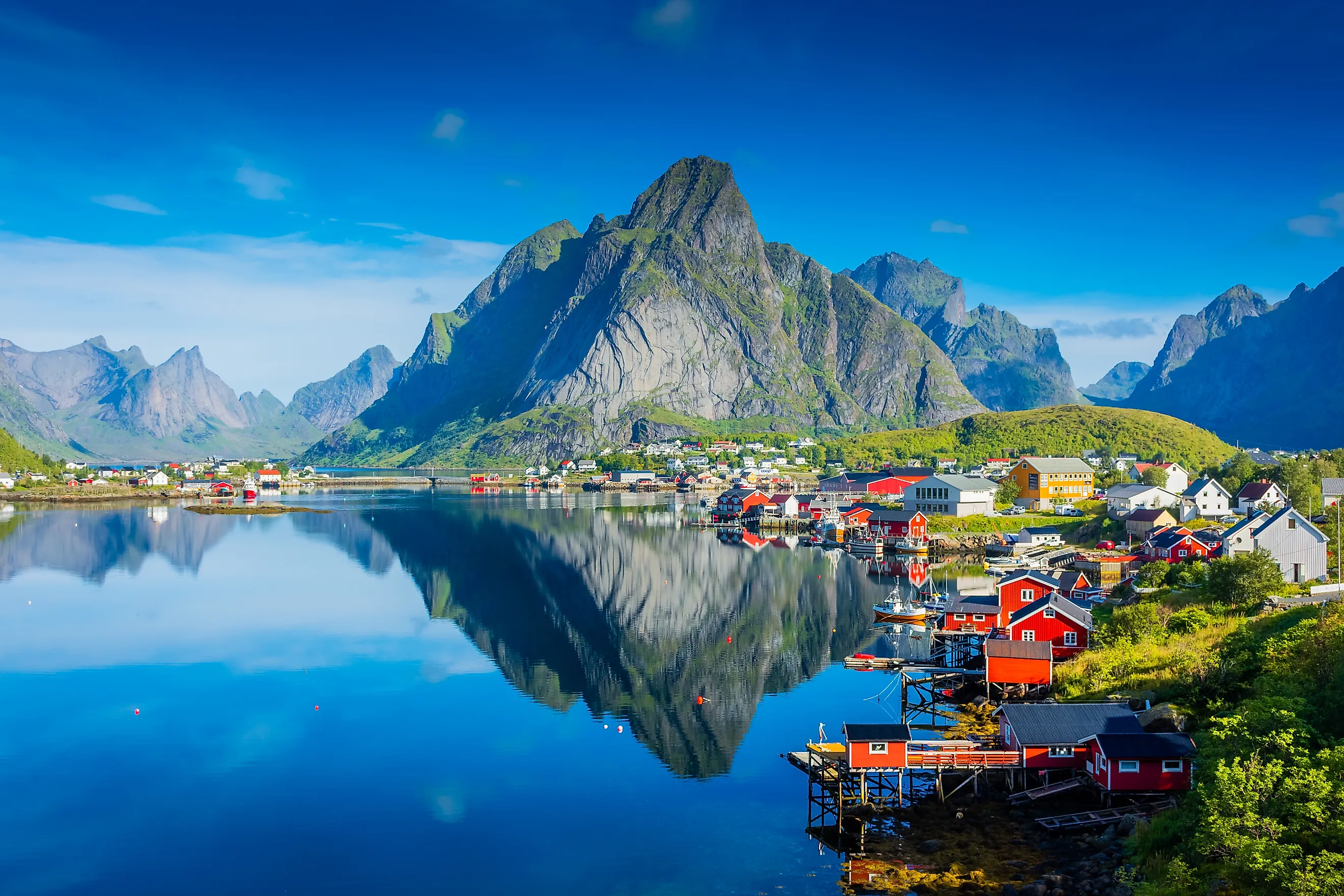
Reine sits on Moskenesøya, the westernmost of the major Lofoten islands, roughly 150 kilometers north of the Arctic Circle in Norway. The population is around 300, and the village is built around a small natural harbor surrounded on three sides by granite peaks that climb almost vertically out of the sea. The red rorbuer, traditional fishermen's cabins on stilts above the water, were originally seasonal housing for crews working the winter cod fishery that has run in these waters since at least the Viking era. Reinebringen, the 448-meter ridge directly above the village, was for years a dangerous scramble; Nepali Sherpa stoneworkers completed a stone staircase of about 1,500 steps in 2019, turning it into a steep but reliable hike. The northern lights are visible from Reine roughly September through April, and the midnight sun runs late May through mid-July.
Ronda, Spain

The Puente Nuevo at Ronda spans 98 meters above the floor of the El Tajo gorge, took 42 years to build (1751 to 1793), and split the town into the medieval Moorish quarter on the south side and the newer 16th-century quarter on the north. Ronda is also where modern Spanish bullfighting was largely codified. Pedro Romero, born in Ronda in 1754, killed an estimated 5,600 bulls across his career and helped establish the on-foot style that replaced the older mounted form. The Plaza de Toros de Ronda, completed in 1785, is one of the oldest still-standing bullrings in Spain. Ernest Hemingway visited often and used Ronda as a model for the village in For Whom the Bell Tolls; Orson Welles liked the town enough to have his ashes interred at the estate of bullfighter Antonio Ordóñez just outside it. The Casa del Rey Moro on the gorge's edge contains a 14th-century Islamic water mine cut into the rock, with 200 steps descending to the river.
Santa Maddalena, Italy

Santa Maddalena (Santa Magdalena in German) is the small village at the head of the Val di Funes in Italy's South Tyrol, with the sawtooth Odle (Geisler) group of the Dolomites rising directly behind it. The white-steepled church of San Giovanni in Ranui, framed against the Odle peaks, is the standard exterior shot for almost any guide to the Dolomites. The Val di Funes is also the home valley of Reinhold Messner, the first climber to summit all 14 of the world's 8,000-meter peaks and the first to summit Everest without supplemental oxygen (in 1978, with Peter Habeler). His Messner Mountain Museum has a branch (MMM Ripa) at Brunico, an hour northeast. The Puez-Odle Nature Park begins immediately above the village, and the Adolf Munkel Trail runs along the base of the Odle with several huts (including Geisleralm and Brogles) serving as walking stops. South Tyrol is one of Italy's officially German-speaking provinces, and most signs and menus in Funes appear in both languages.
What Ten Towns Look Like When They Aren't Backdrops
What these ten share isn't a look. Seven millennia of salt at Hallstatt. A 1300s bridge at Lucerne. The cod migration at Reine that predates Norway as a country. Pedro Romero's bullring at Ronda. A spring at Lourdes that started flowing in 1858 and hasn't stopped. None of them was built for tourism, and each shows up to do its old job whether visitors come or not.