8 Of The Most Adorable Small Towns In The Netherlands
The Dutch have a word for the quality these eight destinations share: schattig. It means adorable. For example, Giethoorn appears straight out of a fairytale book with canals instead of streets running through town. Visitors can take a boat ride to enjoy the picturesque settings of the town, its thatched-roof cottages, and vibrant blooms. Veere is a town steeped in history with grand architectural masterpieces from the past and a harbor lined with cafes and restaurants serving mouth-watering seafood delicacies. Muiden is a river town with a 13th-century castle straight out of a storybook. Read on to discover more about the eight most adorable small towns in the Netherlands.
Giethoorn

Silence defines the historic center of Giethoorn, where canals have replaced streets since the 18th century and 176 wooden bridges connect the thatched-roof cottages. Without streets, no cars can pass through the old village. Visitors walk the footpaths or glide through the waterways in whisper boats, electric craft that move without disturbing the herons that nest along the banks. The thatched roofs, made of reed, slope over windows framed by geraniums and hydrangeas.
The Museum Giethoorn 't Olde Maat Uus reconstructs the life of peat cutters who dug the canals, with a traditional dwelling, a smithy, and a barn filled with regional tools. Each bridge offers a different angle on the same scene: green water, black thatch, and flowers reflected in the canals. The village is in the province of Overijssel, about 120 kilometers from Amsterdam, and the approach through flat farmland makes the sudden appearance of the water village feel like discovering a secret.
Naarden

A double ring of canals and six-pointed bastions encircle Naarden, a fortress town in North Holland that retains its star shape from the 17th century. The fortifications, among the best-preserved examples of the trace italienne style in Europe, create a town that is literally walled in geometry. Visitors can walk the grass-covered ramparts for a full circuit, looking down on red-tiled roofs and the tower of the Grote Kerk.
The Grote Kerk, also known as St. Vitus Church, dates to the 15th century and contains medieval ceiling paintings and a wooden vault that has survived the centuries. The Dutch Fortress Museum occupies the bastions themselves, with exhibits on the Old Dutch Water Line, the defensive system that used inundation to protect the province. The star shape is only fully visible from above, but walking the walls gives a sense of the military precision that shaped the town.
Thorn

Every building in the historic center of Thorn is painted white, creating a streetscape so uniform that the town feels like a set piece. The white paint originated in the 18th century when residents bricked up windows to avoid a tax levied by France based on window size and painted over the mismatched brickwork to match the limestone facades. The effect stuck, and today the entire village glows against the green hills of Limburg.
The Abbey Church of Thorn, a former royal abbey founded in the 9th century for noblewomen, sits in the town center. The interior is Baroque, with gilded altars and the tombs of royal benefactors. Narrow cobblestone lanes wind between the white houses, and the Museum Thorn tells the story of the abbey and the village that grew around it. The town sits near the Belgian border, and the surrounding countryside of orchards and rolling fields feels closer to Belgium and Germany than to the Dutch coast.
Hindeloopen

Sailors returning from the Baltic and the Orient brought more than cargo to Hindeloopen. They brought carved furniture, painted porcelain, and floral motifs from Norwegian Rosemaling and Eastern European folk art that local artists translated into a distinct style. By the late 1600s, the town had developed its own painting tradition, Hindelooper schilderkunst, and the deep blues, greens, and reds that cover the wooden houses are the signature palette of that movement. The town, one of the eleven historic cities of Friesland, also has its own dialect and a unique costume that locals still wear on special occasions.
The Museum Hindeloopen displays the painted furniture, costumes, and maritime artifacts that document the town's seafaring wealth. The harbor on the IJsselmeer remains active with traditional boats, and the waterfront cafes serve coffee in the shadow of the painted gables. The village is small enough to walk in an hour, but the details on the houses will take much longer to appreciate.
Veere

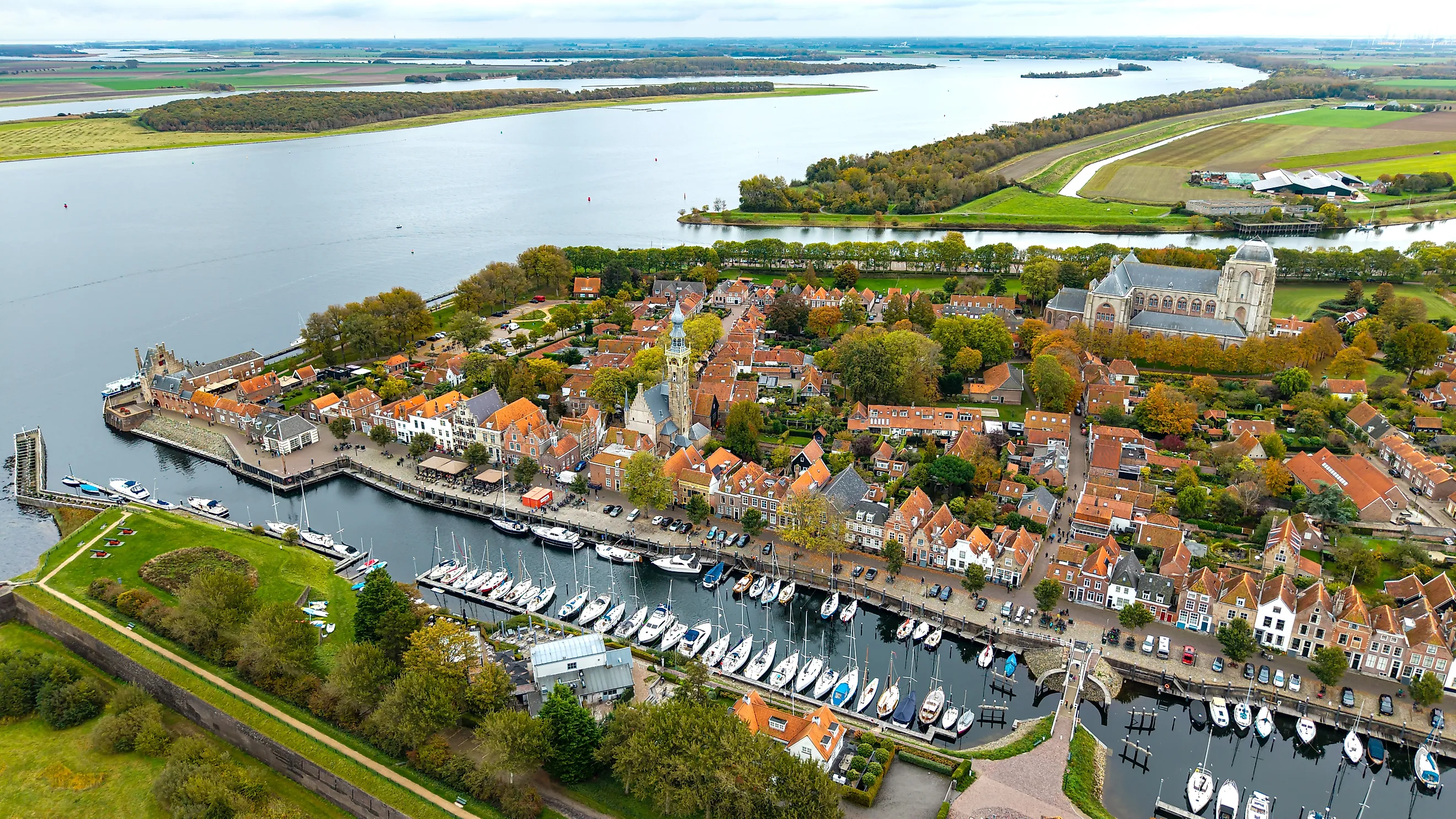
Wool merchants from Scotland played an important role in building the harbor town of Veere in the 16th century, and their legacy survives in the gabled warehouses that line the waterfront of the Zeeland village. The Stadhuis, a late-Gothic town hall with a carillon, sits in the main square with a grandeur that seems oversized for a village of about 1,600 residents. The harbor fills with yachts and traditional boats, and the waterfront promenade curves around the marina with cafes that serve mussels and oysters from the nearby estuaries.
The Scottish Houses, built by merchants who traded wool between Scotland and the Low Countries, preserve the international character of the town's golden age. The Campveerse Toren, a 15th-century tower on the waterfront, is the oldest surviving inn in the Netherlands and still serves meals to both locals and tourists. The town sits on Walcheren Island, surrounded by the North Sea and the Veerse Meer lagoon.
Elburg

A perfect grid of medieval streets fills the walled town of Elburg, with cobblestones and brick houses enclosed by ramparts and a moat. The town was rebuilt in the 14th century after a flood destroyed the original settlement, and the planners created this rectangular street plan, unusual for the period. The Vischpoort, a gatehouse with a tower, marks the main entrance through the walls.
Visitors can walk almost the entire circuit of the fortifications, looking down on the moat and the gardens that back onto the wall. The Agnietenklooster, a former monastery, maintains a herb garden that supplies the local restaurants. The town is in the province of Gelderland, and the surrounding Veluwe forest provides a green backdrop that contrasts with the brick and stone of the old center.
Broek in Waterland

Amsterdam merchants built their country retreats in Broek in Waterland, a village 15 kilometers north of the capital, where the wooden houses are maintained so impeccably that the town earned the nickname "the cleanest village in Holland." The 17th- and 18th-century houses, with carved gables and painted shutters, line canals reflecting the green polder landscape. The village is surrounded by water on all sides, accessible only by bridge.
The Church of Broek in Waterland, dating to the 16th century, contains a carved pulpit and ceiling paintings that survived the Protestant Reformation. The main street, lined with the historic merchant houses, leads to the waterfront where boats still moor along the canals. The proximity to Amsterdam makes the village a popular day trip, but the town remains small enough that the loudest sound is often a bicycle bell.
Muiden

A 13th-century castle with a moat presides over Muiden, a fortress town at the mouth of the Vecht River. Muiderslot Castle, with its towers, gardens, and a keep that overlooks the river, is older than Amsterdam and served as a residence for the poet P.C. Hooft in the 17th century. The castle's kitchen garden, herb garden, and orchard are laid out in formal patterns that visitors can walk.
The 17th-century ramparts encircle the town, restored and walkable, with views across the water to the island fortress of Pampus. The harbor on the Vecht fills with sailing boats, and the waterfront cafes overlook the river that connects the town to the heart of the Netherlands. The town was part of the Dutch Water Line, the defensive system that used controlled flooding to protect the provinces from invasion.
Eight Schattig Towns
The Netherlands made its fortune on trade, canals, and cities, but the country's charm lives in villages with just a few thousand residents. Giethoorn and Broek in Waterland keep their houses immaculate on the water. Naarden and Elburg wrap their streets in walls and geometry. Hindeloopen and Veere carry the evidence of sailors and merchants who brought the world home and painted it on their walls. Each town rewards the visitor who walks slowly, looks up at the gables, and crosses every bridge just to see what is on the other side.