8 Most Hospitable Towns In Spain
In one Galician town, neighbors who have survived a brush with death are carried through the streets in open coffins each July, an offering of thanks watched by thousands. It is one of eight villages, towns, and small cities gathered here across eight regions of Spain, reaching the granite hills of Galicia in the northwest and the limestone coves of Mallorca out in the Mediterranean. What they share is a particular kind of welcome, the kind that comes from places that have been receiving travelers for centuries through pilgrimage routes, trade roads, and old festivals. Several keep medieval fortresses and castles you can sleep in; one is the village the writer Robert Graves never wanted to leave; another holds a carnival that has run since 1418. Each offers the chance to slow down, take in the local history, and get to know a resident or two.
As Neves, Pontevedra

The first pick is a small Galician town in Spain's northwest corner, a few kilometres from the Portuguese border and set among vineyards and low granite hills. As Neves is best known for the unique Festival of Near-Death Experiences, a tradition documented here for centuries. Held each July 29 beside the Church of Santa Marta, a modest granite chapel overlooking the Miño valley, the festival draws national attention for its unusual procession. Neighbors who survived serious accidents or illnesses are carried in open coffins as an offering of thanks. The procession is followed by brass bands, food stalls serving local favorites, and late-night folk performances, bringing in thousands of visitors from around the world. The festival is a glimpse at how the town works the rest of the year: neighbors who really know and care about one another, as well as locals who are quick to make space for visitors, explaining the unusual ritual and sharing other bits of local history.
During your visit, take the short drive from town to the Petroglyphs of Coutada, occupying a low ridge and preserving Neolithic carvings scattered across open granite slabs. Moving to a higher elevation, the San Nomedio summit is topped with a concrete trig pillar and a small chapel, with open views that look toward the Serra da Peneda in Portugal and the vineyard parcels that make up the Rías Baixas wine region.
Cangas de Onis, Asturias

From As Neves, we travel about 500 km to the northeast to reach Cangas de Onís, a small mountain town long used as the entry point to the Picos de Europa and the gateway to the Covadonga sanctuary, about 10 km up the valley. Because of this role, the town has a long tradition of receiving travelers, something still visible in its markets, festivals, and sidrerías.
The town's best-known landmark is the medieval Roman Bridge, whose three arches are crowned by a raised central span, with a replica of the Victory Cross hanging from the middle. A short walk away, the Chapel of Santa Cruz sits atop a Neolithic dolmen dating to around 3000 BC. The chapel has been rebuilt several times, including by King Favila in the 8th century, and the Civil War restoration exposed the prehistoric chamber now visible inside.
A visit here should definitely fall over a Sunday, as it is when the town becomes especially lively thanks to its weekly market. Vendors sell Cabrales cheese, honey, sausages, and plenty of cider. Asturias is responsible for most of Spain's sidra, and local sidrerías follow the traditional long-pour method that is central to the region's cider culture.
From town, the road climbs toward the Covadonga Sanctuary, home to the Holy Cave and the Basilica of Santa María la Real, as well as the alpine Lakes of Enol and Ercina. Beyond them stretches the Picos de Europa National Park, a UNESCO Biosphere Reserve known for its limestone peaks, deep gorges, and rich biodiversity.
Jaca, Huesca

Another 500 km east to Jaca, a small Pyrenean city set 40 minutes from the French border. The city's history stretches back to the 2nd century BC, and it later became the first capital of the Kingdom of Aragon in 1035.
The city's most recognizable landmark is the Citadel of Jaca, a 16th-century pentagonal fortress built under King Philip II to control the main Pyrenean corridor linking Aragon with France. Its large moat, now inhabited by deer, and its five bastions make it one of the best-preserved star forts in Spain. Interestingly, you can find the Museum of Military Miniatures inside.
A short walk from the citadel is Saint Peter's Cathedral, an 11th-century Romanesque church built under the orders of King Sancho Ramirez, who granted the city its charter and made it an episcopal seat. Other closeby sites of interest include the Church of Santiago, built in 1088; the Hermitage of Sarsa, originally built on the slopes of Peña Oroel but relocated to the city in 1972; and the asymmetrical San Miguel Bridge, built in the 15th century and crossing the Aragón River.
Jaca is a popular stop along the Aragonese Way of the Camino de Santiago, the ancient pilgrimage network of routes fanning across Europe, converging at the Cathedral of Santiago de Compostela. For over a thousand years, the town has been a waypoint for walkers arriving from France through the mountain pass above. That long history of welcoming strangers is evident in the locals' strong sense of openness, kindness, and generosity.
Sigüenza, Guadalajara

Heading toward Madrid lies Sigüenza, a small medieval town of a few thousand residents in the high plains of Castile-La Mancha. The town's small size allows visitors to settle into a slower rhythm quickly, exploring the cobbled streets on foot and stopping into the shops clustered around the old quarter.
The town is dominated by the imposing hilltop Sigüenza Castle, originally built after the Arab invasion in the eighth century. Preserved stretches of the defensive walls, gateways, and towers that once protected the fortress still stand, though today the castle operates as a Parador hotel.
Sigüenza Cathedral is just a short walk downhill from the castle. It does not look like a typical church from the outside; it is built from the same heavy stone as the fortress, giving it the same defensive feel. Inside is the tomb of El Doncel, a young knight killed in battle, carved lying on his side with a book open in his hands, an unusual choice for a medieval tomb sculpture.
A short drive outside town, the Barranco del Río Dulce natural park is a canyon carved through Jurassic limestone by the Dulce River, its cliffs home to griffon vultures, eagles, and peregrine falcons, with walking trails threading the gorge.
Deià, Mallorca (Balearic Islands)

Sitting atop a hill in the Tramuntana mountains on the northwest coast of Mallorca, Deià is a small village famous for its honey-colored limestone buildings. Overlooking the Mediterranean, the village is surrounded by olive groves that have been farmed since the Moorish period. At 850 people, Deià is the smallest town on this list, and it has managed to hold onto its local character despite being fairly well known. There are no tourist shops in sight, and outside of peak summer season, it is quiet and slow-paced.
The village has drawn artists and writers since the 19th century, largely because of its isolation. The most famous was Robert Graves, who moved to Mallorca in 1929, left during the Spanish Civil War, returned in 1946, and lived at Ca n'Alluny (now an open house museum in Deià) until his death in 1985. The coastline is a short walk downhill from the village. Cala de Deià is a small rocky cove with a beach bar that has live jazz on summer evenings. Llucalcari, two miles further along, is best reached on foot and has natural clay deposits in the rock that people use as a mud treatment.
The hiking here is serious, too. The most popular trail is the Pirates' Trail, a nine-km coastal loop that runs along the cliffs before looping back through the forest. The Barranc de Biniaraix gorge is a short drive away, a steep canyon of ancient cobblestone paths that date back to when farmers used them to reach the isolated olive groves deep in the mountains.
Águilas, Murcia

Hopping back onto the mainland, we continue southward to the old Roman fishing port of Águilas, located at the southern tip of Murcia's Mediterranean coastline.
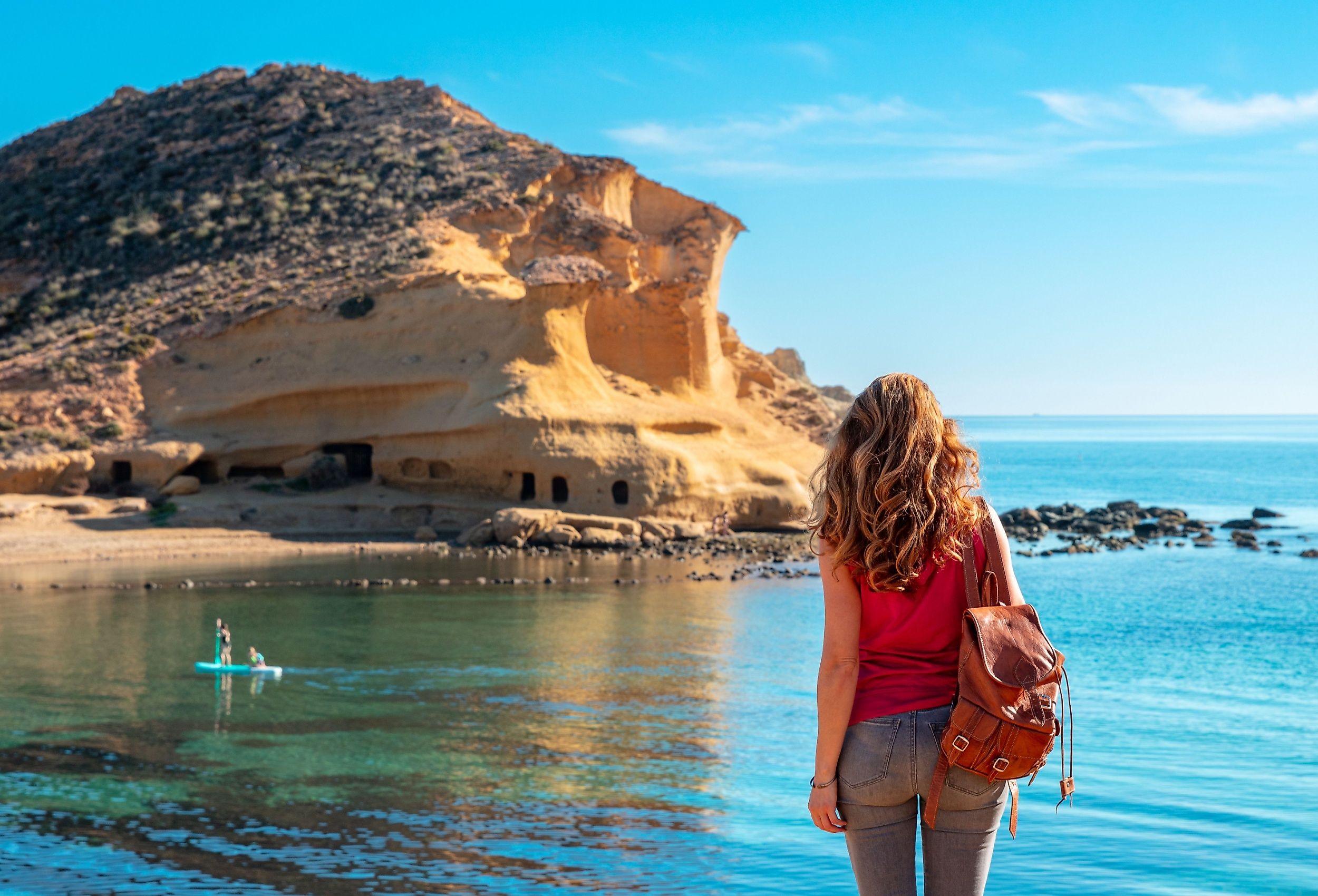
The coast stretches about 28 km and shifts between busy urban beaches like Las Delicias to quieter coves like La Higuerica and La Carolina. The rocky seabed around Fraile Island and Cape Cope makes for one of the better spots on the Mediterranean for scuba diving.
The San Juan Castle sits on the headland above town, built in 1756 as a coastal defence against raids. Below it sits the port and its unique black-and-white striped lighthouse, in operation since the mid-19th century. From there, the Plaza de España is a short walk away. The square is flanked by the 19th-century City Hall and San José Church. Just off the square sits the Carnival Museum, which gives you a sense of what this town is really known for: Águilas Carnival. But if you can time your visit for February, you can see its magic for yourself.
The town's famed annual carnival is the biggest in the Region of Murcia, drawing huge crowds. Locals spend the entire year building floats, sewing costumes, and rehearsing for it. It has been declared a Fiesta of International Tourist Interest. The celebration spans multiple parades and includes the cascarones de confetti tradition, in which eggs filled with confetti are thrown through the crowds.
Zafra, Badajoz

Continuing west and slightly more north into Extremadura, we reach Zafra, sometimes called "Little Seville." People use the nickname mostly because of how the old center is laid out, with Plaza Grande and Plaza Chica sitting close together and the narrow streets running off them in a pattern that feels a bit like Seville, just on a smaller scale.
Zafra's most recognizable building is the Palace of the Dukes of Feria, built in 1443 for one of the most influential noble families in the region. It was designed to function as both a fortress and a residence with large square defensive towers on the outside and a Renaissance inner courtyard within. Like the castle in Sigüenza, it now operates as a Parador hotel.
From the palace, the two main squares are a short walk downhill. Plaza Grande dates to the 1500s and has long been the town's main gathering space. A short walk away is Plaza Chica, which is older and was Zafra's main market during medieval times. Both squares sat along the old Vía de la Plata, the Roman route that connected Seville to Gijón, and over time it became part of the Camino de Santiago.
Just off the squares sits the Church of the Candelaria. Construction began in the 1500s and stretched for more than a century. Inside, you can find several works by Francisco de Zurbarán, one of the greatest Baroque artists in Spain.
Ciudad Rodrigo, Salamanca

Our last pick on this list sits about three and a half hours north of Zafra and about 20 minutes from the Portuguese border. Ciudad Rodrigo is a small fortified city enclosed by 12th-century walls.
The walls were first erected under Ferdinand II in the 1100s and later reinforced in the 18th century. They span more than two kilometres, have seven gates, and five towers. On a clear day from the top, you can see Portugal. And once inside, most of the town's major sites sit only a few minutes apart.
The Cathedral of Santa María began construction around 1165 and was not finished until around 1550, resulting in a blend of artistic styles, including doorways with Romanesque and Gothic carvings. A short walk away is the Castle of Enrique II, built in 1372 under Henry II and now a Parador hotel, like the castles in Zafra and Sigüenza.
Ciudad Rodrigo saw a boom of building palaces and noble houses during the Renaissance period. The Castro Palace is one of the better examples of that period here, a large noble house with an elaborate coat of arms on its facade.
If you happen to visit in February, do not miss the famed Carnival of the Bull, which takes over the Plaza Mayor. Documented since 1418, it is one of the oldest carnivals in Spain and has held a National Tourist Interest designation since 1980. The multi-day celebration features a parade of floats, bull running, capeas, and novilladas.
Spain, Unhurried
Spain's best destinations are not always the ones with the biggest plazas, most social-media-trendy restaurants, longest lines, or most renowned museums. This list shows just how magnificent the places that can be explored in a day or two are. It also shows how varied Spain's smaller communities really are, each one moulded by a different region, history, and daily rhythm. None of these communities asks for much beyond a willingness to wander on foot, strike up a conversation, and spend a day or two living at a local pace. Several sit close enough to one another that a single trip can take in two or three of them, each offering a different version of the same unhurried welcome.