8 Best Small Towns To Retire In Croatia
Croatia's smaller coastal towns offer retirees something increasingly rare: daily life by the sea just a few steps away, with nature, culture, and medical access close by. In Opatija, the 7.5-mile Lungomare was built for exactly that kind of routine, linking seaside neighborhoods from Volosko to Lovran and keeping the Adriatic within reach of an everyday walk. In Mali Lošinj, a long-standing reputation for clean air and respiratory wellness still shapes the town’s appeal, from its climatic health-resort history to its fragrant gardens and pine-lined swimming bays. For Americans looking beyond the usual retirement map, these towns combine Mediterranean weather and a slower coastal rhythm without sacrificing essential amenities.
Rovinj

Rovinj, on the western coast of Istria, operates in two languages. Croatian and Italian both carry official status in the bilingual Old Town, a peninsula that was an island until the 18th century. The Church of St. Euphemia crowns the rise at the center, its 200-foot bell tower modelled on St. Mark's Campanile in Venice and topped by a copper saint that turns with the wind. Cobblestoned Grisia Street climbs from the harbor to the church and hosts artists year-round. Down at the waterfront, the Batana Eco-Museum preserves the traditional flat-bottomed fishing boats that earned UNESCO Intangible Heritage recognition in 2016. The nearest major hospital, in Pula, handles complex care about 25 miles south along the Adriatic. Rovinj fits retirees who want a layered, art-rich coastal town with a Romance-language heritage still in active use.
Opatija

Opatija was built for daily coastal walks. Habsburg authorities declared it the first climatic seaside resort on the Austrian Riviera in 1889, and the town's bones still reflect that purpose. The 7.5-mile Lungomare, officially the Franz Joseph I Promenade, runs along the coast from Volosko to Lovran. Villa Angiolina, built in 1844, marked the birth of Opatija tourism, and the iconic Maiden with the Seagull statue stands on the rocks just below. Učka Nature Park rises directly above town with protected hiking trails throughout. KBC Rijeka, the regional clinical hospital center in Rijeka, handles complex care about 11 miles away. Opatija suits retirees who want a wellness-resort town built around daily access to the Mediterranean.
Mali Lošinj

In 1892, the Austro-Hungarian Ministry of Health designated Mali Lošinj as a climatic health resort, citing the air's unusual purity. The same designation still attracts retirees today. The island hosts more than 1,200 plant species, of which roughly 230 are medicinal. The Fragrant Island Garden displays local sage, rosemary, lavender, and immortelle on a single walkable terrace. The Apoxyomenos Museum centers on a single ancient Greek bronze, recovered from the seabed in 1999 after roughly 1,800 years underwater. Čikat Bay, ringed by pine forest and Belle Époque villas, gives calm Adriatic swimming through the warm months. The town runs its own primary-care health center, with KBC Rijeka reachable on the mainland for complex care. For retirees focused on respiratory health and air quality, Mali Lošinj has few peers in the Mediterranean.
Krk

Krk Town is the easiest Adriatic island settlement to reach by car. Since 1980, the 4,690-foot Krk Bridge has connected the island to the Croatian mainland near Rijeka, and the airport in Omišalj sits at the island's northern end. The town itself, on the southwest coast, holds layers from every period that mattered in the region. The 12th-century Romanesque Cathedral of the Assumption stands on the foundation of Roman thermal baths, with the two-story Church of St. Quirinus beside it. The medieval Frankopan Castle on Kamplin Square belonged to the powerful noble family that ruled here from 1118 to 1480. KBC Rijeka serves the island via the bridge. Krk Town is hard to beat for retirees who want island life with the practical accessibility of a mainland address.
Skradin

Most visitors to Skradin take the boat. The town sits at the river entrance to Krka National Park, with the park's official boats departing from the Skradin harbor for the 25-minute run upriver to Skradinski Buk. The gorgeous cascade system was named after the town and features trails as well as swimming. For those who prefer walking, a 2.1-mile riverside trail covers the same route on foot or by bike. Above the harbor, the medieval Turina Fortress opens to panoramic views over the Krka River estuary. Bill Gates once named Skradin his favorite vacation place in a Forbes interview, which the marina has not let anyone forget. General Hospital Šibenik handles complex care about 11 miles away, in Šibenik. Skradin works for retirees who want a quieter river-port pace with national-park-grade nature opening immediately upstream.
Hvar Town

Hvar Town has long been known for its mild winters and high number of sunny days. St. Stephen's Square, the largest medieval square in Dalmatia at roughly 1.1 acres, opens onto the Cathedral of St. Stephen at one end and the harbor at the other. The Hvar Theatre, opened in 1612 and among the oldest in Europe, is housed in the historic Arsenal building. Above town, the 16th-century Fortica Fortress (locally called Spanjola) offers panoramic views down to the Pakleni Islands, the protected chain of small islets just offshore. Catamaran ferries connect the town to Split for complex hospital care at the University Hospital of Split, also known as KBC Split. Hvar Town rewards retirees who want winter sun, walkable medieval streets, and short-boat access to a wider archipelago.
Omiš

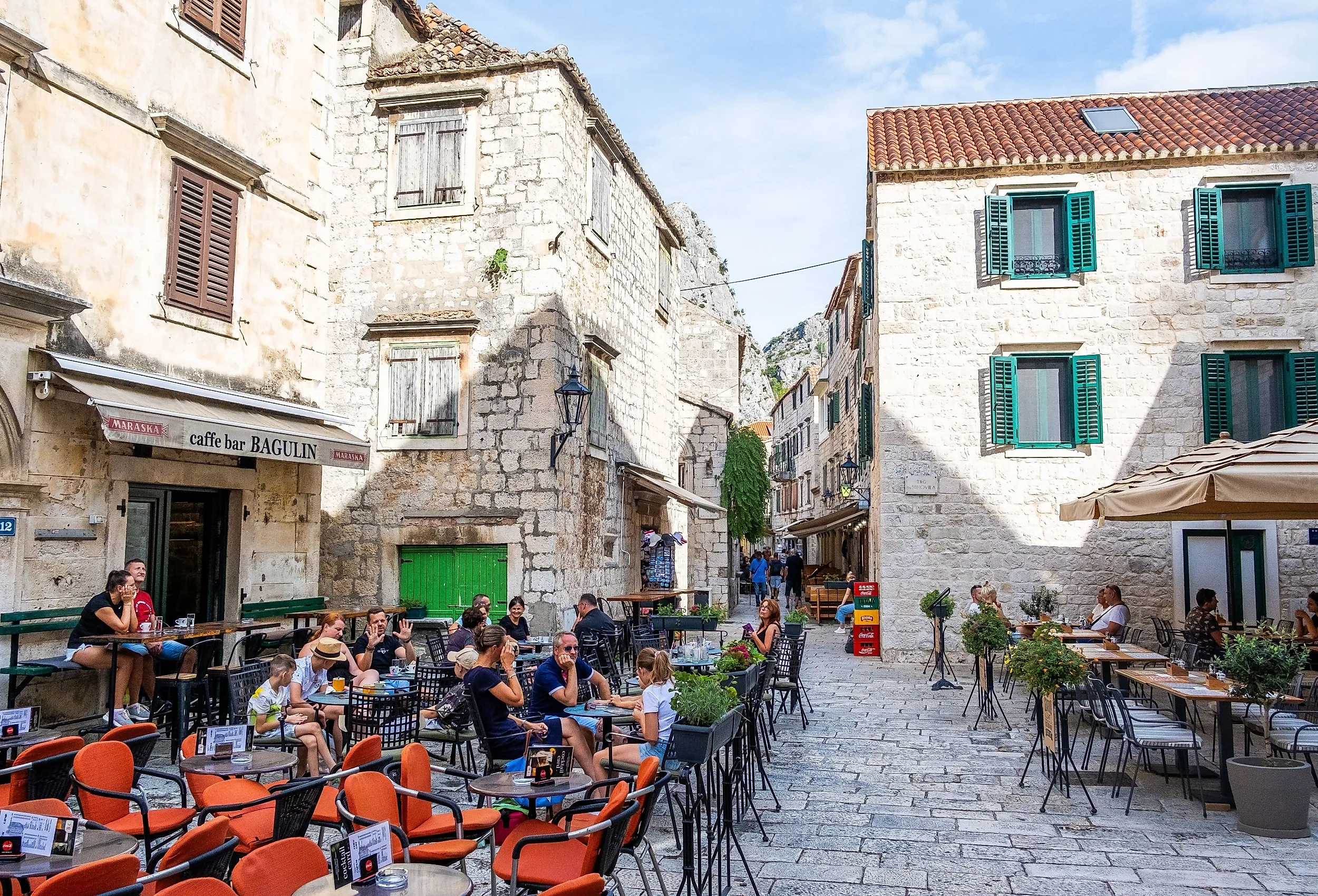
The Cetina River cuts a canyon and meets the sea at Omiš, halfway between Split and Makarska on the Dalmatian coast. The geography produced two fortresses and a long history of piracy. Mirabella Fortress (Peovica), the 13th-century Romanesque tower above the old town, served as the lookout for the local fleet that harassed Venetian shipping until 1444. The larger Starigrad Fortress, called Fortica, sits higher up the hillside with broader views over the canyon. The town remains a center for the Festival of Dalmatian Klapa, the a cappella tradition recognized by UNESCO as Intangible Cultural Heritage in 2012. Split's general hospital handles complex care about 16 miles up the coast. Omiš appeals to retirees who want canyon recreation paired with a coastal address.
Cavtat

Cavtat sits just south of Dubrovnik, about four miles from the airport along the Adriatic Highway. The compact peninsula holds more art history per square block than most cities. The Vlaho Bukovac House, birthplace of one of Croatia's most significant painters (1855 to 1922), preserves his studio and frescoes he painted on his own walls at age 17. Up the cemetery hill, the white-stone Račić Mausoleum is the only complete architectural work by sculptor Ivan Meštrović, completed in the early 1920s. The Renaissance Rector's Palace on the waterfront houses the Baltazar Bogišić Collection. Forbes named the nearby Pasjača Beach Europe's most beautiful secret beach in 2024. General Hospital Dubrovnik handles complex care about 12 miles away. Cavtat is a natural fit for retirees who want a southern Dalmatian climate with easy airport access for family visits.
A Coast Worth Knowing
These eight towns combine a Mediterranean climate with an active coastal infrastructure. Examples include the Lungomare in Opatija, the Krka River boats from Skradin, the Pakleni Islands off Hvar Town, and the harbor promenade in Cavtat. Each town carries hospital access within a reasonable distance and a daily life organized around walking rather than driving. The cost of living remains lower than in comparison to Italian or French coastal towns, and EU membership makes residency administratively manageable for Americans. Croatia delivers what many retirees actually want: a Mediterranean town that feels like home.