Atomic City, America's Forgotten Nuclear Town
Most people know the Chernobyl nuclear disaster of 1986, the worst accident in the history of nuclear power. Far fewer know that the only fatal nuclear reactor accident in United States history happened years earlier, in a stretch of southeastern Idaho desert beside a town now all but abandoned. In the 1950s, that town rode the optimism of the Atomic Age, drawing families to work in the new field of nuclear research. Its brief boom faded as the nearby testing station matured and a series of accidents unsettled the region. Today the place is called Atomic City, a near-ghost town and a curiosity for the occasional traveler, while nearby Idaho Falls has grown into the fourth most populous city in the state.
Where Is Atomic City, Idaho?

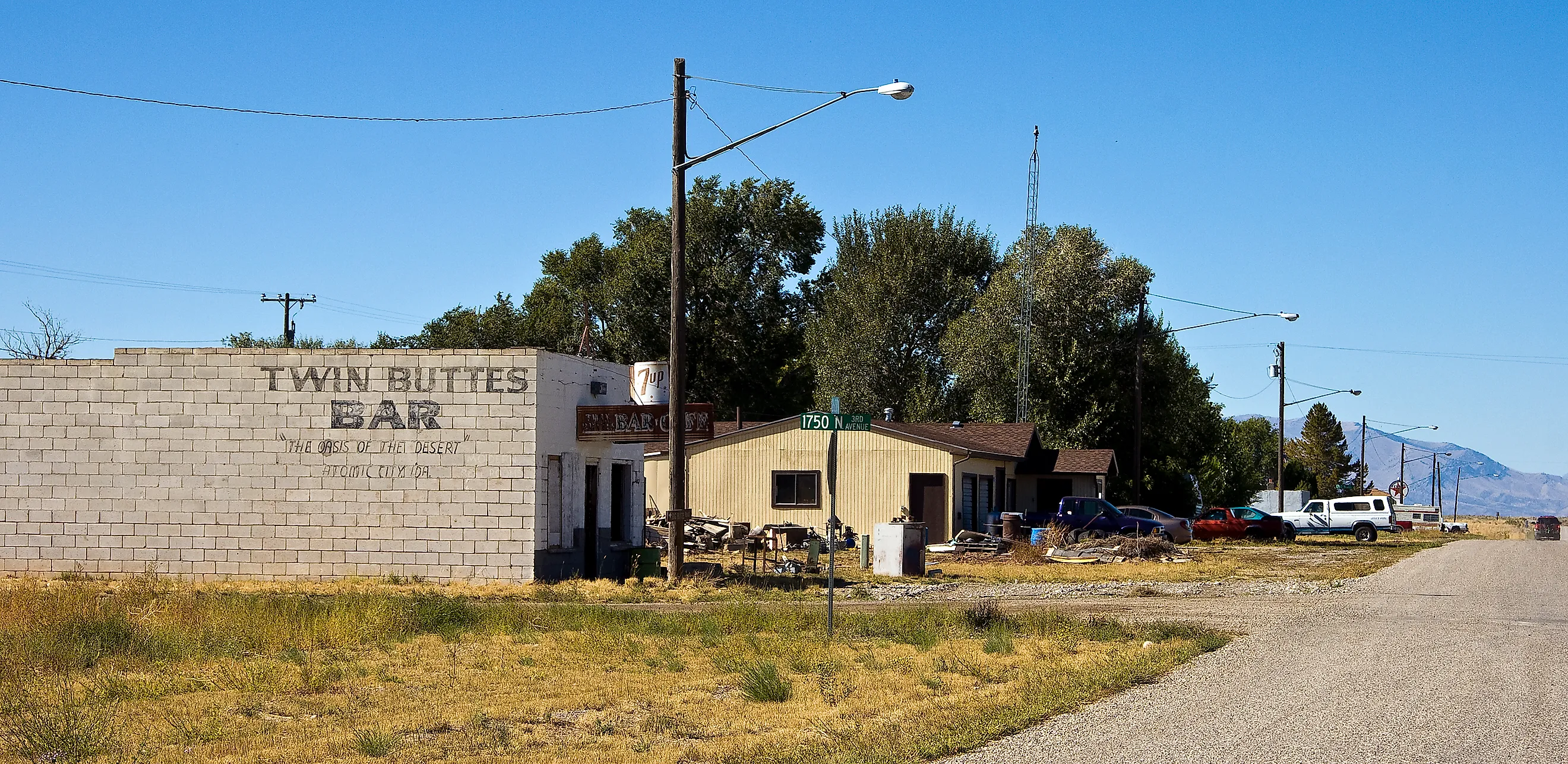
Atomic City sits in southeastern Idaho, in Bingham County, and is easy to drive right past. It is overshadowed by the region's better-known draws, chief among them Craters of the Moon National Monument and Preserve, whose lava flows, cinder cones, and caves pull in far more visitors. The town itself is tiny. Only about 40 people remained at the 2020 census, and that year residents voted to give up the town's incorporated status altogether. What is left is a scatter of old houses, a single store, a bar, and the Atomic City Raceway. Nearby Idaho Falls, by contrast, has kept growing and is now the fourth most populous city in Idaho.
A Little Bit of History

Atomic City was not always a ghost town, and it was not always called Atomic City. Until 1950 it was named Midway, because it sat halfway between the towns of Arco and Blackfoot. Its fortunes turned with the Atomic Age. In 1949, the federal government established the National Reactor Testing Station on a vast tract of desert nearby, the roughly 890-square-mile (2,305 sq km) site known today as the Idaho National Laboratory. Argonne National Laboratory engineers had already begun building the Experimental Breeder Reactor I (EBR-1) at the station, northwest of Midway near Arco. EBR-1 was the world's first breeder reactor, and on December 20, 1951, it became the first reactor anywhere to generate a usable amount of electricity, lighting four 200-watt bulbs. The promise of steady work and cheap atomic power drew families to the area, though not everyone welcomed a reactor complex in the neighborhood.
The Power Plant

EBR-1 was one of the world's first electricity-generating reactors, a genuine milestone, and it opened the door to the reactors that followed. By the late 1950s, the U.S. Army had built a small prototype called SL-1 much closer to Atomic City, only a few miles from the town, as part of a program to power remote military radar stations. Not everyone welcomed the buildup. Some residents feared the reactors would draw a flood of newcomers or turn the area into a target in a future war, while others raised health and environmental concerns as the public grew more aware of what radiation could do.
The growth, at least, was real. Between 1950 and 1960, the population of Idaho Falls climbed from 19,218 to 33,161 as the testing station pulled in workers and their families, and new neighborhoods spread across the valley.
The Partial Meltdown in Arco

Arco earned its own place in atomic history. On July 17, 1955, an experimental boiling-water reactor at the station called BORAX-III was connected to the grid and powered the town for about an hour, making Arco the first community in the world to run entirely on nuclear electricity. The moment was brief and largely symbolic, but it made headlines.
The same year brought a setback. On November 29, 1955, EBR-1 suffered a partial meltdown of its core during a coolant-flow test. The melting happened quietly, without an explosion, but it forced workers to evacuate the building and unsettled people in the surrounding towns. EBR-1 was repaired rather than retired, and the government kept it running for research until 1964. It would not be the last nuclear accident in the area, and the next one, much closer to Atomic City, would be far worse.
The Fatal Incident

Six years later, the area's luck ran out. On January 3, 1961, the SL-1 reactor, a few miles from Atomic City, was destroyed in a catastrophic accident. The reactor had been shut down over the holidays, and a three-man military crew was on duty to reconnect the control-rod mechanism and prepare it for restart. For reasons never fully settled, the central control rod, which by itself governed most of the reactor's activity, was pulled far past its safe limit, roughly 20 inches instead of about four. The reactor went "prompt critical" in an instant, flashing the surrounding water to steam and driving a pressure wave that made the entire reactor vessel leap about nine feet into the air.
The steam explosion killed all three men. Two died at the scene, one of them pinned to the ceiling by an ejected control rod, and the third died about two hours later. It was, and remains, the only fatal reactor accident in United States history. The victims' bodies were so radioactive that portions had to be handled as nuclear waste, and the men were buried in lead-lined caskets. During the long cleanup, hundreds of workers received measurable radiation exposure as the wrecked reactor was dismantled and its debris buried in the desert.
For all its horror, the accident reshaped nuclear safety. Investigators traced the disaster in part to a design flaw, a reactor whose fate could hinge on a single control rod, and new rules required that no lone rod could ever again trigger such a runaway. The reactor designs that came afterward were safer for it.
Where Is the City Today?

Experts consider the area safe today, its contamination long since cleaned up or contained, yet almost no one has chosen to move back. Atomic City instead draws the occasional curious visitor, and ghost-town tours lead people past the remains of the old community. Idaho Falls, meanwhile, never stopped growing. With about 64,800 residents at the 2020 census, it is the fourth most populous city in Idaho, home to a college, several museums, and a minor-league baseball team. The natural landmarks nearby are thriving as well, and Craters of the Moon offers popular hikes such as the North Crater Trail through its volcanic badlands.
A Reminder in the Desert
Atomic City endures as a physical reminder of the Atomic Age's high hopes and hard lessons. The SL-1 accident, grim as it was, pushed American engineers to rethink reactor design and operating procedures, and the safeguards that followed shaped the plants built afterward. Later disasters elsewhere, such as Chernobyl and Fukushima, would show that the work of making nuclear power safe is never quite finished. The near-empty streets of Atomic City are a quiet record of where some of that work began.