10 Prettiest Small Towns In Scotland
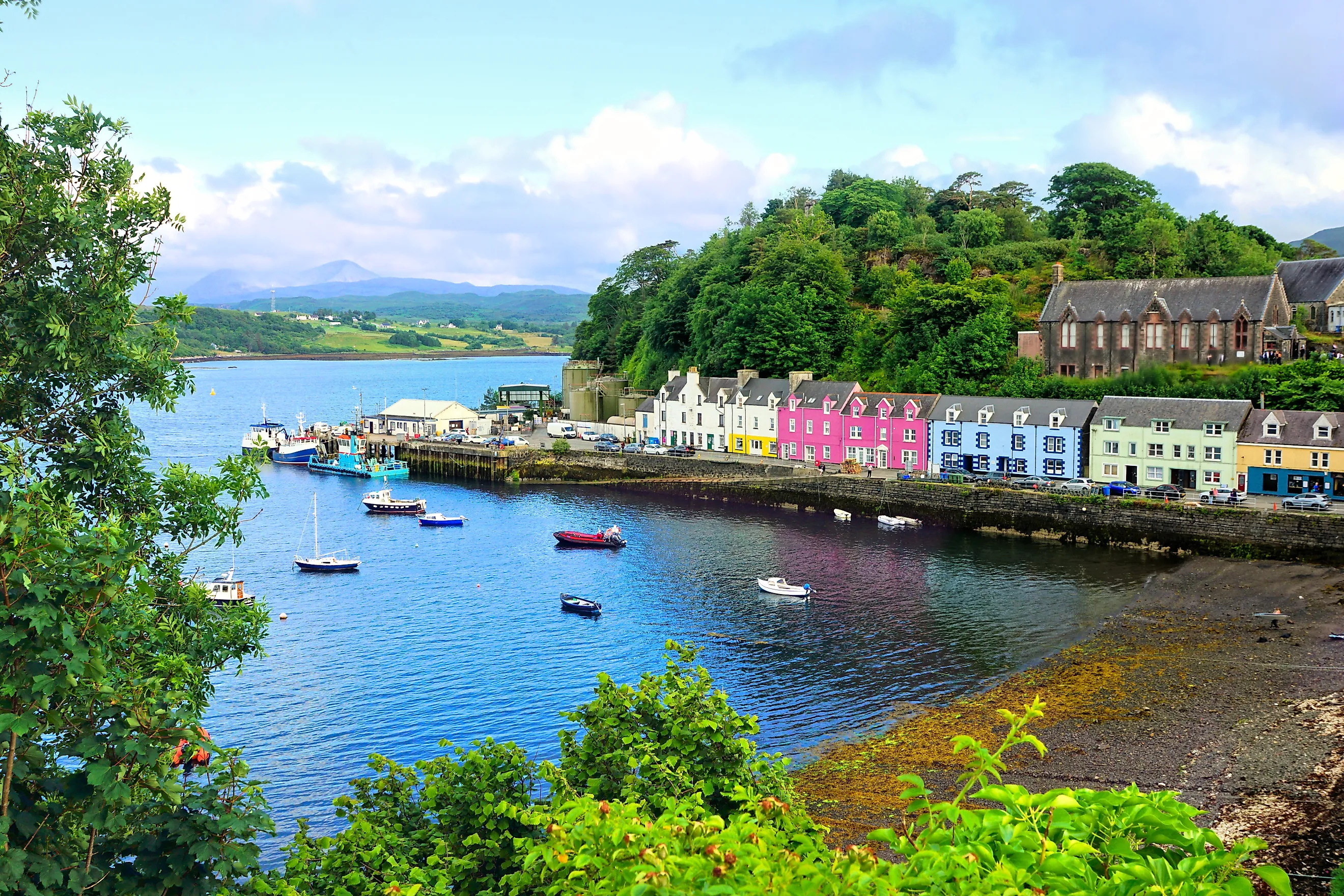
A curved row of houses painted blue and yellow and pink and red reflects in Tobermory's bay. Pastel harbourfront buildings stack beneath a low cliff on the east coast of Skye at Portree. Cabbage palms grow along the shore at Plockton thanks to the warm North Atlantic Drift. White-harled and red-pantiled houses climb the cobbled streets of Culross above the Firth of Forth. Crail's tiny harbour is photographed so often that a Danish Legoland built a copy of it. Melrose Abbey glows rose-pink in ruin beside the River Tweed under the three Eildon peaks.
Tobermory, Isle of Mull

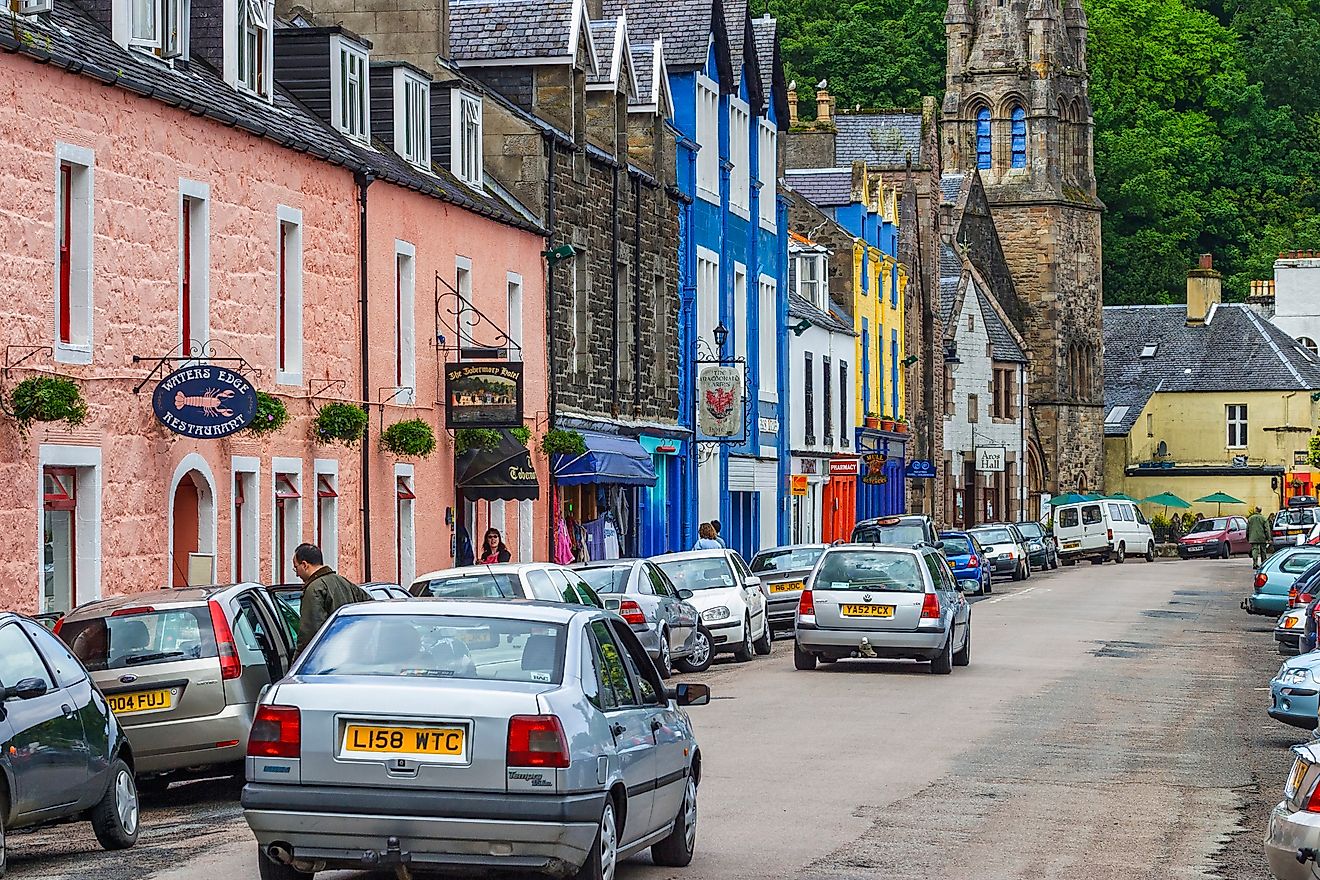
The painted harbourfront of Tobermory is one of the most recognisable sights in the Hebrides, a curved row of houses in blue, yellow, pink, and red reflected in the bay. The town of roughly 1,000 residents was laid out in 1788 by the British Fisheries Society as a planned herring port, and that single crescent of Main Street still curls beneath a wooded bluff on the north coast of Mull. Fishing boats and ferries share the water. Behind them, the shops, galleries, and cafes keep the waterfront busy the year round. Tobermory Distillery has worked at the south end of the bay since 1798, producing both its namesake malt and the peated Ledaig. Above the town, Aros Park offers woodland trails to a waterfall on the shore of the bay, and the Mull Museum lays out the island's crofting and seafaring past. A short drive west, the white sands of Calgary Bay open onto some of the finest beach scenery in the Inner Hebrides.
Portree, Isle of Skye

Portree is the capital of Skye, and its harbour of pastel-painted houses stacked beneath a low cliff has become the island's defining image. Home to around 2,300 people, the town grew as a planned fishing village in the early 19th century under Lord MacDonald, arranged around a sheltered bay on Skye's east coast. The Lump, a wooded headland above the harbour, carries the Apothecary's Tower and now hosts the Isle of Skye Highland Games each August, a gathering first held in 1877. Boats leave the pier for seal and sea-eagle trips. The Scorrybreac path circles the coast north of town for wide views across the Sound of Raasay. Portree also makes the natural base for the Trotternish peninsula just north, where the rock pinnacles of the Old Man of Storr and the folded ridges of the Quiraing draw walkers from around the world. In the town itself, the Royal Hotel stands where Bonnie Prince Charlie said his farewell to Flora MacDonald in 1746.
Plockton, Wester Ross

Sheltered from the open sea on a curve of Loch Carron, Plockton was laid out in 1801 by the landowner Sir Hugh Innes as a fishing village for tenants cleared from inland glens. It has since become one of the loveliest villages in the western Highlands. Its single street of whitewashed cottages faces the water, and thanks to the warm current of the North Atlantic Drift, a line of cabbage palms grows along the shore, an unlikely sight at this latitude. The village belongs to the National Trust for Scotland as a conservation area within the Balmacara Estate, and its calm harbour and mountain backdrop have long drawn painters and sailors alike. Small boats run trips out to spot the resident seals, and the hills behind offer quick climbs to views over the loch and its scattered islands. Screen fans may recognise the village as the setting for the 1990s television series Hamish Macbeth. Each summer the Plockton Regatta fills the bay with sails, and the little railway station on the Kyle of Lochalsh line puts the village within reach without a car.
Culross, Fife

Culross is the most complete surviving example of a 17th- and 18th-century Scottish burgh, a cluster of white-harled, red-pantiled houses climbing cobbled streets above the Firth of Forth. Once a busy little port trading in coal and salt, the village escaped modern redevelopment almost entirely. Much of it passed into the care of the National Trust for Scotland, which has looked after the historic core since 1932. The ochre-coloured Culross Palace, built between 1597 and 1611 for the coal merchant Sir George Bruce, anchors the lower town with its painted rooms and terraced garden. Uphill stand the 1626 Town House, the Mercat Cross, and the ruins of Culross Abbey, a Cistercian house founded in the 13th century. The whole village is walkable in an afternoon, its lanes so intact that they regularly stand in for the past on screen, most recently as a location in Outlander. From the abbey ground at the top of the hill, the view stretches back over the rooftops to the Forth below.
Melrose, Scottish Borders

At the foot of the three peaks of the Eildon Hills, on a bend of the River Tweed, Melrose is widely held to be the prettiest of the Border towns. Its centrepiece is Melrose Abbey, a rose-pink Cistercian ruin founded in 1136 by David I, where the embalmed heart of Robert the Bruce is believed to lie buried. The compact town centre, home to around 2,300 people, gathers around a market cross, with Georgian and Victorian stone houses, small hotels, and independent shops lining the streets. Just outside town, the Roman fort and museum at Trimontium recall the legions who camped beneath the Eildons, and Abbotsford, the baronial home Sir Walter Scott built for himself, sits two miles west along the Tweed. Melrose is also the birthplace of Rugby Sevens, first played here in 1883 and still celebrated each spring. The town serves as a hub for three long-distance trails, and the climb to the Eildon summits rewards walkers with a panorama across the whole of the central Borders.
Inveraray, Argyll

Inveraray is one of Scotland's finest planned towns, a gleaming set piece of black-and-white Georgian buildings arranged along the shore of Loch Fyne. The 3rd Duke of Argyll swept away the old fishing village in the 1740s and commissioned a new town to complement his castle, laid out with the architects John Adam and Robert Mylne. The result is a main street of striking uniformity, its arches and white frontages little changed in more than 250 years. Inveraray Castle, the turreted Gothic Revival seat of the Duke of Argyll and chief of Clan Campbell, rises among trees just north of the town. Nearby, Inveraray Jail recreates 19th-century prison life inside a preserved courthouse and cells, staffed by costumed guides. The bell tower of All Saints, built in the early 20th century as a Clan Campbell war memorial, holds the second-heaviest ring of ten bells in the world and rewards the climb with a loch-and-town view. A woodland path leads up Dun na Cuaiche to a hilltop watchtower above it all.
Dunkeld, Perthshire

Where the River Tay slips out of the Highlands, Dunkeld gathers on the north bank around its part-ruined cathedral, a town of about 1,200 long known as the gateway to the Highlands. Dunkeld Cathedral stands half in ruin and half in use, its choir still serving as the parish church, on a green beside the river where St Columba's relics were once enshrined. The lanes leading up from it are lined with the Little Houses, a row of 18th-century merchants' homes raised after the town was razed in the 1689 Battle of Dunkeld and lovingly restored by the National Trust in the last century. Thomas Telford's elegant bridge of 1809 carries the road across the Tay, and on the far bank at Birnam an ancient oak survives as the last trace of the wood immortalised in Macbeth. A short way upriver, The Hermitage frames a folly above the plunging Black Linn Falls amid some of Britain's tallest Douglas firs. The Loch of the Lowes reserve nearby offers a hide for watching nesting ospreys.
Ballater, Royal Deeside

Ballater sits in a bend of the River Dee at the eastern edge of the Cairngorms, a tidy Victorian village of about 1,500 that owes its character to the royal family up the road at Balmoral. The town first grew as a spa around 1770, drawing visitors to the mineral wells at nearby Pannanich, then flourished after Queen Victoria settled at Balmoral in the 1850s and the railway reached the village in 1866. The old station, complete with the Queen's private waiting room, has been rebuilt as a visitor centre after a fire, and many of the shops still display royal warrants earned by serving the estate. Granite Victorian houses line the conservation-area centre, ringed by pine-covered hills that turn gold in autumn. The Royal Bridge, opened by Queen Victoria in 1885, crosses the salmon-rich Dee at the edge of town. Walkers set off from here for Lochnagar and the trails of the Cairngorms National Park, and the Ballater Highland Games have gathered the village every August since 1864.
Wigtown, Dumfries & Galloway

In the far southwest, on a low rise above the Cree estuary, Wigtown has reinvented itself as Scotland's National Book Town, its wide streets now lined with more than a dozen bookshops. Named Scotland's book town in 1998, it revived a market town that had fallen on hard times, and each autumn the ten-day Wigtown Book Festival fills its halls and gardens with readers and writers. Second-hand shops spill from the broad central square, among them The Book Shop, the largest of its kind in the country, and The Open Book, where visitors can book a stay and run the shop themselves. The French Gothic County Buildings of 1862 overlook the square and house a live camera trained on a nearby osprey nest. Below the town, the saltmarshes of the Cree draw huge flocks of geese in winter, and a monument on the flats marks the Wigtown Martyrs, drowned there for their faith in 1685. The Galloway hills roll away inland toward some of Britain's darkest night skies.
Crail, East Neuk Of Fife

At the eastern tip of Fife, Crail guards a tiny harbour ringed with red-pantiled cottages that is often called the most photographed in Scotland. This is one of the oldest of the East Neuk fishing villages. It was made a royal burgh in 1178 and once held one of the largest medieval markets in Europe along its wide Marketgate. The quay below, sheltered by a wall first built with Dutch help and later extended by the engineer Robert Stevenson, still lands the occasional creel of lobster and crab. White-harled houses with crow-stepped gables and pantiled roofs tumble down the slope toward the water, painted and repainted by generations of artists. A seafood shack on the quay serves fresh-cooked lobster through the summer, and the Crail Museum tells the village's long story a few steps up from the shore. The Fife Coastal Path runs through the village, north to the lighthouse at Fife Ness and south along the shore toward the neighbouring harbours of Anstruther and Pittenweem.
Why These Towns Are Worth The Journey
What links these ten places is the way setting and settlement complete each other: a painted harbour needs its backdrop of hills, and an abbey ruin gains something from the river bending past it. Cities have their galleries and their nightlife, but this is a different kind of beauty, one measured in harbour reflections, cobbled climbs, and the long light of a northern evening on stone. Scotland's roads make the travelling part of the reward, threading the coast and the glens between one town and the next, so the drive itself becomes a slow unspooling of scenery. Choose a corner of the map, set aside an unhurried weekend, and let these small towns show you the country the motorways never reach.