7 UK Towns Where Time Stands Still
Across the United Kingdom, several towns hold onto their past a little more tightly than most. Wareham in Dorset preserves its Saxon defensive walls, while Malmesbury in Wiltshire is the country's oldest borough. In Scotland, Stirling stands guard over medieval battlefields while the wonderfully named Gatehouse of Fleet grew up around a river crossing and an old inn. Wells’ cathedral makes it the smallest city in England, Ventnor retains its Victorian-era resort vibe, and Marlow boasts a River Thames bridge that became the blueprint for even fancier bridges in Europe. In these seven towns, time really has stood still.
Malmesbury, Wiltshire

Standing on a hilltop ringed by the River Avon at the southern edge of the Cotswolds, Malmesbury is the oldest borough in England. Granted a charter and self-government under Alfred the Great in the 880s, at its heart is Malmesbury Abbey, a Benedictine monastery founded in the 670s. By the 11th century, the abbey housed one of the largest libraries in Europe, while its spire, since lost, was one of the tallest in the country.
Athelstan, the grandson of Alfred and considered the first king of all England, was buried in the abbey in 939. While much of the medieval abbey is now ruined, the nave still serves as the parish church, and its elegant Romanesque south porch is among the country’s finest. The abbey grounds and gardens are also worth exploring.

Next door, The Old Bell Hotel has been looking after guests since 1220. Built as the abbey's guesthouse, it’s said to be the oldest hotel in England and is just bursting at the seams with old-world charm. Malmesbury’s old town center is home to the Market Cross, a late-15th-century octagonal stone shelter built for traders, and the Athelstan Museum, with exhibits on local history.
Stirling, Stirlingshire

Few places pack as much Scottish history into a single travel destination as Stirling. Set on the River Forth at the crossroads of the Lowlands and the Highlands, the commanding views from the town’s rocky crags sealed its strategic importance. Stirling Castle, a royal stronghold and residence that changed hands several times during the Wars of Independence, dominates the town.
Across town, on the other side of the river, the National Wallace Monument stands 220 feet tall and is visible for miles in all directions. This striking Victorian Gothic tower was built in 1869 to honor William Wallace, the Scots warrior immortalized in the movie, Braveheart. It’s a 246-step climb to the top, but the views of Stirling and its castle are breathtaking. The tower also overlooks the ground where Wallace beat a far larger English army at the Battle of Stirling Bridge in 1297.

The crossing at the center of that battle is marked by Stirling Old Bridge, a stone arch structure built in the 15th century and one of the finest medieval bridges in Scotland. Stirling's Old Town is immensely walkable, its cobbled streets lined with medieval and Renaissance buildings, creating a scene that has changed little over the centuries. One of the most notable is the Church of the Holy Rude, built in 1456, where the infant James VI was crowned in 1567.
Wells, Somerset

Set below the Mendip Hills in Somerset, Wells is the smallest city in England by population, and its city status dates back to its cathedral. Wells Cathedral was built between the late 12th and 15th centuries and remains one of the prettiest places of worship in the country. Look for the nearly 300 carved medieval figures on the cathedral’s West Front. Inside, a pair of crossed stone arches known as the scissor arches was added in 1338 to brace the central tower after it began to sink under its own weight.
Construction of the adjacent moated Bishop's Palace started in the early 13th century and has housed the Bishops of Bath and Wells for more than 800 years. Spread over 14 acres around the springs (or wells) that give the city its name, the grounds and gardens are simply spectacular. Be sure to stroll the old palace walls for great views of the palace, its grounds, and the moat.

A few steps away, the remarkably well-preserved Vicars' Close is a narrow street of terraced houses built between 1348 and 1430 that continue to house members of the cathedral choir. At 460 feet long and lined with 27 listed homes, a chapel, and a hall, making it one of the oldest residential streets in Europe, with original buildings still being lived in
For a memorable stay that’s just a stroll away from Wells’ historic attractions, check out The Swan Hotel. Dating from the 15th century, this former coaching inn was an important stop for horse-drawn coaches and has a lovely patio that opens directly onto the green in front of the cathedral.
Gatehouse of Fleet, Dumfries and Galloway

Gatehouse of Fleet is undoubtedly one of the most romantic small towns in Southern Scotland. Named after the Old Norse word for road (gait) and the inn (“gait house”) built to serve travelers, by the 1760s, a planned village was developed, and the original inn grew into what is now the Murray Arms as for the “Fleet” in the town’s name, that stems from the Water of Fleet, which had to be crossed a short distance from the inn.
The town’s High Street leads straight to its most striking landmark, the Clock Tower. Built in 1871 of local stone, the tower marks the crossroads where two of the town’s most impressive historic views can be enjoyed. One looks up High Street past the Murray Arms to the town’s war memorial, while the other looks up Ann Street past the adjacent Masonic Arms in a scene that easily rivals other UK destinations such as the Cotswolds.

The Mill on the Fleet, a restored cotton mill built in 1788, is also worth a visit. Now home to a museum and a café with a riverside terrace, it also retains its original water wheel. In addition to being an excellent place to stay, the Murray Arms famously hosted Scots poet Robbie Burns in 1793. It was here that Burns wrote the first draft of Scots Wha Hae, the patriotic song composed as the address Robert the Bruce gave his army before the Battle of Bannockburn in 1314. A quiet reading room at the hotel is named in the poet's honor.
Ventnor, Isle of Wight

Once an unassuming fishing village on the Isle of Wight, Ventnor’s fortunes changed in the 1830s after the curative benefits of its mild seaside climate became known. Almost overnight, the village turned into a fashionable health resort, with Victorian villas, hotels, and terraces springing up along the steep slopes below St. Boniface Down, the island's highest point.
The settlement literally clings to the cliff face in tiers, connected by zig-zagging roads and walkways, earning it the nickname “English Mediterranean.” Visits by celebrities like Charles Dickens and even Queen Victoria herself cemented the town’s reputation. If either were to visit today, chances are they might recognize landmarks like The Cascade, a landscaped run of water and flowerbeds stepping down toward the seafront, and the Undercliff, which shelters the town.

To really get a feel for Ventnor and its Victorian-era charm, plan to stay at The Royal Hotel. Set above the bay, this elegant grand hotel hosted Dickens, and Queen Victoria famously visited to partake in afternoon tea. For spectacular views over Ventnor Bay, make the short climb through the hotel’s clifftop gardens.
Marlow, Buckinghamshire

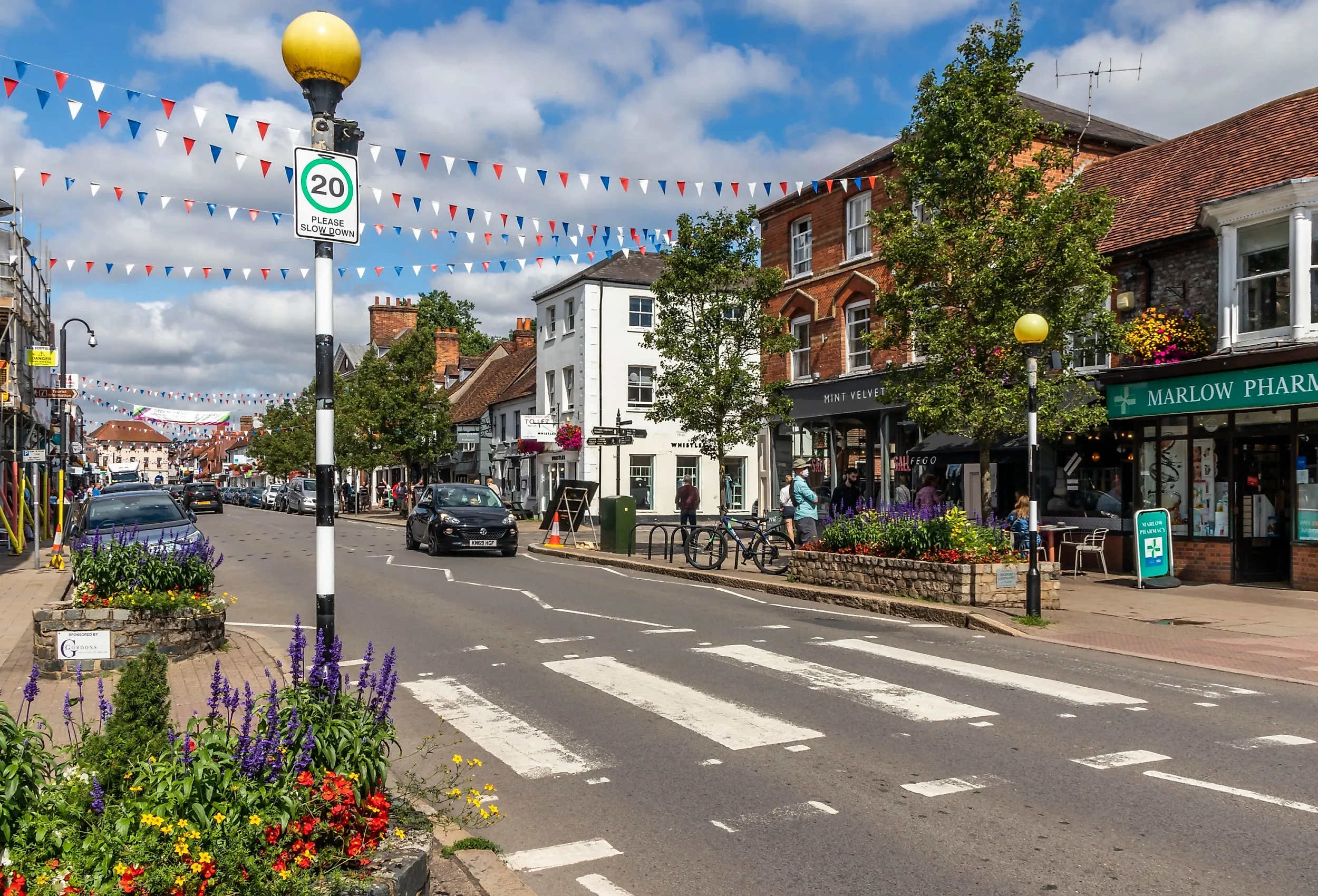
Located on the banks of the River Thames, 33 miles upstream from central London, a wander along Marlow High Street in Buckinghamshire is a must-do. Although the current bridge is a more recent addition, a bridge has crossed the river here since the 14th century. Built between 1829 and 1832, the Marlow Bridge, as seen today, might look familiar to those who have visited Hungary: spanning 235 feet, it served as the working model for the even larger Szechenyi Chain Bridge over the Danube in Budapest.
For great views (and fewer crowds), follow the path that leads to the river from All Saints Church. Higginson Park also provides access to the water and the bridge, and is where you can hop aboard a River Thames boat trip all the way to Windsor. Alternatively, you can walk all the way into London along the Thames Path, the long-distance trail that follows the river.

For a stay with its own unique slice of history, Danesfield House occupies a classy neo-Tudor mansion just outside Marlow. Completed in 1901 and set on 65 acres, offering stunning views of the Thames, it was used by the RAF during the Second World War. Fascinating photo displays from the period show men and women in uniform throughout the property.
Wareham, Dorset

Wareham’s location on the banks of the River Frome made it an excellent choice for a fortified town. Fortified from the beginning of Alfred the Great’s reign as an Anglo-Saxon burh to help defend Wessex from Viking raids, several earthwork ramparts that once protected it are still visible. Known locally as the “Walls,” they stand up to 17 feet high and 55 feet across in places and are the best-preserved Saxon town defenses in England.
St Martin 's-on-the-Walls, a Saxon church built in 1030, is the oldest and most complete of its kind in Dorset. It’s also famous for its carved stone effigy of T. E. Lawrence, the soldier and writer better known as Lawrence of Arabia. The Church of Lady St. Mary, at the southern edge of town near the quay, dates to the eighth century and was briefly the final resting place of King Edward the Martyr, before his body was later moved to Shaftesbury Abbey.
For an overnight stay that’s steeped in history, The Priory hotel occupies a 16th-century building beside Lady St Mary. Wandering the hotel’s four-acre grounds and historic gardens overlooking the Frome and the church is like stepping into a whole other world.
Towns Where Time Stands Still
Together, these seven destinations represent some of the best-preserved small towns in the United Kingdom. And best of all, the past in each of them isn’t roped off in a museum but is instead accessible to everyone. All of which visits feel less like a routine sightseeing trip, and more like stepping back in time.