7 Prettiest Main Streetscapes In New York
New York’s most memorable Main Streets are more than collections of shops and restaurants. Warren Street in Hudson pairs 19th-century buildings with galleries and restaurants, Lake Placid’s Main Street combines Olympic history with views of Mirror Lake, and Cooperstown brings baseball heritage into the heart of its village center. Whether you visit Cold Spring’s riverfront setting or Garden City’s tree-lined commercial streets; these towns reveal their histories in a single streetscape.
Hudson

Warren Street climbs about seven blocks up from the Hudson River. Whaling merchants out of Nantucket and Rhode Island bought the site in 1783 and had a working port within two years. Hudson never got rebuilt the way most river cities did. What survives is a nearly unbroken run of Federal, Greek Revival, and Victorian storefronts on a single street. Hudson Hall stands at number 327, built in 1855 as the city hall and now the oldest surviving theater in New York State.
Wasabi has been serving sushi at 807 Warren for years. Savona's Trattoria and Bar opened at 136 Warren, the fourth restaurant for brothers Stephen and Daniel Savona, whose father emigrated from Sicily and started with a bakery on Coney Island. The 510 Warren Street Gallery is an artist-owned membership co-op that has been hanging shows since 2010, open Friday through Sunday. Further down at 205, the Front Room Gallery shows photography and installation work. None of these are chains, which is the whole point of the street.
Cold Spring

The West Point Foundry, just south of Cold Spring, produced the Parrott rifle, the artillery piece that armed much of the Union Army. Main Street runs downhill from that industrial past to the water in a short, tight descent. At the very bottom, at 2 Main Street, is the Hudson House River Inn. The building was built in 1832 and has welcomed guests ever since, making it the second-oldest continuously operating inn in New York State. It joined the National Register of Historic Places in 1982.
Doug's Pretty Good Pub is located at 54 Main Street in a building that has been a bar since the 1800s. Owner Doug Price closes Monday and Tuesday, and the pub's own website explains those days as time at the racetrack. Uphill, the Cold Spring General Store handles pantry goods and souvenirs for the weekend crowd coming off the train. Studio Tashtego at 158 Main makes and sells ceramics, glass, and textiles.
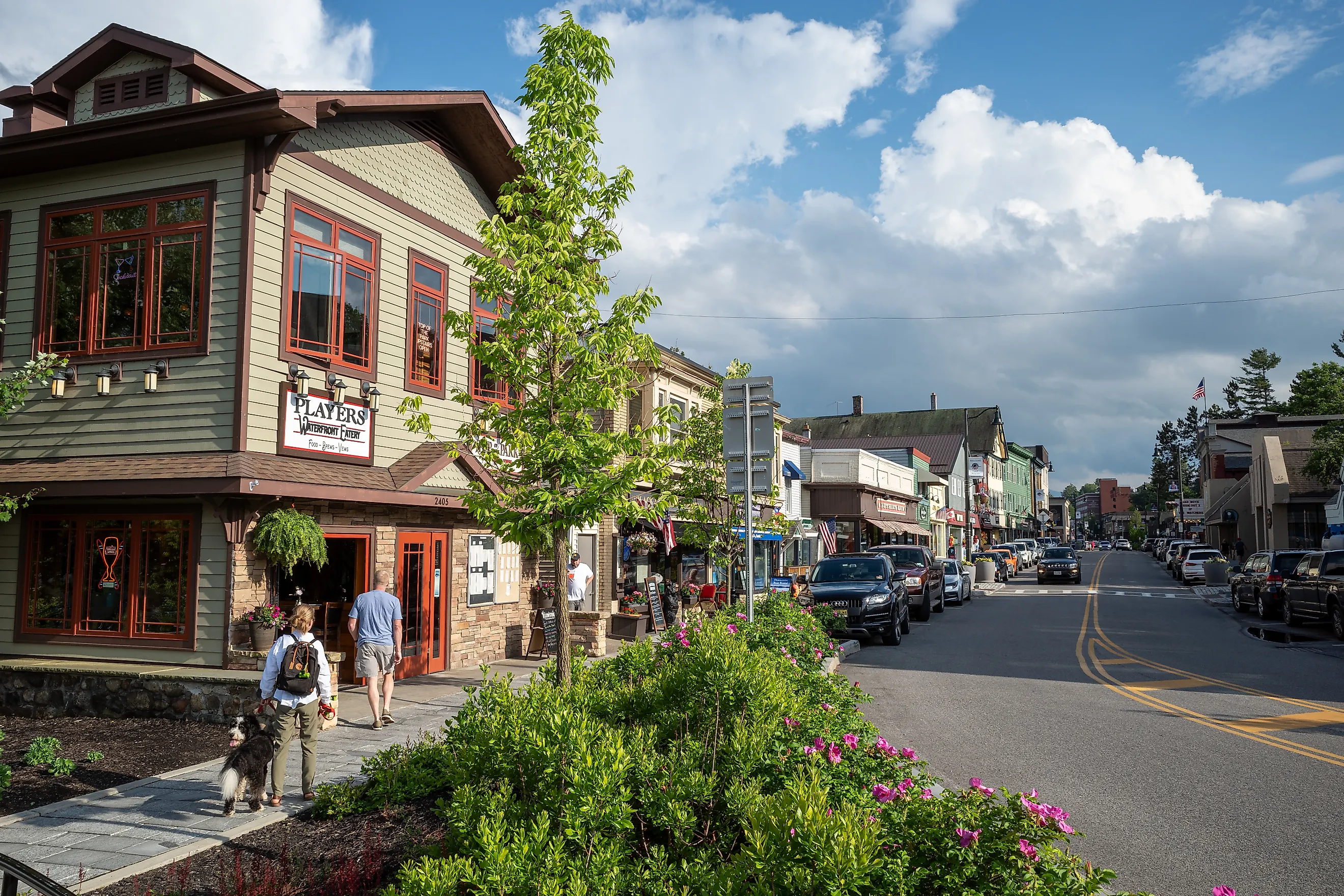
Lake Placid

On February 22, 1980, the United States beat the Soviet Union 4-3 in a hockey arena on Main Street. The building is still standing and still booking games, renamed for coach Herb Brooks. The Lake Placid Olympic Museum sits inside the same Olympic Center complex and covers both the 1932 and the 1980 Winter Games. Main Street tracks the shoreline of Mirror Lake for much of its length, so storefronts line one side and open water the other. That geometry is why Lake Placid reads as an alpine village and not a highway strip, with the Adirondack high peaks closing off the view at both ends.
Prison City Brewing runs a taproom at 2577 Main Street, the third location for a brewery based in Auburn. Dawn and Marc Schulz met in Lake Placid in 1996 and brewed their first batch together here, which is the reason the outpost exists at all. The room is small and counter-service only, with rotating drafts including the Mass Riot IPA. A short walk along, Mid's Park sits between an outdoor outfitter and The Haus, a narrow strip of grass with a bandshell facing the water. Songs at Mirror Lake has run free Tuesday evening concerts there for twenty summers, funded by volunteers and a state arts grant.
Cooperstown

Most people walk the National Baseball Hall of Fame backwards on purpose. Staff send you to the second floor first, then the third, and save the Plaque Gallery on the ground floor for last. That room holds more than 300 bronze plaques hung in order of induction, with the first five inductees at the center of the rotunda. The museum has occupied 25 Main Street in Cooperstown since its dedication in June 1939. Doubleday Field is two blocks off, which keeps foot traffic moving the length of the street all summer.
The Cooperstown Art Association shows regional painters and sculptors at 22 Main and runs Fine Arts on the Lawn every Labor Day weekend. Artists set up tents on the grass while members work on the front porch. Norbu opened at 149 Main in the former Alex's World Bistro space and serves Himalayan and Indian food. Cousins Nawang and Dasang Gurung run it, and the walk-up window on Main sells momo dumplings alongside bubble teas named for ballplayers. Yogi Berry and Milk Tea Mantle are two of them. The Cooperstown Bat Company sells its own bats up the street, custom orders included.
Corning

A gaffer is a master glassblower, and Corning named its downtown district after the job. The Gaffer District spans roughly six blocks of Market Street and houses well over 100 businesses. Market Street is also the finish line for the Wineglass Marathon each fall, which puts several thousand runners on the pavement in a single morning. Vitrix Hot Glass Studio at 77 West Market keeps a working furnace behind the retail floor, so pieces get made in view of anyone buying one.
The West End Gallery sits a few doors up the same street and represents regional painters, sculptors, and woodworkers. Rico's Pizza and Subs sells a thin-crust pie with two types of pepperoni. Off the west end of Market, Riverfront Centennial Park opens onto the Chemung River and links to the Centerway pedestrian bridge. The Corning Farmers Market takes over that park on Thursday mornings between early June and late October, run by the Gaffer District itself rather than an outside operator.
Garden City

Alexander Turney Stewart made his fortune in dry goods and spent part of it on 7,000 acres of the Hempstead Plains in 1869. He laid out a village on flat, treeless grassland and then planted it, which is how the place got its name. The village still carries the nickname Stewart's Folly. The trees took. Garden City was incorporated in 1919, and fifty of Stewart's original structures went onto the National Register in 1978 as the A. T. Stewart Era Buildings. The Cathedral of the Incarnation was finished in 1885, and Stewart and his wife, Cornelia, are buried beneath it.
Seventh Street and Franklin Avenue carry the shops, and both still hold the mature canopy that Stewart's plan called for. The Garden City Hotel occupies a site that has held a hotel since Stewart's day, the grandest version of which came from the firm of McKim, Mead and White. Its dining rooms and the lower-level Red Door Spa keep the building busy outside of wedding season. Leo's Midway at 190 Seventh Street is the plainer, older counterweight to all of that. Muse Paintbar sits up Franklin Avenue at 837, and Lacrosse Unlimited works the same stretch for a village that takes the sport seriously.
Williamsville

Jonas Williams built a grain mill on Ellicott Creek in 1811, and the settlement that grew around it took his name. The Williamsville Water Mill still stands on Spring Street above the falls and still presses cider for sale. Main Street here is New York Route 5, the old road between Buffalo and Batavia, and the village sits about ten miles out from downtown. Williamsville was incorporated in 1850 and later adopted a preservation code protecting thirty-four sites inside roughly one square mile.
Overwinter Coffee occupies a Civil War-era general store facing Main Street near Glen Park, fitted out to match the period. Britesmith Brewing took the 1800s blacksmith shop at 5611 Main and named itself for the tinsmiths who once worked the building, with a stone patio over Ellicott Creek. Glen Park is the reason most people stop. The village and the Town of Amherst have jointly owned it since 1976, and Glen Falls drops about thirty feet over a lip of the Onondaga Escarpment at its edge. The Evans House handles weddings and showers just off the street in a three-story house.
Why These Streets Are Still Standing
Hudson’s Warren Street stands out for galleries and dining, Cold Spring pairs preserved buildings with Hudson River views, and Lake Placid brings Olympic history to the edge of Mirror Lake. Cooperstown’s baseball landmarks, Corning’s glass studios, Garden City’s tree-lined shopping streets, and Williamsville’s cafés and Glen Falls show how each town turns its Main Street into a distinct destination.