7 of the Most Vibrant Towns in Southern California
In January 1904, a hotel magnate named George Boldt sent a telegram to a private island in the St. Lawrence River with three words on it: stop all construction. His wife had died suddenly, he could not face finishing the 120-room castle he was building for her, and he never went back. It is still standing at Alexandria Bay, unfinished, and you can walk through it. Upstate New York is full of stories like that, sitting quietly in towns of two thousand people. Eleven of them are below, and each one has something the other ten do not.
Lake Placid

Roughly 2,300 people live in Lake Placid, and it has hosted the Winter Olympics twice. That is an absurd ratio, and the town has never once pretended otherwise. The 1980 rink where the American hockey team beat the Soviets is still in use. The ski jumps are still there on the edge of town, visible from the highway like two enormous exclamation points, and you can ride an elevator up one of them.
Main Street runs along Mirror Lake, which is not the lake the town is named after, a distinction locals will make politely. In winter the lake becomes a skating surface with a plowed oval on it. Whiteface Mountain handles the downhill skiing, the High Peaks handle summer, and the whole place smells like woodsmoke by October.
Saranac Lake

Ten miles from Lake Placid and running at a completely different tempo, Saranac Lake made its name in the nineteenth century as a tuberculosis town. Doctors sent patients to the Adirondacks for the cold, dry air, and the town filled up with cure cottages built with enormous porches where people slept outdoors year-round on purpose. Many of those houses are still lived in.
What that left behind is a town with real bones and no resort gloss. The Adirondack Artists Guild runs a working co-op gallery downtown. Winter Carnival, going since the 1890s, includes an ice palace built by volunteers out of blocks cut from the lake, which is exactly as good as it sounds. The rest of the year it is paddling, fishing, and the six-mile Bloomingdale Bog Trail, where the birding is better than the name suggests.
Skaneateles

Skaneateles sits at the north end of a lake so clean that Syracuse drinks it essentially unfiltered, one of a small number of American cities that gets away with that. Say it "skinny-atlas" and nobody will correct you.
The village is about 2,400 people and looks like a set. The Sherwood Inn has been putting up travelers since 1807, back when this was a stagecoach stop. The John D. Barrow Art Gallery, tucked inside the public library, holds a large collection of work by one nineteenth-century local painter, which is an unusual thing for a village this size to have. Mid-Lakes Navigation still runs the mail boat down the lake in summer, delivering to docks the way it has for over a century, and passengers can ride along. Bill and Hillary Clinton spent a summer vacation here in 1999, which the town mentions but does not belabor.
Watkins Glen
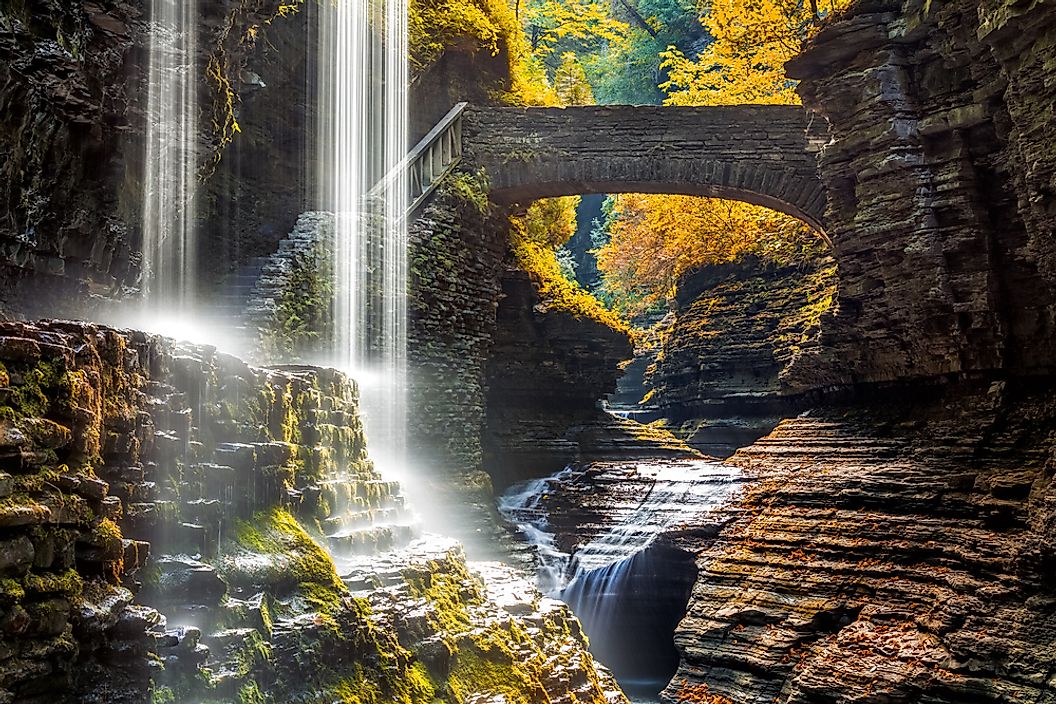
The gorge at Watkins Glen drops 400 feet in about two miles and produces 19 separate waterfalls doing it, which is one of the densest concentrations anywhere in the East. The trail runs over, under, and occasionally behind them. At Cavern Cascade you walk through the spray behind a 52-foot fall, then climb the Spiral Tunnel, a staircase carved through solid rock.
The Civilian Conservation Corps laid the 832 stone steps in the 1930s. Before that, visitors squeezed through a narrow spot in the rock that the Victorians named Fat Man's Delight, which tells you something about both the geology and nineteenth-century tact. Above the gorge, the village sits at the foot of Seneca Lake in the middle of Finger Lakes wine country, and Watkins Glen International brought Formula One racing here for two decades, so the same town does gorge hiking and engine noise.
Aurora

Around 700 people live in Aurora, strung along the eastern shore of Cayuga Lake, which covers about 66 square miles and takes the weather personally. For 156 years the village was built around Wells College, which closed for good in 2024. The campus is quiet now, and the town is working out what it becomes next.
What remains is remarkably intact. The Inns of Aurora occupy several restored nineteenth-century houses along the lake and have turned the place into a small hospitality operation with a spa and serious kitchens. The Fargo Bar and Grill has been the village's public room for generations. MacKenzie-Childs, the ceramics and furniture company known for its hand-painted checkerboard patterns, works out of a farm just north of the village and opens it to visitors, which means you can watch someone paint a teapot by hand and then buy it.
Hudson

Hudson was founded in 1785 by Nantucket whalers who wanted a port the British navy could not easily reach, which is why a town 120 miles inland has a whaling history. It spent the twentieth century as a rough river town and the twenty-first becoming an antiques capital. Warren Street runs straight uphill from the river for a mile, lined with dealers, galleries, and restaurants.
Hudson Hall, in the 1855 Opera House, bills itself as the oldest surviving theater in New York State and has the programming to justify keeping it. Time and Space Limited puts experimental work into old warehouse space. And the view west across the river toward the Catskills is the actual view that launched the Hudson River School painters, which you can verify by standing in the same spot they did.
Woodstock

First, the correction everyone deserves: the 1969 festival did not happen here. It happened on a dairy farm in Bethel, about 60 miles southwest, after Woodstock declined to host it. The name stuck anyway, and the town has spent five decades being asked about a weekend it had no part in.
The real story is older and quieter. Artists established a colony here in 1902, and the creative population never left. The Woodstock Artists Association and Museum has been running since 1919. Tinker Street holds the galleries and the bookshops. Overlook Mountain climbs to 3,140 feet on a steep two-and-a-half-mile fire road, passing the gutted stone ruins of a hotel that burned more than once before anyone took the hint, and finishing at a fire tower with the whole Hudson Valley underneath it.
Saugerties

Ten minutes from Woodstock and considerably less self-conscious about it, Saugerties has the better lighthouse. The 1869 Saugerties Lighthouse sits where Esopus Creek meets the Hudson, reachable by a half-mile trail that floods at high tide, so check the tables before you set out. The keeper's quarters operate as a two-room bed and breakfast, which means you can sleep in a working lighthouse if you book far enough ahead.
Partition Street handles the rest: bookshops, Lucky Chocolates, Miss Lucy's Kitchen. Each September the town hosts the Hudson Valley Garlic Festival, which draws tens of thousands of people to a field to eat garlic in every conceivable preparation, including ice cream. It is the largest event of its kind in the country and the town leans all the way into it.
Cooperstown

The National Baseball Hall of Fame is in Cooperstown because of a story that turned out to be false. A 1907 commission concluded that Abner Doubleday invented baseball in a Cooperstown pasture in 1839, which historians have since thoroughly dismantled; Doubleday was at West Point that year and never mentioned baseball in his life. The Hall opened here in 1939 regardless, and it is magnificent, so nobody is complaining.
The town is about 1,800 people and would be worth the drive without the baseball. Otsego Lake runs nine miles north, and James Fenimore Cooper called it Glimmerglass in the Leatherstocking Tales, which his father's town has been trading on ever since. The Fenimore Art Museum holds a serious folk art and Native American collection. The Glimmerglass Festival stages full opera productions in a lakeside theater every summer, in a village with one traffic light.
Corning

The Corning Museum of Glass holds the largest collection of glass in the world, roughly 50,000 objects spanning 3,500 years, in a town of about 10,500 people. Glassblowers give live demonstrations all day, and you can book a workshop and make something yourself, badly, which is part of the fun.
In 1972 Hurricane Agnes put five feet of water through the museum and damaged tens of thousands of pieces. Staff and volunteers spent years on the recovery, and the flood is now part of the institution's own history displays. Down the hill, Market Street's brick blocks hold the restaurants and shops, the Rockwell Museum covers American and Western art, and the surrounding hills put Corning at the southern door of the wine country.
Alexandria Bay

Back to the telegram. George Boldt ran the Waldorf-Astoria and in 1900 put 300 workers on Heart Island to build Louise Boldt a six-story, 120-room Rhineland castle, complete with tunnels, a powerhouse, an Italian garden, and a separate tower as a playhouse for the children. Louise died in January 1904. The telegram went out, the workers left, and the shell sat open to Adirondack weather and vandals for 73 years until the bridge authority took it over in 1977 and began putting it back together.
You reach it by boat from Alexandria Bay, a village of about a thousand people on the St. Lawrence River in the middle of the Thousand Islands, where the actual island count is closer to 1,800. Tour boats thread the channel past summer houses built on rocks barely larger than their foundations. The town itself is small, seasonal, and unpretentious, and the castle across the water is one of the strangest and saddest things in the state.
Eleven Towns, Eleven Reasons
These places are not interchangeable, which is the point. One has two Olympic torch legacies and a ski jump you can ride up. One has 19 waterfalls stacked into two miles of gorge. One built a national museum on a story that was not true and got a great museum out of it anyway. One is famous for a festival that happened in a different county entirely. Pick by the specific thing rather than the general vibe, because the specific thing is what you will actually remember.