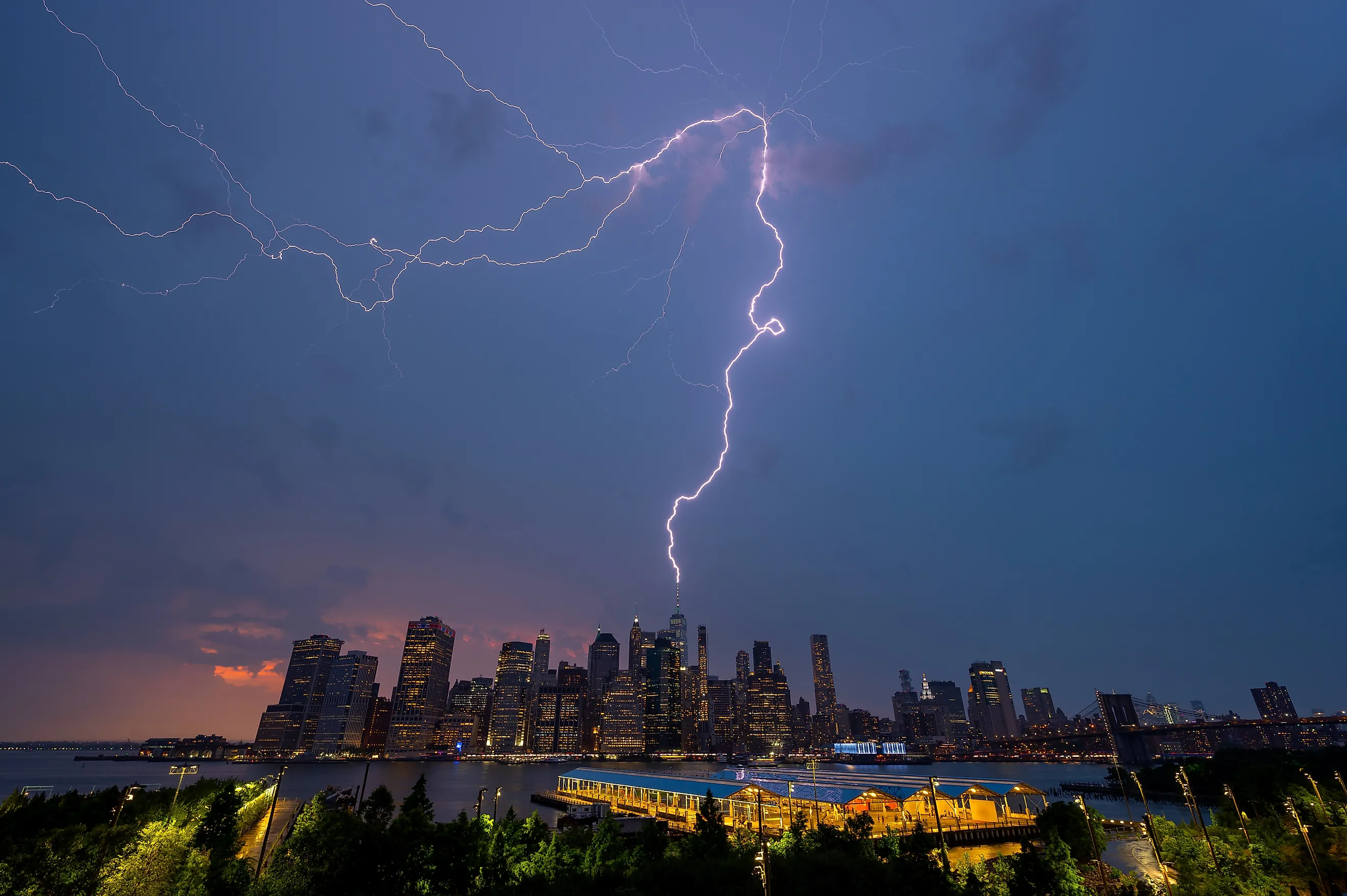
The American Buildings Struck By Lightning Most Often
Lightning never strikes the same place twice. An untruer word has never been spoken, especially when it comes to America’s skyscrapers. The Willis Tower in Chicago gets struck by lightning between 50 and 100+ times every year. Vaisala data recorded 250 strikes on the building between 2015 and 2020 alone. In 2023, the tower was struck 38 times, and One World Trade Center was struck 26 times. No updated data for 2026 is available yet, but multiple videos show the buildings being struck this year as well. The ranking below is based on the most recent past data.
Willis Tower, Chicago, Illinois

In June 2025, a triple lightning strike hit the Willis Tower, Trump Tower, and 875 North Michigan Avenue at the same time. Lightning strikes were not exactly unexpected during the thunderstorm raging at the time, but the triple strike was something of a rare event. Between 2015 and 2020, lightning struck the tower 250 times, according to limited available data. Surprisingly, despite being struck so many times, the building, completed in 1973, has never suffered damage. It stands 1,451 feet (442.3 meters) high, reaching 1,729 feet (570 meters) with its broadcast antennas. When storm clouds pass the building overhead, the antennas become a gigantic lightning rod. At the same time, the building features a deep steel foundation with piles driven into the bedrock. This helps route currents from strikes away from the building’s tenants and into the ground.
One World Trade Center, New York City, New York

Lightning struck the One World Trade Center 189 times between 2015 and 2020. More, uncounted strikes have happened in 2026, with some recorded footage shared on news outlets. The building with its symbolic height of 1,776 feet (541.3 meters) was officially opened in 2014 and is now a natural lightning rod. The electricity from the lightning strikes is channeled down the exterior of the tower and discharged into the bedrock below. When severe weather systems hit the area and pass over the Hudson River, the building is more at risk of multiple strikes. Bad weather also causes another natural phenomenon at the tower that once led people to believe it was haunted. When the wind picks up, it rushes through the spire's lattice design and the open shaft areas. This creates an almost eerie musical or ‘wailing’ sound.
Bank of America Plaza, Atlanta, Georgia

Between 2015 and 2020, the Bank of America Plaza in Atlanta, completed in 1992, was struck 173 times (some sources say 156 strikes). The 1,023-foot building featured metal terminals at the highest points of its roof and spire. These pull the downward strikes, channeling them into metal cables and the building’s steel frame. The terminals also launch reverse lightning strikes, which are very common with supertall structures. Well-known meteorologist Derek Van Dam shared fascinating footage of this phenomenon on X in 2025. More videos over the past five years show back-to-back lightning strikes on the spire in 2021, a direct strike in 2025, and a lightning storm with another direct strike in August 2026.
Empire State Building, New York City, New York

It becomes harder to rank the buildings most struck by lightning from here on out because of a lack of information. It is estimated that the Empire State Building’s antenna is hit by lightning at an average of 25 times a year. There is no official statistic that proves the figure is up to 100, so for this article the lowest figure applies. If the building were struck 25 times per year between 2015 and 2020, it would have 125 total strikes, fewer than the Bank of America Plaza. Bearing in mind this is just an estimate for the sake of this article, here are some facts. The building is 95 years old and has been a lightning rod for almost all of that time. Some strikes have been captured, creating dramatic photos of pink lightning and moody clouds around the building.
Other American Buildings Affected by Lightning Strikes

Data shows 75 strikes on Houston's JPMorgan Chase Tower over the same period as the towers above. The Key Tower in Cleveland was hit 39 times. There isn't much more information about the strikes that hit these towers, but the limited data shows they deserve a spot on this list.
According to the Vaisala report, 875 North Michigan in Chicago experienced 15 lightning strikes in 2023. It is said that the Aon Center, also in Chicago, experiences anything from 15 to more than 100 strikes per year (going with the lowest figure as per the above explanation). Lightning also strikes the Chrysler Building in New York, but there is no reliable tally for how many have affected the building over the past years.
America’s Supertall Lightning Rods
It is easy to look past the supertall buildings in America’s cities, especially when you see them every day. But when the thunder starts rumbling and lightning flashes across the sky, they become lightning rods that protect people from the incredible amount of static electricity discharged. Those sheltered inside can safely marvel at the spectacle while the buildings draw away the electrical charges far into the earth below.