7 Bizarrely Named Towns In New York
New York is full of town names that look like typos and moonlight as pronunciation tests. Tuxedo lent its name to the jacket you wear to weddings, not the reverse. Over in the Finger Lakes, Skaneateles dares you to land the stress on that middle "at." Poughkeepsie looks nothing like it sounds, and the locals absolutely notice. Most trace back to the Indigenous languages spoken here first. A couple came from settlers with questionable branding instincts. Either way, none of them go down easy on a first read.
Chautauqua

Chautauqua comes out as shuh-TAW-kwuh, and you will botch it on the first try. The Seneca word means "a bag tied in the middle," a description of the pinched waist of the lake the town wraps around. Board the Chautauqua Belle steamboat for a slow lap and you can see exactly what the namers meant, the water cinching in at the center like a sack. Chautauqua Lake lies about half an hour from Lake Erie in a pocket of state forest that doubles as the region's air conditioning.
The Chautauqua Institution opened on the lake in 1874 to train Sunday school teachers, and the name carried far past it. Traveling tent shows called Chautauquas soon toured the country, until "a Chautauqua" meant any summer assembly of the self-improving sort. Theodore Roosevelt is often quoted as calling it the most American thing in America. Back on the original lake, Norton Hall still stages opera and the Miller Bell Tower still pokes into the water near the Barcelona Lighthouse.
Horseheads

Horseheads is exactly what it sounds like, and the backstory is grim enough to be great. In 1779, General John Sullivan's troops marched through on a campaign against the Iroquois. On the way back they put down a large number of worn-out pack horses near here. By legend, the surviving Iroquois later lined the bleached skulls along the trail, and arriving settlers took one look and named the place the Valley of the Horses' Heads. Horseheads bills itself as the only municipality in the country dedicated to the service of military pack horses, which is a sentence no other town in America can say with a straight face.
Hanover Square, the old center, marks the spot with a memorial, and the horse motif turns up around town like a mascot that happens to be a skull. Teal Park nearby occupies land donated by Eugene Zimmerman, a political cartoonist who signed his work "Zim." The Wings of Eagles Discovery Center fills its hangars with vintage aircraft and a giant animated globe called Science on a Sphere. Horseheads Brewing pours the local stuff, and Harris Hill just west offers glider rides over the Southern Tier.
Oneonta

Oneonta lands somewhere around oh-nee-ON-tuh and comes from a Native American word for "place of open rocks." The town tried on two other names before this one stuck, going by McDonald's Mills and then Milfordville, which it ditched in 1817. Apparently the third weird name was the charm. The college town in the Catskill foothills leans on a SUNY campus and deep baseball roots.
Historic Damaschke Field opened in 1906 as Elm Park and, by local accounts, once hosted Babe Ruth and Rogers Hornsby. Cooperstown All-Star Village pulls in the youth crowd today. Those open rocks show up best at the Franklin Mountain Hawkwatch south of town, where hawks and turkey vultures ride the autumn thermals along the Susquehanna River.
Penn Yan

Penn Yan is a peace treaty disguised as a place name. Pennsylvanians and New England Yankees settled the spot together and promptly could not agree on what to call it. For a time they settled on Union, which fooled no one. The compromise came by gluing the first syllable of each group together, and Penn Yan has worn the mashup ever since. The village rests on the shore of forked Keuka Lake, a Seneca name for "canoe landing."
Settlers thought Keuka meant "crooked," so they called it Crooked Lake, and the Crooked Lake Canal once linked it to Seneca Lake before the name lost out to Keuka in 1887. The Keuka Outlet Trail now follows the old canal towpath past waterfalls on the way to Dresden. Down on the water, Red Jacket Park honors the Seneca leader Red Jacket, a reminder of whose names came first. The seasonal Windmill Farm and Craft Market sells fresh-dug potatoes and jars of honey, and the white-columned Laurentide Inn puts you up for the night.
Poughkeepsie

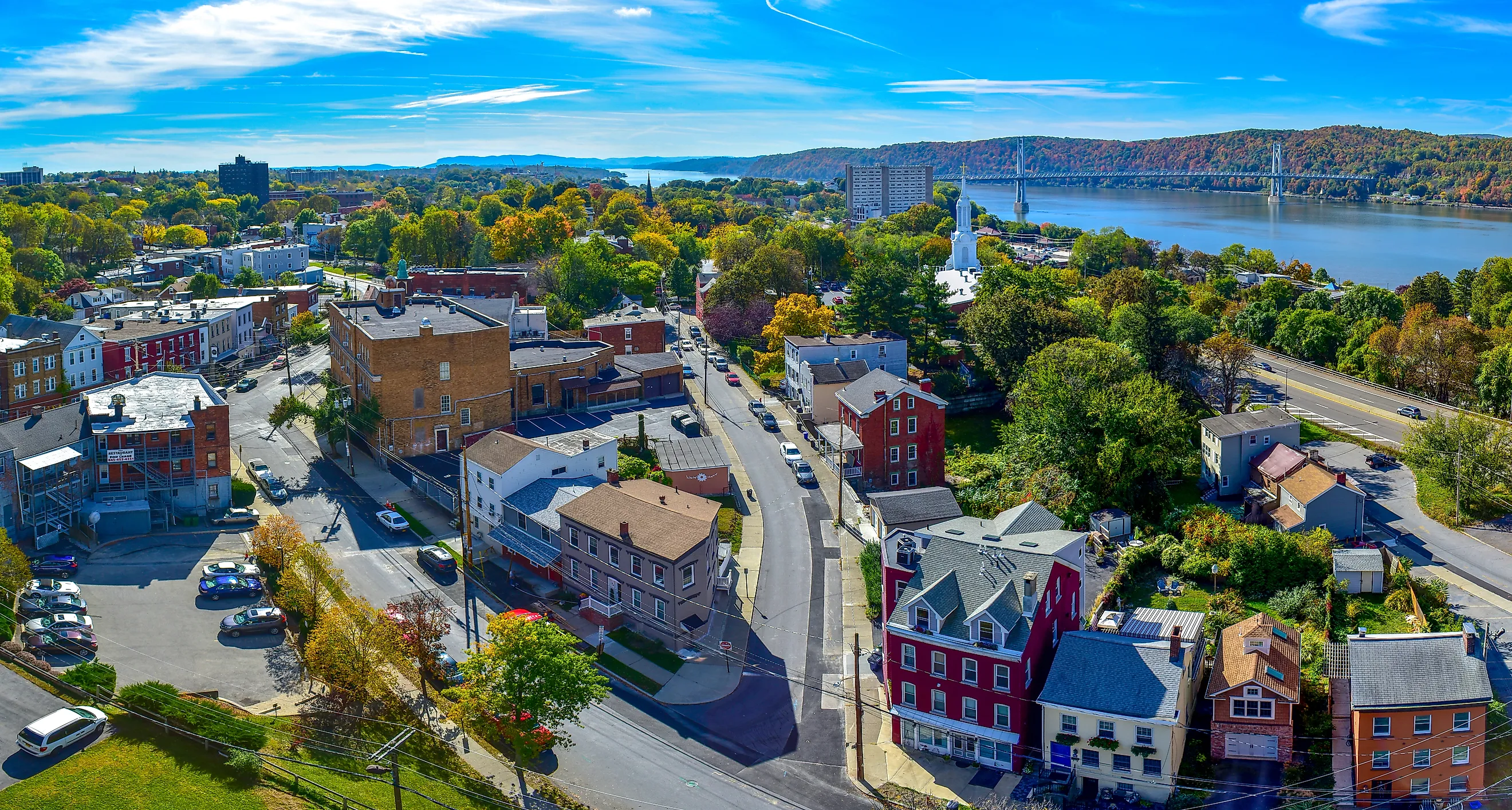
Poughkeepsie is Puh-KIP-see, full stop, and staring at the spelling will not help you. The name comes from a Wappinger phrase that translates to something like "reed-covered lodge by the little-water place." It points to a real spot, a spring fringed with cattail reeds that still bubbles up on the edge of town. This Dutchess County seat on the Hudson River's east bank packs a lot of history behind a name people still butcher. Dutch settlers arrived in the 1680s. The state convention ratified the US Constitution at the courthouse here in 1788.
Before the spelling settled down, the name got written about 42 different ways, lurching through versions like Apokeepsing and Pooghkepesingh before anyone agreed on Poughkeepsie. Locals long ago gave up and just say Po-Town or PK. The Smith Brothers cough-drop empire started here when James Smith bought a recipe from a peddler and cooked his first batch in 1852. Vassar College opened in 1861 as one of the country's first colleges for women. The Walkway Over the Hudson State Park crosses the river on a converted railroad bridge, and trains from New York City reach Poughkeepsie in under two hours.
Schoharie

Schoharie sounds like skuh-HAIR-ee and comes from a Mohawk word for "floating driftwood." The county seat lies where Schoharie Creek meets Fox Creek in the northern Catskills, and that creek has been floating debris downstream since long before anyone wrote the name down. Schoharie Valley Farms and its Carrot Barn draw a crowd for apple cider and cider doughnuts.
The Palatine House 1743 Museum tells the story of the early German settlers who first farmed the valley. Gas Up is a quirky open-air museum of regional history, and the Schoharie Valley Railroad Museum still shows off a red caboose. Lily Park along Fox Creek features a covered bridge made for a quick photo, and Wayward Lane Brewing closes the day with craft beer on the edge of town.
Skaneateles

Skaneateles lands as skanny-AT-lus, stress on the middle "at," and the locals will clock you the instant you fumble it. The name comes from an Iroquois word for "long lake," which is about as literal as a name gets. Skaneateles Lake stretches long and skinny below the town and ranks among the cleanest in the country. The town hugs the northern shore and has drawn well-off New York City families up for the summer since the 1800s.
The long lake earns its name, with cruises and a shoreline path that prove just how long it is. A local trail of wineries and distilleries handles the drinks, and the Charlie Major Nature Trail follows an old railbed past the Last Shot distillery. Stop at the gazebo in Clift Park, then try not to mangle the name on your way out of town.
Tuxedo

Tuxedo gave its name to the formal jacket, not the other way around, which makes it the only town here you have probably worn. The name itself comes from a Lenape word attached to nearby Tuxedo Lake, though the translation is anyone's guess, landing on either "round foot" or "crooked water" depending on the source. A short, tailless dinner coat made its American debut at the Tuxedo Club's autumn ball in the 1880s, and the town's name rode along onto formalwear racks everywhere.
Tuxedo Lake, the Lenape namesake that started all this, now lies inside the gated enclave of Tuxedo Park, where Gilded Age mansions ring the shore. Beyond town, Harriman State Park spreads across lakes and wooded trails, with quick access to the Appalachian Trail just north. Lemon Squeeze is a rock formation where you can wedge yourself through the gap and scramble out the far side. When you head home in gear named after your own hometown, refuel first at Dottie Audrey's Bakery Kitchen.
Names Worth Tripping Over
Most of these names carry a meaning that beat the town to the spot, whether a pinched-waist lake or a reed-covered spring. Two of them, Tuxedo and Chautauqua, escaped town entirely and turned into everyday words. The Indigenous languages of New York did most of the naming first, and the spellings have tripped up newcomers ever since. Nail the pronunciation and you pass for a local. Botch it and you join a very long club.