2026's 8 Most Scenic Scotland Towns
The prettiest corners of Scotland tend to be small, and they tend to lie where the land meets the water. Picture a harbor lined with pastel houses, or a palm tree improbably rooted on a Highland shore. Each of these eight towns is built around one of those images. A few overlook deep-blue lochs, others face the open sea or a slow river famous for its salmon. A traveler gets more out of them on a slow walk than in a quick photo. Here is where to find the country's most scenic small towns and what to see in each one.
Portree

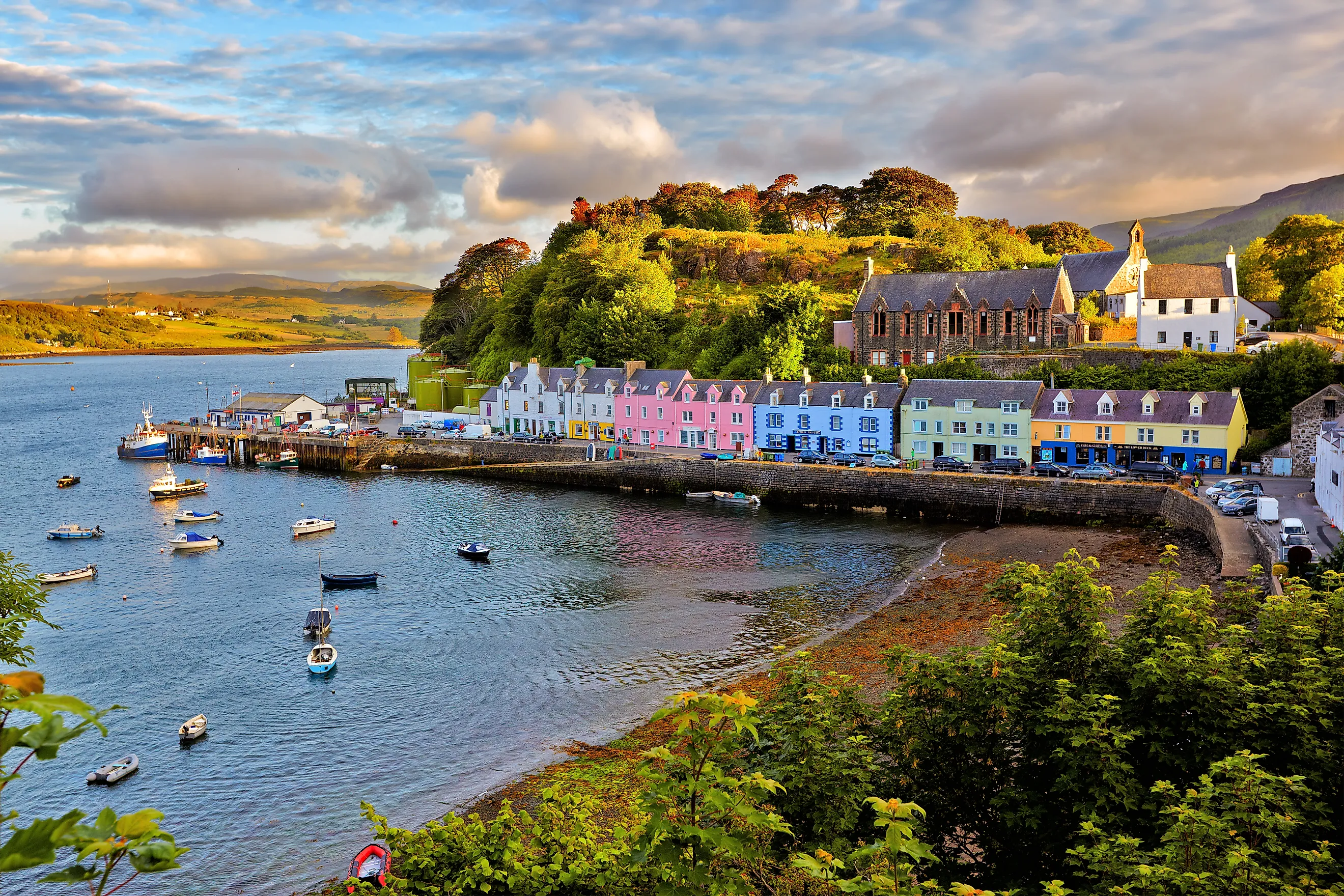
The pastel houses along the harbor put Portree on so many scenic-town lists, and the setting on the Isle of Skye does the rest. After a look at the houses, visitors can head to the Scorrybreac Trail on the north side of Portree Bay, where the Isle of Raasay comes into view on a clear day. Those who want a shorter walk can take the Portree Walkway near the harbor, which runs about 30 minutes and opens onto wide views of the bay. Across the water, a wildlife boat trip runs out to Kilt Rock, and visitors can spend another day at sea on the Isle of Rona whale trail. Visitors can close the day with a coffee and a pastry at Birch before the sun drops behind the harbor.
Pittenweem

For history and wide sea views together, visitors head to the village of Pittenweem along the East Neuk coast. The old streets run down to the harbor, past a row of pastel cottages on the way. St Fillans Cave and Cove Wynd stand among the notable historic buildings, and fragments of medieval priory walls still remain nearby. At the harbor, visitors can walk out to the Pittenweem lighthouse or watch the fishing boats come and go. Pittenweem Beach sits right on the sea, and the Fife Coastal Path continues to St Monans, home of the Welly Boot Garden.
Culross

Culross lies an hour from Pittenweem on the Fife coastline. It is Scotland's best-preserved 17th-century village, a compact grid of cobblestones and white-harled houses with Culross Palace at its center. Eagle-eyed travelers might also spot filming locations from the series Outlander. The palace is the best place to start. Its west block dates to 1597, its interiors hold painted ceilings more than four hundred years old, and local legend gives it the stubborn ghost of Sir George Bruce, the merchant who built it. More history lines the Fife Witches Trail, which begins at a marked plaque. Visitors can also climb to the highest point in Culross for the ruins of Culross Abbey, which carry a spooky legend of their own. For the best views, visitors can follow Hagg's Wynd, the road up to the palace's back wall, where the ground drops away toward the water and beyond.
Dunkeld

Shakespeare fans come to Dunkeld, an hour north of Culross, for the Birnam Oak in Birnam Wood, about three minutes from downtown. Estimated at 500 to 600 years old, the tree is thought to be the last survivor of the wood named in the tragedy of Macbeth. From the oak, visitors can head to Dunkeld Cathedral, a site marked by Viking raids and the Jacobite Wars, with Gothic arches and a grey sandstone exterior. The 13-mile path between Dunkeld and Loch Ordie runs through the Atholl woods and stays scenic the whole way. The Hermitage Walk climbs to Ossian's Hall for a look at Black Linn Falls. For a gentler outing, visitors can stroll the banks of Scotland's longest river, the River Tay, or cast a line for a salmon.
Plockton

Plockton sits on the west coast and is one of the few places in Scotland with swaying palm trees, warmed by the mild air of the Gulf Stream. Historic stone walls run along the waterfront in this western Highlands village, looking out over Loch Carron, and the palm trees frame the cottages and the water. From here, visitors can walk out to the cottages on Eilean nan Gamhainn at low tide. For a different vantage, the viewpoints at Brae Track and Carn a' Bhaid look out over the bay and the mountains. Walkers can also take the 25-minute stroll to Coral Beach, where a shore of white coral meets turquoise water.
Fort Augustus

Fort Augustus is almost an automatic entry on a list like this, since it sits at the southern end of the world-famous Loch Ness. Hundreds of thousands of people pass through the small town every year, drawn by the views and by the hope of spotting Nessie. Those who want more than a shoreline vigil with binoculars can join a Loch Ness cruise to look for the elusive monster. Visitors with no interest in monsters can sit beside the Caledonian Canal and watch the boats work through the five locks that form a water staircase. The Caledonian Canal Centre lays out the canal's history in its displays. For scenery alone, the Great Glen Way runs past town, good for wide views and the occasional glimpse of local wildlife.
Tobermory

Mull is the second-largest island of the Inner Hebrides, and Tobermory is its largest town. Its houses are painted in bright colors, and the Rubha nan Gall lighthouse stands above a dramatic stretch of coast, with a sheer drop to the water on one side and a bluff on the other. From the lighthouse, the view crosses the Sound of Mull to the Ben Hiant peak in the distance. Boat trips leave from the main car park for a chance to see porpoises, whales, and dolphins. Seasonal trips also run six-hour puffin tours, with a stop at the Isle of Staffa to see Fingal's Cave. The sea cave is named after the hero of a poem by James Macpherson and is known for its natural acoustics. After a day on the water, visitors can head to the Galleon for a seafood meal and a look at the sunset.
Inveraray

Inveraray is a scenic town in the Argyll region, set on the banks of Loch Fyne and well placed for exploring the Scottish Highlands. Most people head first to Inveraray Castle along the loch for the historic architecture and the 16-acre castle gardens, planted with roses, rhododendrons, and daffodils, with wildlife in the surrounding woodland. Visitors who want the castle's history can look through the Armory Hall, where the weaponry is on display. In town, the Inveraray Jail museum has welcomed visitors since it reopened in 1989, a century after the prison closed. For an outdoor day and a longer view, visitors can climb the nearby Ben Cruachan, known as the Hollow Mountain, or walk the Gruffalo Trail in the Ardkinglas Woodland Garden.
Go Beyond the Postcard
Scotland's scenic towns make for good photographs, but there is more to them than that. A walk through Culross or Pittenweem covers four centuries of building and trade, and a boat out of Portree or Tobermory brings the coast and its wildlife within reach. In each town, a visitor finds history, scenery, and local story close together, and that mix is what a traveler remembers long after the trip ends.