11 Scotland Towns With Unforgettable Main Streets
Scotland’s topography shapes unforgettable main streets into inviting places packed with historic architecture, natural landmarks, and Scottish traditions. In the Inner Hebrides, coastal communities brighten their waterfront streets with pastel-colored buildings while celebrating the region’s maritime and whisky-making heritage. Elsewhere, streets in Plockton are bordered by whitewashed cottages and the waters of Loch Carron. The Tweed and Teviot rivers flow toward Kelso’s connections to an agricultural trade past, and the Eildon Hills provide a backdrop to the pink-toned architecture of Melrose’s High Street. These narrow walkways and winding alleys honor Scotland’s royal origins and cultural history, from the Highlands to the islands of the Inner Hebrides.
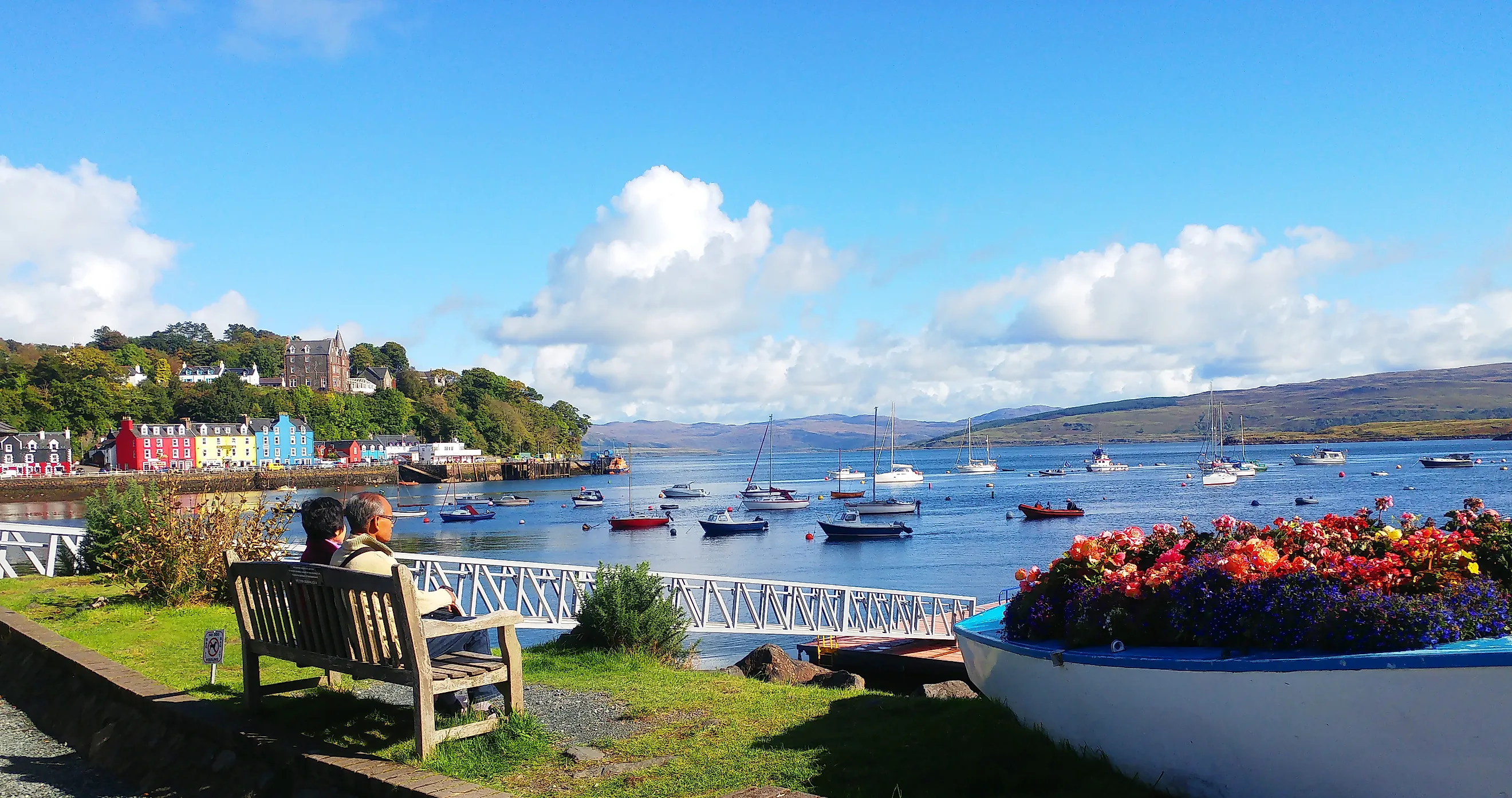
Tobermory

On the Isle of Mull in Scotland’s Inner Hebrides, Tobermory was founded in the 18th century as a fishing port and remains closely connected to the sea. Its Main Street runs along Tobermory Bay, lined by multi-colored buildings and the historic 1869 Mishnish Pub. Tobermory's maritime heritage is evident in its availability of sightseeing and wildlife boat tours to view whales, dolphins, and seals.
Tobermory Distillery, on the western end of Main Street, explores the country’s national beverage. It dates to 1798 and is one of the oldest whisky distilleries in Scotland, producing single malt whisky. Nearby, the Mull Museum preserves the town's art, geology, and geography.
Portree

Portree is known for the pastel-colored buildings on Portree Harbour along Portree Bay. The waterfront setting is framed by the hills of Ben Tianavaig, contributing to the town’s traditional Scottish location. Scottish engineer Thomas Telford designed the harbour and built the original pier in the 1800s when it was a trade port for livestock and cargo. Today, the harbour is a hub for fishing fleets and maritime leisure. The street is home to local marinas and seafood restaurants, such as The Lower Deck Seafood Restaurant and the Pier Hotel Restaurant.
About a 10-minute walk from Portree Harbour, The Lump and the Apothecary's Tower overlook the waterfront. The Lump, a wooded hilltop, has been the venue for the Isle of Skye's Highland Games since 1877. The Apothecary Tower, dating to the mid 1800s, served as a way to alert sailors of the availability of medical assistance if it was needed. The high tower has views of the Cuillin mountains, high above Portree Harbour.
Plockton

Plockton harbour in Plockton, Scotland.
Plockton, sometimes referred to as the Jewel of the Highlands, contains a combination of traditional Scottish culture and historic architecture. On Harbour Street, a row of 19th-century whitewashed cottages overlooks Loch Carron, where seals and dolphins can sometimes be spotted. The Wester Ross mountains oversee the streetscape and its unique palm tree-like New Zealand cabbage trees.
The Plockton Distillery offers tasting tours to learn about the distilling process of small-batch whisky and gin. Continuing on, Hidden Treasures, a local gift shop and information center for Calum's Seal Trips, sells handmade ceramics and local art, as well as fishing gear.
Culross

Set on the Firth of Forth, Culross is a preserved 16th and 17th-century town known for its historic structures. Back Causeway has narrow cobblestone streets lined with textured whitewashed buildings topped with red-tiled roofs and stepped gables. The cobblestone streets tell the story of the historic divide between the upper class and the commoners, as the raised center stones allowed the upper class to walk at a higher level, thereby saving their shoes and clothing from the filth that filtered out into the streets.
The Town House, with a historic clock and bell tower, is a former prison site for those accused of witchcraft. It is now a visitor center. With sections dating to the 1500s and 1600s, Culross Palace is just a few blocks down the street. The former merchant's house appeared in scenes from the Starz "Outlander" series.
Millport

Guildford Street, on the island of Great Cumbrae in Millport, features red sandstone buildings that house small shops and cafes. The locally-owned Isle of Cumbrae Distillers produces gin and single malt Scotch whisky. The family-run Sweet Shop Millport is known for luxury chocolates, ice cream, and the Millport Tablet, a traditional Scottish candy that is similar to fudge but has a grainer texture.
At one end of Guildford Street, along Newtown Bay, the Millport Memorial stands near Millport Awards Beach. It is dedicated to those lost during World Wars I and II. Nearby, Crocodile Rock is a natural rock formation painted to look like a crocodile. It has been a photo op since 1913. Just off the other end of Guildford, The Wedge is said to be among the narrowest structures in the world, at 47 inches wide.
Melrose

Backed by the three peaks of the Eildon Hills, Melrose’s High Street has pink-toned 18th-century architecture and local shops. Selections include bakeries and artisan craft stores, as well as coffee shops and pubs, including Baguette'n'Go, a sandwich shop. This adds to the local atmosphere and reveals the cultural and culinary ties of a Scottish Borders town.
At the end of High Street, near Market Square, the Trimontium Museum tells the region's Iron Age history and its prominence as the largest Roman fort north of Hadrian's Wall. At the other end of the street, Gibson Caravan Park has hiking and bicycling trails that run along the River Tweed, along with campsites and fields for rugby and golf.
Crieff

A view down King Street in Crieff, Scotland. Editorial credit: Douglasmack / Shutterstock.com.
In the Perthshire region, Crieff is centered on High Street. The historic area hosts stone and stucco buildings that house local boutiques and art galleries, such as the Strathearn Gallery, as well as pubs and cafés. Actor Ewan McGregor, raised in Crieff, praises the pies at Campbell’s Bakery. Scotland's whisky heritage is strong at Glenturret Distillery. Established in 1775, it is one of the country's oldest working distilleries.
Traversing the street, the Scottish medieval Crieff and Strathearn Museum is in the former Town Hall. High Street opens up onto the historic James Square and the 1894 Murray Fountain. A Highland Games festival, the Crieff Highland Gathering, has been an annual event since 1870. It celebrates the traditional culture and sports of Scotland through challenging events and parades. The event takes place at Market Park, near High Street.
Kelso

Kelso Farmers Market in Kelso, Scotland.
At the confluence of the Tweed and Teviot rivers, Kelso is characterized by an equestrian and agricultural heritage. The town’s main street, Horsemarket, derives its name from Kelso’s history as a center for livestock trading. Lined with two- and three-story stone buildings dating from the 18th and 19th centuries, the walkable street has residences and local businesses such as restaurants serving traditional fish and chips and international selections like Indian and Italian cuisine. Horsemarket opens onto a cobblestone town square, which hosts events and farmers' markets.
Antique stores, independent retailers, and the grand 1816 Town Hall are also found there. The River Tweed Salmon Fishing Museum, located within the town hall, explores the environmental and cultural impacts of fishing through exhibits like antique rods and reels, tools, and photographs.
Inveraray

In Argyll and Bute, Inveraray is a planned 18th-century town with black and white Georgian architecture along its central hub. Main Street has seafood restaurants and small shops, such as Loch Fyne Whiskies and the Harbour Gallery. The George Hotel is a former roadside coaching inn dating to the 1700s. It has a pub and a restaurant, serving fresh seafood and Scottish steaks. Main Street meets up with Front Street, near the Loch Fyne waterfront and the Inveraray Pier at the Inveraray Cross, a carved medieval market cross from the 15th century.
Pittenweem

Pittenweem, on Scotland’s east coast, is an active fishing port along the Firth of Forth. Its walkable High Street contains 16th and 19th-century architecture and pastel-painted cottages, connected along winding alleyways. At one end of High Street, Parish Church features Scottish medieval and Victorian elements, with parts of the structure dating to the 1300s.
The Fife Coastal Path passes through Pittenweem near High Street, offering views across the Firth of Forth and access to St. Fillan’s Cave, about a five-minute walk to Parish Church. The site is noted for its association with a 7th-century Irish missionary.
Dunkeld

Dunkeld’s Bridge Street makes an impression with stone-fronted 18th-century architecture and classic pubs, as well as bakeries and wine shops. At one end of the street, ARAN Bakery, sells artisan bread and pastry items, such as spelt and sesame sourdough and fennel shortbread. The shop is owned by Flora Shedden, a finalist on "The Great British Bake-Off."
Continuing on, the Atholl Arms Waterfront Bar has a terrace dining area with views of the River Tay. A defining feature of this scenic street, the seven-arch stone Dunkeld Bridge dates to the early 1800s. Bridge Street runs directly to it as it spans 685 feet across the River Tay and connects to Little Dunkeld.
Scotland's Timeless Main Streets
At first glance, Scotland’s main streets are defined by historic architecture and ancient landmarks. Upon further inspection, they reveal a distinctive set of attributes that give each its own identity. On the east coast, pastel cottages and winding alleys reflect the maritime heritage of traditional fishing villages in Pittenweem. Meanwhile, Culross's Main Street shares the scenic combination of whitewashed buildings and red-tiled roofs near the Firth of Forth waterfront. These main streets remain the heart of their communities and some of the most memorable places to experience Scotland's history and character.