2026's 11 Most Scenic The Maritimes Towns
Scenery is the native currency of the Maritimes. The coastline does most of the work here, bending around bay after bay, and the best views tend to collect in small towns where the water is never more than a few blocks away. This is a region of red sandstone cliffs, granite headlands, working harbours full of fishing boats, and the highest tides on the planet. These 11 towns were chosen for one reason: they are a treat for the eyes. They cover the best of all three Maritime provinces, and they are arranged here as a rough loop, down the South Shore of Nova Scotia, up to the Bay of Fundy and Cape Breton, over to New Brunswick's Fundy coast, and across the bridge onto Prince Edward Island. Every one of them gives you a reason to slow the car down and breathe in the salt air and scenery.
Peggy's Cove

Peggy's Cove sets the tone for the whole list. This working fishing village of only a few dozen residents sits on a bare sweep of glacier-scoured granite where the open Atlantic runs straight up to the sky, and the low light out here does remarkable things at dawn and dusk. The Peggy's Point Lighthouse, a squat red-and-white tower from 1915, is the most photographed lighthouse in Canada, and one look at it against the surf explains why. Around it spread acres of pink and gray granite barrens, a rolling field of boulders with new viewing decks set where the waves hit hardest. Down in the cove, lobster boats and silver-shingled fish shacks lean over the water, and the deGarthe Memorial, a fisherman scene carved straight into the bedrock, keeps watch. When you are ready to come in off the rocks, the hilltop Sou'Wester looks straight down at the lighthouse over bowls of seafood chowder and lobster from its own pound. It is a village built for looking at the sea.
Mahone Bay

Follow the shore southwest about 45 minutes, and it opens onto Mahone Bay, a village of just over 1,000 wrapped around a calm, island-flecked inlet. Its signature view is a plain one that has anchored Nova Scotia calendars for decades: three churches standing shoulder to shoulder along the waterfront, their steeples doubling in the still water at high tide. The bay is the other draw, sheltered and scattered with small islands, and kayak and paddleboard rentals at the wharf let you drift out among them. Back on land, the tree-lined Main Street traces the waterline, its old wooden storefronts holding galleries, the workshops of potters and wooden-boat builders, and beloved local spots like Betty's at the Kitch. In autumn, the streets fill with hundreds of handmade scarecrows for the town's long-running Scarecrow Festival, set against red maples rising behind the spires.
Lunenburg

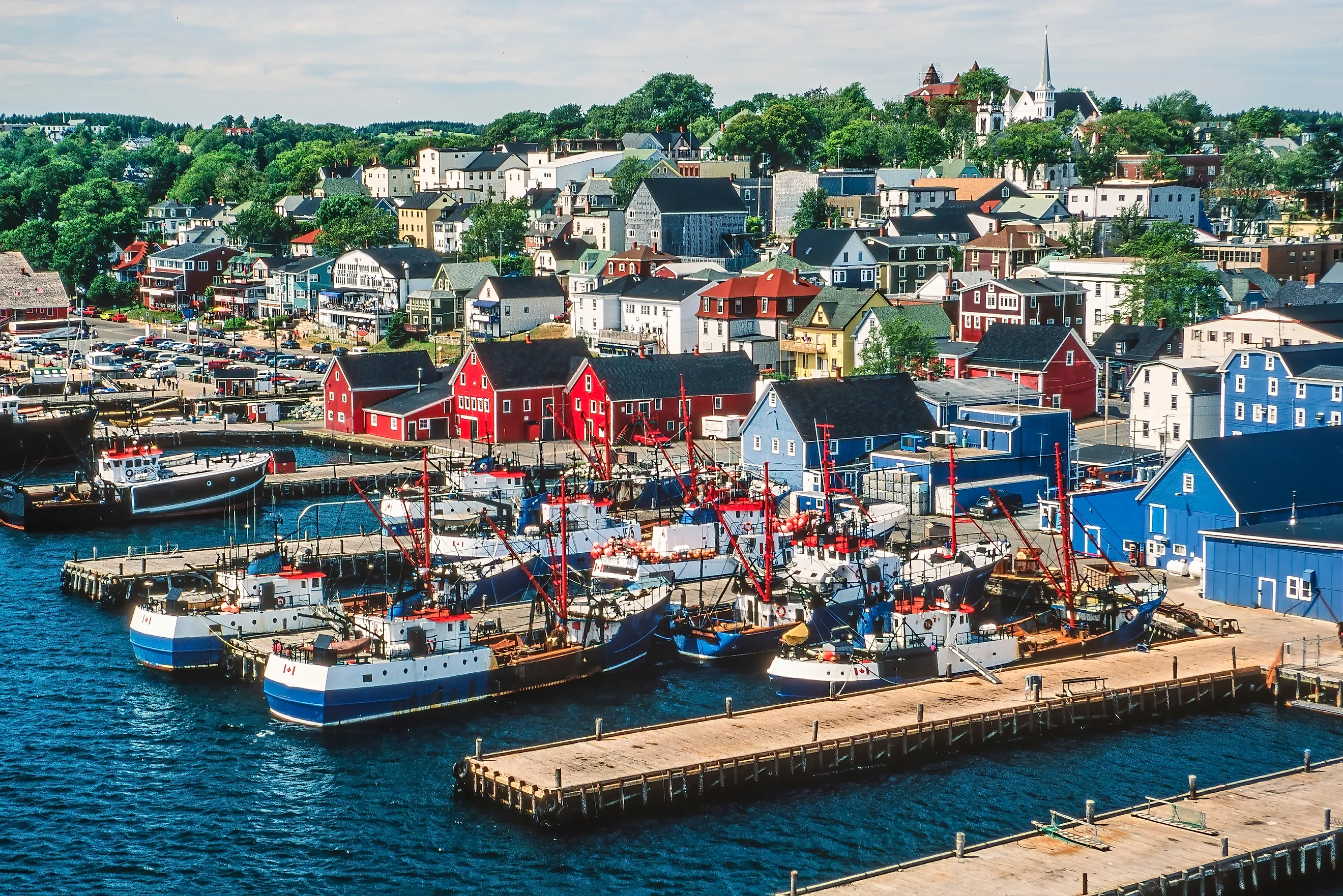
Barely ten minutes south of Mahone Bay, Lunenburg pours down its hillside to the harbour in rows of red, ochre, and blue. Its Old Town, a UNESCO World Heritage Site since 1995, is one of the best-preserved painted waterfronts in North America, and it is best seen from the far side of the harbour, where the whole tiered grid stacks up at once. At the docks sits the Bluenose II, the tall reproduction of the racing schooner on the Canadian dime, open for harbour sails when she is in port. The waterfront Fisheries Museum of the Atlantic, itself a bright red landmark, ties a pair of historic vessels up alongside its wharf. For the classic overview, climb to the black-and-white Lunenburg Academy on the hilltop and look back down across the rooftops to the water.
Wolfville

Cross the peninsula to the Bay of Fundy side and the coast trades granite for farmland at Wolfville, a college town of about 5,000 at the edge of the Annapolis Valley. The scenery here is soft and agricultural: dyked marshes, apple orchards, and the vineyards of the Gaspereau Valley rolling down toward the water, with tasting rooms that look out over the rows. The town faces the red bluffs of Cape Blomidon across the Minas Basin, where the highest tides on earth drain the harbour to red mud and refill it to the brim twice a day, a slow-motion show you can watch from the waterfront park. A few miles east, the reclaimed farmland of Grand Pre spreads beneath a lone hilltop church, a UNESCO site that gathers the valley, the dykes, and the tides into one long green view.
Baddeck

Nova Scotia saves its most expansive scenery for the far northeast, and the drive out to Baddeck on Cape Breton Island pays off the moment Bras d'Or Lake comes into view. This blue-green inland sea fills the middle of the island, and the village of about 800 lines its shore at the start and end of the Cabot Trail, the coastal drive that rings the highlands above. The waterfront is a single walkable street of inns and cafes facing the water, with a wharf where the Amoeba schooner sets out on afternoon sails past forested points. Just offshore, Kidston Island and its small lighthouse sit a short ferry hop away, with a beach on the far side. Baddeck was Alexander Graham Bell's summer retreat, and the Alexander Graham Bell National Historic Site sits on a rise above the water, laying out his kites, hydrofoils, and the record-setting Silver Dart against the same lake views that kept pulling him back.
St. Andrews

Cross into New Brunswick, and the scenery reorganizes around the Bay of Fundy. In the southwest corner, St. Andrews sits on Passamaquoddy Bay, a seaside resort town of about 2,000 with a tidy waterfront of clapboard inns and a long wharf. Its finest view is a cultivated one: Kingsbrae Garden, 27 acres of terraced beds, ponds, and sculpture that step down toward the bay and rank among the best public gardens in the country. From the wharf, whale-watching boats head out onto Fundy waters where humpback and the rare right whale surface through the summer. At low tide the sea pulls back to uncover a gravel bar out to Ministers Island, so you can drive across the ocean floor to a cliff-top estate and be back before the water closes the road again.
St. Martins

Follow the Fundy shore east and the coast turns rugged again at St. Martins, a village of around 320 at the mouth of two rivers. The tide itself is the attraction. Twice a day it drains far enough to let you walk the ocean floor into the St. Martins Sea Caves, deep red sandstone hollows worn into the cliffs, then floods back to swallow them. Beside the beach, two covered bridges and the harbour lighthouse line up close enough to sit in a single frame, a combination the village claims is the only one of its kind. East of town, the Fundy Trail Parkway climbs the coastal cliffs for 19 miles of lookouts, waterfalls, and a suspension footbridge over the Big Salmon River, the wide brown bay always off to the right.
Shediac

New Brunswick's eastern shore is a different sea altogether. On the warm Northumberland Strait, Shediac is a town of about 7,500 that calls itself the Lobster Capital of the World and greets drivers with a 90-ton lobster sculpture, one of the most photographed roadside stops in the province. The real scenery is the water. Parlee Beach Provincial Park runs for a long, warm mile of pale sand backed by dunes, with some of the warmest saltwater north of Virginia. Out on Shediac Bay, the Lobster Tales cruise from Shediac Bay Cruises drops and hauls traps and serves the catch at a table on deck as the low shoreline slides past. Every July, the streets close for a lobster festival, and the smell of the boil drifts clear down to the beach. It is scenery with a side of butter.
Summerside

The eight-mile Confederation Bridge lifts you across the strait onto Prince Edward Island, and Summerside is the first town of any size on the far side, about 16,000 people along Bedeque Bay. Its reclaimed waterfront is the place to walk: a long boardwalk follows the seawall past a marina of bobbing masts, open water, and grassy parkland. At the center, Spinnakers' Landing gathers a cluster of bright wooden shops and a lighthouse-shaped lookout around an outdoor stage that hosts free music all summer. The town also keeps the College of Piping and Celtic Performing Arts, where bagpipes and step-dancing spill outdoors on fine days. Uphill, streets of tall shipbuilding-era houses in painted wood look down toward the bay, a shaded green counterpoint to the open shoreline below.
Victoria-by-the-Sea

Half an hour east along the south shore, Victoria-by-the-Sea is a fishing village of fewer than 150 people laid out on a neat grid that the highways happened to skip. That accident of routing left it small, low, and full of light, its lanes running down to a working wharf and a red-and-white seaport lighthouse from 1879 at the water's edge. Artists have taken over many of the old buildings, so a short walk leads to studios, a little theatre in the Victoria Playhouse, and handmade chocolates dipped inside a former general store. Kayak tours leave the wharf into the warm, protected south-shore water for sunrise and sunset paddles. Settle in for lobster or oysters at a table over the harbour, watching the boats come in with the tide.
North Rustico

Over on the island's north shore, North Rustico curls around a busy harbour that locals have always called the Crick. Forty-odd fishing boats still run out of the wharf, and in early summer, you can buy lobster off the deck or ride out on a deep-sea tour past the dunes. The 1876 North Rustico Harbour Lighthouse marks the narrow channel where the harbour opens to the Gulf of St. Lawrence, and a level boardwalk called the Sea Walk runs from the village out along the shore. It leads into Prince Edward Island National Park, where the island shows its signature landscape: rust-red sandstone cliffs, wind-combed dunes, and warm surf running east for miles. Between the fleet, the light, and the red-and-gold coast, North Rustico is Prince Edward Island in miniature.
Guided by the Coast
What ties these 11 towns together is not size or fame but a certain generosity with the view. In the Maritimes, the good stuff is rarely far inland. It is right there at the end of the wharf, along the boardwalk, at the foot of the lighthouse, or across the harbour where the churches line up on the water. Some of these towns sit close enough to string together in a single afternoon, and others earn the longer drive on their own. Either way, the coast is the whole point, and it holds up in every season and every kind of light.