14 Prettiest Towns In the Gulf Coast
The Gulf of Mexico runs about 1,680 miles of shoreline across the five US Gulf states, and most of the prettiest towns along it are barrier islands or small Main Streets a block from the dunes. The common ingredients are sugar-white quartz sand, water that runs warm from April through November, and a vernacular architecture (cottage-scaled, raised on pilings, painted in the salt-bleached pastels that the salt air dictates) that ties Florida cottages to Texas barrier-island fishing villages to Mississippi coastal towns. The fourteen Gulf Coast towns below cover the prettiest of these, ranging from planned New Urbanist communities to barrier islands rebuilding after hurricanes.
Seaside, Florida

Seaside was founded in 1981 by developer Robert Davis as the first major project in the New Urbanism movement, an approach to town planning emphasizing pedestrian-friendly streets, narrow lots, and traditional architecture. Architects Andrés Duany and Elizabeth Plater-Zyberk designed the master plan, which has since influenced hundreds of planned communities. The 1998 film "The Truman Show" used Seaside as its filming location and the town has since become a reference point for the Florida Panhandle pastel-cottage aesthetic. Central Square in the middle of town hosts free outdoor jazz concerts and movie screenings throughout the summer. The Airstream food trucks at the trailer-park-style food court on Highway 30A run a rotating cast of local vendors. The white-sand beach along Seaside's mile-long Gulf frontage is one of the most photographed beaches on the Emerald Coast.
Dauphin Island, Alabama

Dauphin Island is a 14-mile barrier island at the mouth of Mobile Bay, accessible from the mainland via a 3-mile bridge built in 1955. The Alabama Legislature designated Dauphin Island the official Sunset Capital of Alabama in 2014, citing the unobstructed western Gulf horizon. Fort Gaines on the eastern tip of the island, a 19th-century masonry fort that guarded the entrance to Mobile Bay during the Civil War, was the Confederate position during the August 1864 Battle of Mobile Bay (the engagement at which Admiral Farragut reportedly ordered "Damn the torpedoes, full speed ahead"). The Dauphin Island Sea Lab runs the Estuarium aquarium with exhibits on the four major Gulf ecosystems (delta, bay, barrier island, and open Gulf). The Audubon Bird Sanctuary on the island's eastern end protects 137 acres of maritime forest and is one of the top spring migration stopovers on the Gulf flyway.
Captiva Island, Florida

Captiva Island, attached to Sanibel Island via the Blind Pass bridge, runs as a quieter and more residential alternative to its larger southern neighbor. The island's beaches face west across the Gulf of Mexico and deliver some of the most consistent sunset views in southwest Florida. The Bubble Room on Captiva Drive is a longstanding local restaurant filled with vintage toys, ornaments, and movie memorabilia. 'Tween Waters Inn, the island's primary historic resort, dates to 1931 and has hosted long-term guests including Anne Morrow Lindbergh, who wrote "Gift from the Sea" while staying there. Captiva is also the launch point for ferry trips to Cabbage Key and Useppa Island in Pine Island Sound.
Mustang Island, Texas

Mustang Island runs 18 miles of barrier-island Gulf coast between Port Aransas and Corpus Christi. Mustang Island State Park covers 3,954 acres of beach and dunes with 48 campsites for tent and RV use plus primitive beach camping along the shoreline. The Whooping Crane Festival each February draws birders from across the country for guided boat tours into the Aransas National Wildlife Refuge, the wintering home of the largest natural population of whooping cranes in North America. Port Aransas at the northern end of the island runs a working fishing port and a 600-foot Horace Caldwell Pier for fishing. The island's flat, hard sand makes it one of the few Texas beaches where driving on the sand is permitted.
Orange Beach, Alabama

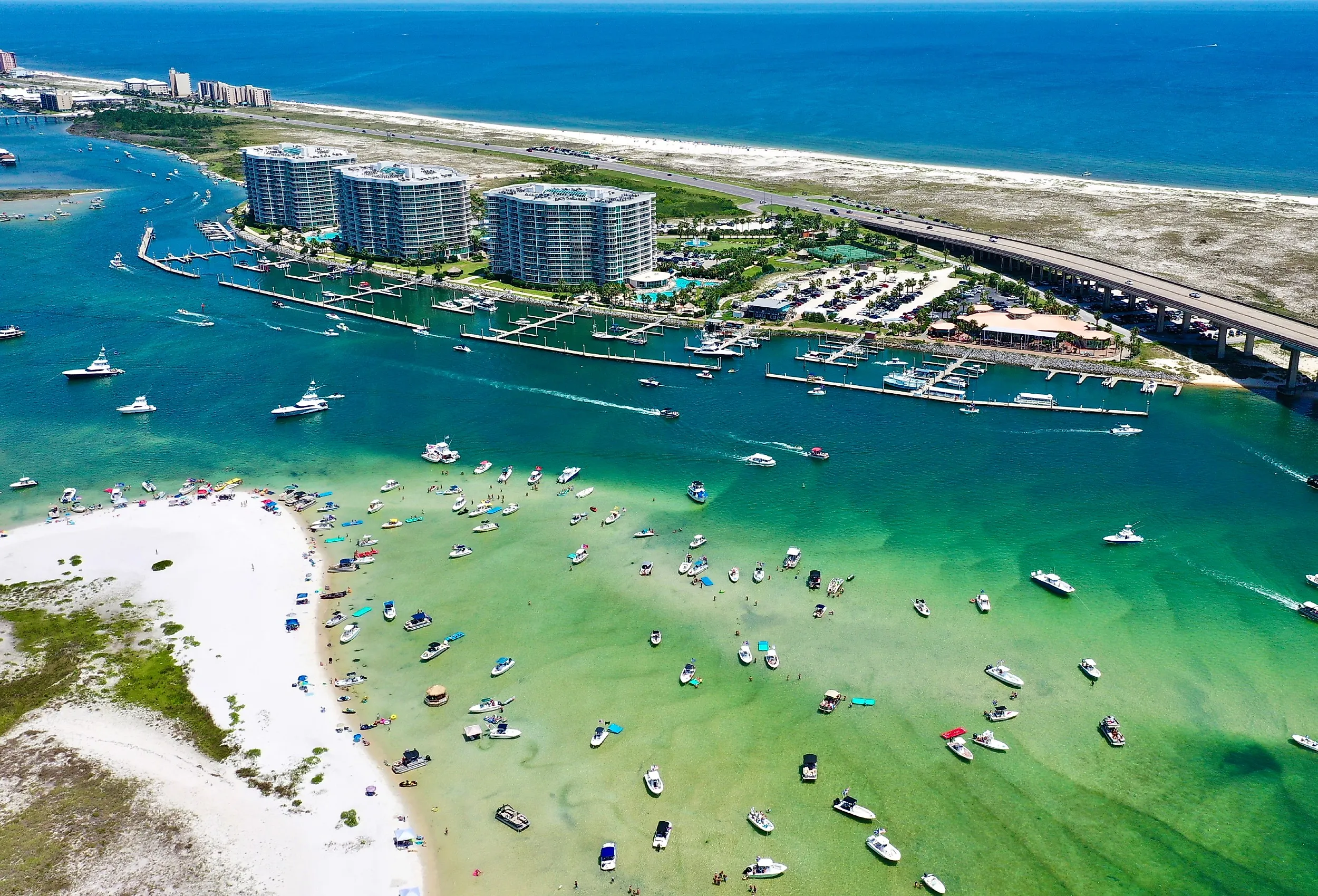
Orange Beach sits on the easternmost stretch of Alabama's 32-mile Gulf coast. The Hugh S. Branyon Backcountry Trail covers 28 miles of paved and natural-surface trails through six different ecosystems within Gulf State Park. The Wharf along the Intracoastal Waterway holds the largest Ferris wheel on the Gulf Coast (the Wharf Ferris Wheel at 112 feet) plus a marina, an amphitheater, and a strip of restaurants and shops. Adventure Island just inland from the Wharf runs go-karts, bumper boats, mini-golf, and an arcade. Perdido Pass at the eastern edge of town offers offshore fishing charters for red snapper, king mackerel, and grouper.
Naples, Florida
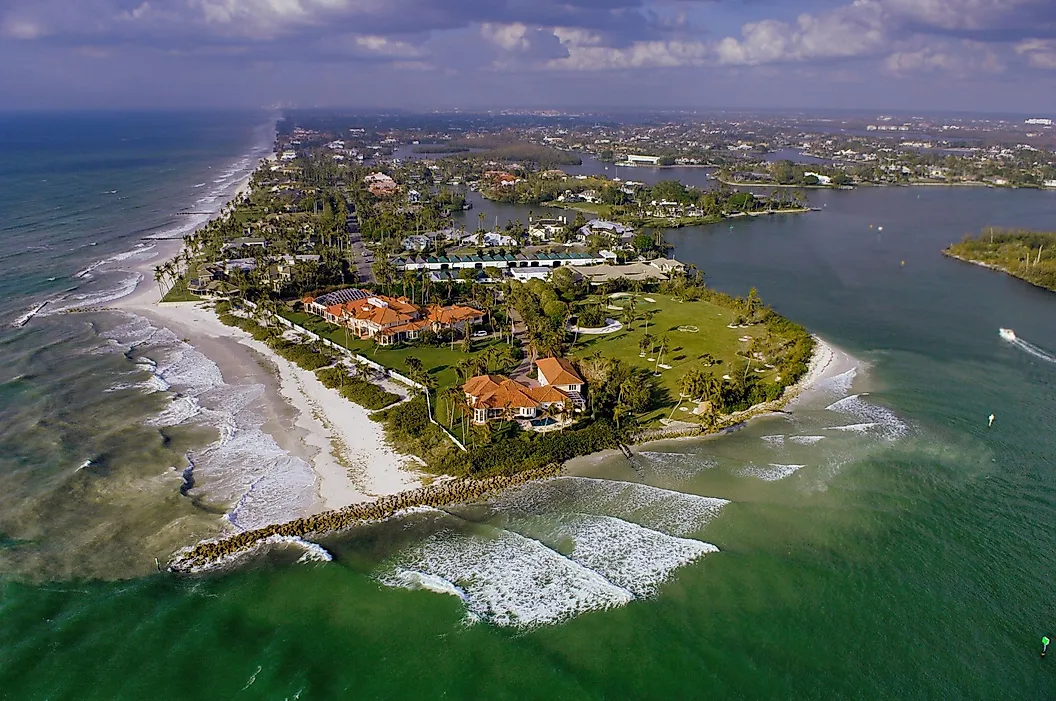
Naples sits on the southwest Florida coast as one of the wealthiest small cities in the United States. Third Street South and Fifth Avenue South run the town's two upscale shopping and dining corridors, with Third Street South being the older of the two and hosting the Naples Wine Festival each January. The Naples Pier, an unbroken 1,000-foot wooden pier originally built in 1888, anchors the south end of the public beach. The Naples Botanical Garden covers 170 acres of curated tropical garden landscapes including a Vietnamese highlands garden, a Caribbean garden, and a Brazilian garden. The Naples Zoo at Caribbean Gardens runs across a 1919 botanical garden site with more than 70 animal species.
Gulf Shores, Alabama

Gulf Shores is the headline beach town of the Alabama Gulf coast. Gulf State Park covers 6,150 acres along three miles of beach with a 740-foot fishing pier (one of the longest on the Gulf), 28 miles of paved trails, and a longstanding state park lodge. The Bon Secour National Wildlife Refuge west of town protects 7,000 acres of coastal dune habitat and is one of the most important loggerhead and Kemp's Ridley sea turtle nesting beaches in Alabama. The annual Hangout Music Festival each May fills the public beach with major touring acts (the festival has hosted Kendrick Lamar, Foo Fighters, and Tom Petty in recent years). The Alabama Gulf Coast Zoo, recently relocated to a 25-acre site, runs more than 290 animals across naturalistic habitats.
Grayton Beach, Florida

Grayton Beach is a small unincorporated community along Highway 30A in Walton County, Florida. Grayton Beach State Park, opened in 1968 and covering 2,000 acres, is consistently ranked among the top beaches in the United States by Dr. Beach's annual America's Best Beaches survey (the park topped the list in 1994 and 2020). The park's Western Lake is a rare coastal dune lake, one of only about 15 in the world, found primarily along this stretch of the Florida Panhandle. The park runs 4 miles of nature trails through coastal forest, scrub, and salt marsh, plus campsites and rental cabins. The unincorporated village of Grayton Beach itself runs a handful of locally owned restaurants and shops, with The Red Bar (a longstanding local institution rebuilt after a 2019 fire) the central downtown anchor.
Bay St. Louis, Mississippi

Bay St. Louis runs Mississippi's quieter, more local-leaning alternative to the more developed Florida and Alabama Gulf beaches. The town was largely rebuilt after the August 2005 Hurricane Katrina destroyed about 90% of its structures (Katrina's storm surge here reached more than 27 feet, the highest ever recorded in the United States at the time). Old Town Bay St. Louis along Main and Beach Boulevard preserves the rebuilt commercial district with locally owned restaurants, art galleries, and antique shops. The Bay St. Louis Harbor at the western end of Beach Boulevard holds the Jimmy Rutherford Fishing Pier for speckled trout and redfish. The Mockingbird Café on Court Street is a longstanding local favorite. The annual Cruisin' the Coast antique-car festival each October fills Beach Boulevard.
Panama City Beach, Florida

Panama City Beach runs 27 miles of Gulf shoreline along the Florida Panhandle. St. Andrews State Park at the eastern end of town covers 1,260 acres including Sand Pine Pass and one of the most consistent surf breaks on the Florida Gulf. Shell Island, the undeveloped 7-mile barrier island visible offshore from St. Andrews, is reachable by ferry or shuttle from the park and runs no facilities. Pier Park along the Gulf at the central part of town runs the 1,500-foot Russell-Fields Pier and an open-air shopping-and-dining village. The Shipwreck Island Waterpark on Middle Beach Road runs water slides, a wave pool, and a lazy river.
Destin, Florida

Destin was founded in 1845 by Connecticut fishermen led by Leonard Destin and bills itself as "The World's Luckiest Fishing Village." The town sits on a small peninsula between Choctawhatchee Bay and the Gulf of Mexico along Florida's Emerald Coast, a stretch of about 100 miles of white-quartz-sand beaches. The Destin Harbor's fishing fleet is one of the largest charter-fishing operations in the country, with regular runs for red snapper, grouper, amberjack, and pelagic species. Henderson Beach State Park covers 208 acres of preserved coastal dune habitat along 1.25 miles of beach. The Air Force Armament Museum at Eglin Air Force Base just inland from Destin holds the largest collection of Air Force armament in the country, including a B-17, a B-52, and the SR-71 Blackbird. The Destin History and Fishing Museum on Stahlman Avenue covers the town's commercial fishing heritage.
Longboat Key, Florida

Longboat Key runs 12 miles of barrier-island Gulf coast between Sarasota Bay and the open Gulf of Mexico. The Joan M. Durante Community Park along Sarasota Bay covers 32 acres of restored mangrove forest with a paved walking-and-biking trail, observation platforms, and a butterfly garden. The Beer Can Island spit at the northern tip of the island (named for the beer cans that washed up there in the 1960s) is a popular informal weekend beach for Sarasota-area locals. The southern stretch of the key runs upscale resorts including The Resort at Longboat Key Club, Zota Beach Resort, and the longstanding St. Regis Longboat Key. Whitney Beach at the north end of the island is one of the quieter public-access beaches in the area.
Grand Isle, Louisiana

Grand Isle runs as Louisiana's only inhabited barrier island, covering seven miles between the Gulf of Mexico and Caminada Bay south of New Orleans. The town has been hit by major hurricanes repeatedly (Hurricane Ida in August 2021 destroyed an estimated 700 of the island's 1,400 buildings) but rebuilds each time. Grand Isle State Park at the eastern end of the island covers 140 acres of beach, dunes, and salt marsh, with a 400-foot fishing pier and 49 campsites. The Migratory Bird Festival each April marks the spring trans-Gulf migration when warblers, tanagers, and other neotropical migrants make landfall here after crossing the Gulf of Mexico. Queen Bess Island, a restored brown pelican nesting island in the bay, holds one of the largest colonies of brown pelicans and roseate spoonbills in Louisiana.
Sanibel Island, Florida

Sanibel Island runs 12 miles of east-west barrier-island Gulf coast off the southwest Florida shore. The island's east-west orientation is unusual for a barrier island and creates the famous "Sanibel Stoop," the bent-over posture adopted by shell collectors picking through the heaviest shell beach in the United States. The Sanibel Lighthouse at the eastern tip of the island, an open iron-skeleton design completed in 1884, anchors Lighthouse Beach Park. The J.N. "Ding" Darling National Wildlife Refuge covers 6,400 acres on the northern half of Sanibel, with a 4-mile Wildlife Drive popular for spotting roseate spoonbills, white pelicans, dolphins, and manatees. The Bailey-Matthews National Shell Museum runs the only museum in the United States devoted entirely to shells. Sanibel was heavily damaged by Hurricane Ian in September 2022 but reopened to visitors in 2023.
What Makes The Gulf Pretty
The fourteen towns above share four things: warm Gulf water, quartz or shell sand white enough to photograph, vernacular cottage architecture sized to the dunes behind it, and a Main Street or village center small enough to walk in twenty minutes. Seaside, Grayton Beach, and Destin anchor the Florida Panhandle's Emerald Coast quartz-sand stretch. Naples, Captiva, Longboat Key, and Sanibel cover the southwest Florida barrier islands. Gulf Shores, Orange Beach, and Dauphin Island hold the Alabama beach-and-bay identity. Bay St. Louis runs the Mississippi alternative; Mustang Island brings the Texas barrier-island version; Grand Isle closes the list with Louisiana's only inhabited barrier island.