14 Prettiest Small Towns In New York
Skaneateles holds about 130 Federal, Greek Revival, and Italianate buildings within walking distance of the clearest lake in the Finger Lakes region. Lake Placid sits in the High Peaks with Whiteface Mountain rising 4,867 feet to the east. Aurora's one-mile Main Street follows the east shore of Cayuga Lake. The fourteen New York towns ahead split into four regional clusters: the Adirondacks, the Catskills and Hudson Valley, the Finger Lakes country, and the river-and-Atlantic edges. Each holds a setting that has shaped the look of the place for at least a century.
Saranac Lake

Saranac Lake sits in the Adirondack High Peaks region with about 4,800 residents and a working downtown that has not changed character much in a hundred years. The Saranac Lake Winter Carnival has run annually since 1898 with a hand-built ice palace as its centerpiece, making it one of the oldest winter carnivals in the country. The carnival typically runs the first two weeks of February and pulls a few thousand visitors into town in the coldest part of the season.
The Adirondack Artists Guild on Main Street runs the gallery rotation, and the Adirondack Carousel just off Main is a hand-carved local-themed carousel that opened in 2012 after a fifteen-year community fundraising effort. The Hotel Saranac on Lake Flower has been the town's anchor lodging since 1927 and was renovated by Roedel Companies in 2018. The town also serves as the year-round training base for the United States Biathlon Team at the nearby Mount Van Hoevenberg Olympic facility.
Beacon

Beacon sits along the east bank of the Hudson River about an hour and a half north of New York City by Metro-North train. Dia:Beacon is the anchor cultural institution, a 240,000-square-foot former Nabisco printing plant that the Dia Art Foundation converted into a museum in 2003 to house its collection of large-scale minimalist works. The collection includes installations by Richard Serra, Donald Judd, Sol LeWitt, and Walter De Maria.
Main Street runs the working downtown for about a mile with independent galleries, the Beacon Theatre, and several blocks of bookstores and cafes. Mount Beacon rises 1,580 feet directly behind the town and is reached by the Mount Beacon Casino Trail, a steep two-mile round trip that climbs the route of the former Mount Beacon Incline Railway, which ran 1902 to 1978 as one of the steepest railways in North America. The hike ends at a fire tower with views across the river to the Catskills.
Saugerties

Saugerties sits at the mouth of Esopus Creek on the west bank of the Hudson with the Catskills directly behind it. The Saugerties Lighthouse on the river was built in 1869 and operates today as a two-room bed and breakfast, reachable only by a half-mile trail across a tidal marsh at low tide. The B&B has been independently operated by the Saugerties Lighthouse Conservancy since 1993 and is one of the few overnight lighthouse stays on the East Coast.
Opus 40 occupies an abandoned bluestone quarry just outside town. The sculptor Harvey Fite spent 37 years building a six-and-a-half-acre dry-stone earthwork there from 1938 until his death in 1976, working alone with hand tools and the stones of the quarry. The site is open to visitors May through October and remains the largest earthwork sculpture in the United States. HITS-on-the-Hudson at the Saugerties showgrounds runs major hunter-jumper horse competitions every summer.
Hammondsport

Hammondsport sits at the south end of Y-shaped Keuka Lake with a village population of about 600 and a wine industry that predates Prohibition. Pleasant Valley Wine Company, the oldest bonded winery in the country, opened just outside town in 1860. Heron Hill Winery and Bully Hill Vineyards work the slopes above the lake on the west branch, and Dr. Konstantin Frank Vineyards on the east branch produces the cold-climate vinifera that put Finger Lakes winemaking on the international map starting in the 1960s.
The Glenn H. Curtiss Museum on Lake Street covers the aviation career of Hammondsport's most famous native son. Curtiss was the first American to fly a public flight of more than a kilometer, won the inaugural Gordon Bennett Trophy at Reims in 1909, and held US Pilot License No. 1. The museum holds about 30 of his aircraft and motorcycles, several of them airworthy and flown during summer events.
Narrowsburg

Narrowsburg sits at the deepest point of the Delaware River in Sullivan County on the Pennsylvania border. The river runs 113 feet deep at the bend, the deepest spot on the entire 419-mile river. The Tusten Mountain Trail above town climbs to a clifftop overlook of the bend, and the river itself is one of the best eagle-viewing rivers in the eastern United States, with around 200 wintering bald eagles in Sullivan County between December and March.
The Delaware Valley Arts Alliance runs gallery and theatre programming out of the Tusten Theatre, a 1903 building on Main Street. Maison Bergogne sells antiques and French farmhouse furniture on Main Street and has become the town's signature design destination. The summer kayak run between Lackawaxen and Narrowsburg downstream is one of the calmest mid-Delaware paddles and a regular weekend draw for visitors from the city.
Skaneateles

Skaneateles sits at the north end of Skaneateles Lake, the easternmost and clearest of the Finger Lakes. The lake supplies unfiltered drinking water to the city of Syracuse, and its clarity allows visibility to roughly 30 feet below the surface in calm summer water. The Skaneateles Village Historic District holds about 130 buildings spanning the Federal, Greek Revival, and Italianate periods, with the Sherwood Inn on Genesee Street operating continuously as a tavern and inn since 1807.
Mid-Lakes Navigation runs sightseeing and dinner cruises from the village pier on the original wooden tour boats from May through October. The Dickens Christmas weekends in November and December bring costumed Victorian characters through the streets, a tradition the village has run annually since 1994. The Skaneateles Festival, a summer chamber music series, draws major classical performers to the lakeside Anyela's Vineyards barn each August.
Woodstock

Woodstock has been an arts colony continuously since 1902, when Ralph Whitehead, Hervey White, and Bolton Brown founded the Byrdcliffe Colony on the slopes of Mount Guardian. The Byrdcliffe Art Colony remains the oldest active arts colony in the United States and continues to run summer residencies, classes, and exhibitions on the same property. The Woodstock Artists Association and Museum on Tinker Street has displayed regional artists since 1919.
The 1969 Woodstock Music and Art Fair took place in Bethel, about 60 miles southwest of town, but Woodstock kept the cultural association anyway. The Karma Triyana Dharmachakra monastery on Meads Mountain Road has served as the North American seat of the Karmapa since 1978 and is open daily for guided tours. Overlook Mountain rises 3,140 feet directly behind town with a fire tower at the summit and the ruined stone walls of the Overlook Mountain House along the way up.
Lake Placid

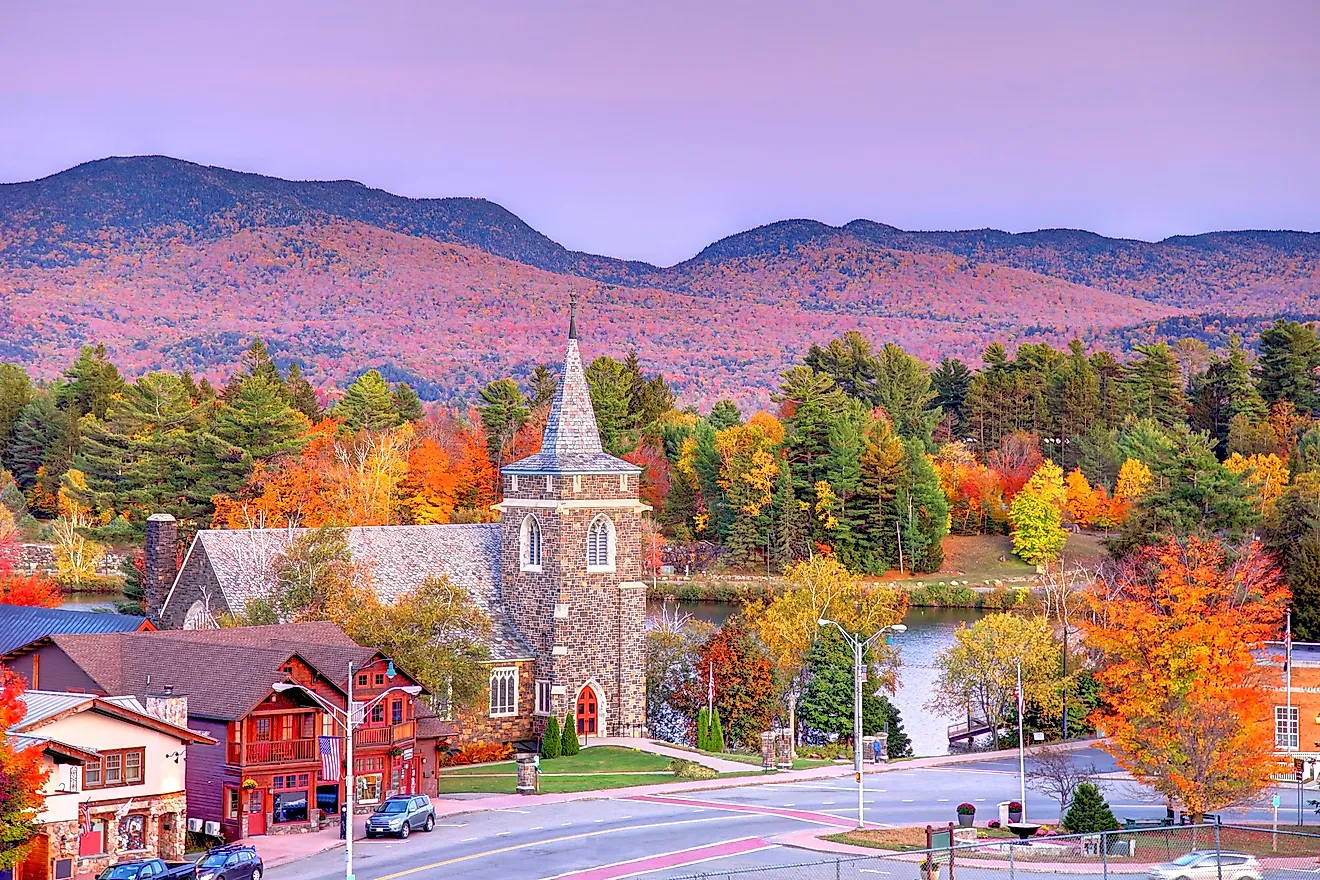
Lake Placid hosted the Winter Olympics in 1932 and 1980, and the Olympic facilities still operate as a year-round training center. The Olympic Center on Main Street is the only complex in the world to have hosted the Winter Games twice. The Herb Brooks Arena inside it was the site of the United States hockey team's "Miracle on Ice" victory over the Soviet Union on February 22, 1980.
The village sits on the south shore of Mirror Lake rather than Lake Placid itself, which lies to the north and is reachable by a short walk. Whiteface Mountain rises to 4,867 feet about ten miles east of town and runs the only chairlift in the Adirondacks to a 4,400-foot summit accessible by car. The Adirondack High Peaks region around Lake Placid holds the 46 named peaks above 4,000 feet that gave rise to the Adirondack Forty-Sixers hiking club.
Aurora

Aurora sits on the east shore of Cayuga Lake with a village footprint of about 700 residents along a single mile of Main Street. American Girl founder Pleasant Rowland began acquiring and restoring buildings in the village in the early 2000s through her Aurora Foundation, and the Inns of Aurora group now runs the Aurora Inn, the E.B. Morgan House, the Rowland House, and Wallcourt Hall as a connected lodging operation along the lakefront.
MacKenzie-Childs operates its flagship retail farm just north of the village, with the famous black-and-white checkered ceramics and decorative-home goods on display in a 65-acre Victorian farmstead open for daily tours. The former Wells College campus on the south end of the village closed in spring 2024 after 156 years of operation, and the Hiawatha Institute for Indigenous Knowledge has agreed to purchase the property to establish a tribal college beginning in 2027.
Montauk

Montauk sits at the easternmost tip of Long Island about 120 miles east of Manhattan. Montauk Point Lighthouse, commissioned by George Washington in 1792 and completed in 1796, is the oldest lighthouse in New York State and the fourth-oldest active lighthouse in the country. The lighthouse and its small museum sit at the eastern point inside Montauk Point State Park.
The hamlet has been a surf town since the mid-twentieth century and runs the most consistent Atlantic surf break in the New York metropolitan area. Ditch Plains beach east of town is the local surf anchor. Shadmoor State Park on the south side of the hamlet covers 99 acres of preserved coastal heathland with cliffs over the Atlantic and two abandoned 16-inch gun batteries left over from World War II. The Montauk fishing fleet still works out of Montauk Harbor on the bay side.
Ticonderoga

Ticonderoga sits on the narrow neck of land between Lake George and Lake Champlain in the southeastern Adirondacks. Fort Ticonderoga, built by the French as Fort Carillon between 1755 and 1758 and renamed Fort Ticonderoga after the British capture in 1759, sits on a bluff above the lake outlet. The fort is best known for the May 10, 1775 capture by Ethan Allen and the Green Mountain Boys, an action that gave the Continental Army the cannons later hauled overland by Henry Knox to break the British siege of Boston.
The fort operates today as a private nonprofit museum that runs full-scale reenactments, cannon-firing demonstrations, and an 18th-century working garrison. The King's Garden, a 1920s Colonial Revival garden designed by Marian Cruger Coffin, sits within the fort grounds and is open seasonally. The Ticonderoga Heritage Museum on Montcalm Street covers the town's separate industrial history as the longtime home of Eberhard Faber pencil manufacturing.
Sleepy Hollow

Sleepy Hollow sits on the east bank of the Hudson River about 25 miles north of New York City. The Old Dutch Church of Sleepy Hollow on Pierson Avenue was built around 1685 and is one of the oldest active church buildings in the United States. The adjacent Sleepy Hollow Cemetery covers about 90 acres and contains the graves of Washington Irving, Andrew Carnegie, Walter Chrysler, Brooke Astor, and a number of other figures of nineteenth and twentieth century New York.
Washington Irving published "The Legend of Sleepy Hollow" in 1820 while living in Tarrytown, and the Headless Horseman tradition has anchored the village's October identity ever since. Historic Hudson Valley runs Horseman's Hollow at Philipsburg Manor inside the village and the Great Jack O'Lantern Blaze at Van Cortlandt Manor about 20 minutes north, with a combined run of about 7,000 hand-carved jack-o'-lanterns between September and November.
Chatham

Chatham sits in northwestern Columbia County in the rolling country between the Hudson Valley and the Berkshires. The Crandell Theatre on Main Street is a single-screen 1926 vaudeville-era movie house that runs first-run films and a regular calendar of repertory screenings. The Mac-Haydn Theatre on Route 203 has produced summer musical theater in the round since 1969 and runs about six full productions across each May-through-October season.
The town's food and farm scene runs on the Hudson Valley's wider farm-to-table economy. Yellow Wood and the Blue Plate run the sit-down restaurant side, and Chatham Brewing on Main Street pours regional craft beer in a 19th-century commercial building. The Chatham Farmers Market on Friday afternoons May through October runs on the village green outside Tracy Memorial Hall.
Cooperstown

Cooperstown sits at the south end of Otsego Lake in Otsego County. The National Baseball Hall of Fame and Museum on Main Street opened in 1939 and remains the central attraction of the village, with about 270,000 visitors a year and a continuously updated collection that runs from the Knickerbocker Rules of 1845 through the most recent inductee class. Doubleday Field a block away is the village's working ballpark.
The Fenimore Art Museum on the lake holds a strong collection of Hudson River School paintings and the Eugene and Clare Thaw Collection of American Indian Art. The Glimmerglass Festival summer opera company performs at the Alice Busch Opera Theater on the lake's west shore each July and August. The Farmers' Museum across the road keeps a working 19th-century village preserved on its grounds.
What Carries These Fourteen
The fourteen split roughly into four regional clusters. The Adirondacks produce Saranac Lake, Lake Placid, and Ticonderoga. The Catskills and the Hudson Valley produce Beacon, Saugerties, Woodstock, Sleepy Hollow, and Chatham. The Finger Lakes country produces Hammondsport, Skaneateles, Aurora, and Cooperstown. The river and Atlantic edges produce Narrowsburg and Montauk. Each runs on a single durable anchor that has held for at least a century. Each is small enough to walk and substantial enough to fill a weekend.