11 Most Relaxing Virginia Towns
Virginia's small towns hold up well to an unhurried afternoon. Luray drops below ground into caverns deep enough to keep August at bay. Middleburg sits in horse country with porches at the Red Fox Inn that have been in use since the 18th century. Occoquan looks out over a tidewater river that has been turning mill wheels since the 1700s. The eleven towns ahead spread across the Tidewater country, the Piedmont, and the Blue Ridge foothills. Each is small enough to cover on foot in a day.
Abingdon

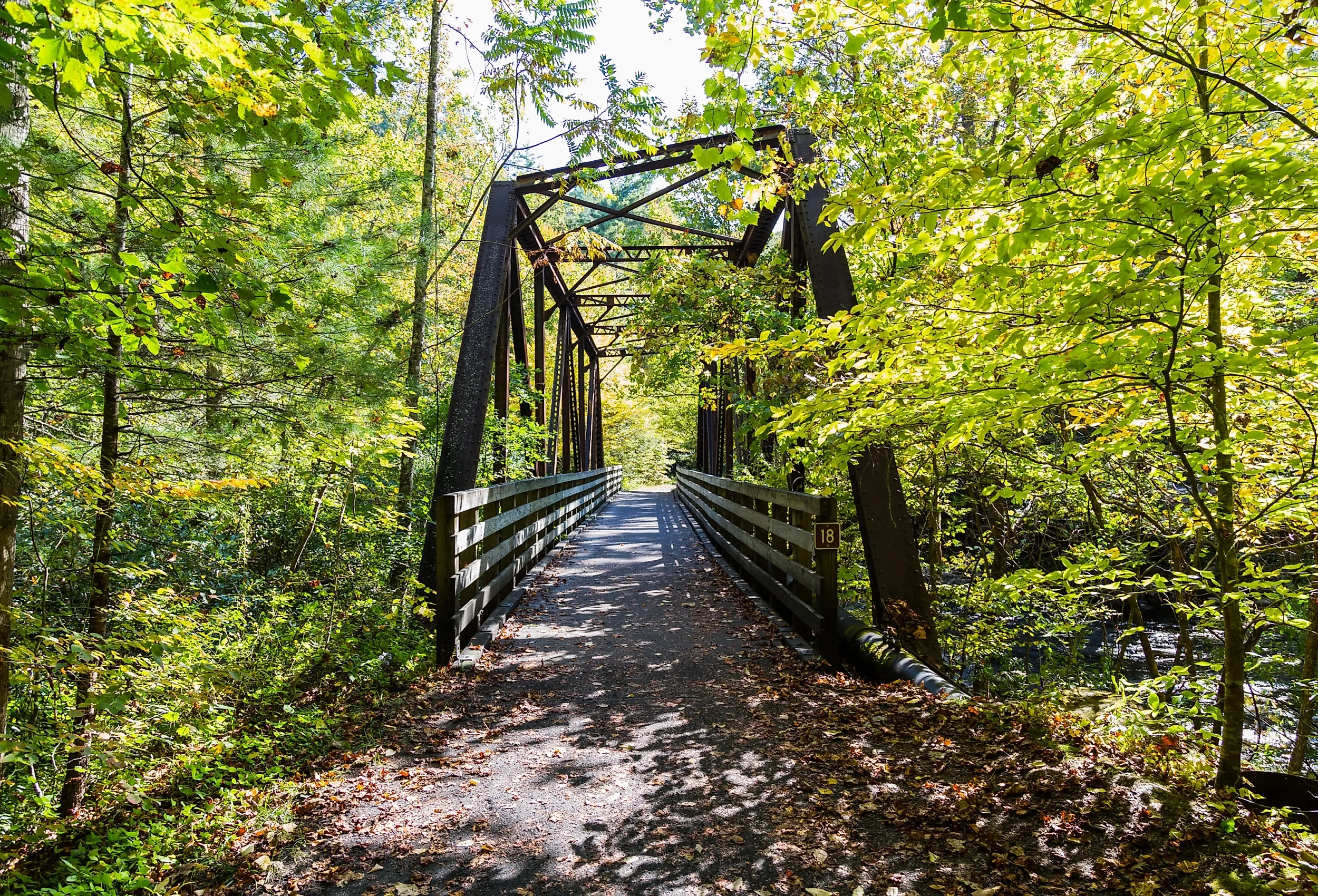
The Virginia Creeper Trail's Abingdon trailhead is a good place to begin. The former rail line runs east past woods, fields, trestles, and creek crossings before looping back toward Main Street. Once back in town, Barter Theatre runs plays and musicals on a stage with roots reaching back to 1933, when Robert Porterfield founded the company by accepting produce from Depression-era audiences in lieu of ticket prices.
The past runs deeper at Abingdon Muster Grounds, where frontier militia gathered in September 1780 before marching toward the October 7 Battle of Kings Mountain, a pivotal turning point in the southern campaign of the Revolutionary War. For a broader taste of the region, the Southwest Virginia Cultural Center and Marketplace gathers crafts, exhibits, music, and local makers under one roof. Wolf Hills Coffee on Court Street makes a comfortable stop before wandering the surrounding blocks.
Chincoteague

Chincoteague is shaped by salt air, marsh grass, and the pony lore that has made the island famous. Marguerite Henry's 1947 novel Misty of Chincoteague remains central to the island's identity, and the Museum of Chincoteague Island keeps the story close with exhibits on Misty, decoy carving, watermen, and island life. The real landscape behind the legend is just up the road: Chincoteague National Wildlife Refuge offers Beach Road, the Wildlife Loop, and the Woodland Trail, all passing through birding habitat where herons, egrets, deer, and the famous Assateague ponies turn up regularly.
When the Assateague Lighthouse on nearby Assateague Island is open seasonally, the climb rewards visitors with a wider view over marsh, forest, and the Atlantic side of the island. Island Creamery is the obvious stop on the way back, with house-made flavors like Wallops Rocket Fuel and Bourbon Caramel Crunch making the decision easy.
Cape Charles

On the Chesapeake Bay side of the Eastern Shore, Cape Charles has a beach made for an unhurried afternoon: shallow water, easy public access, and west-facing sunsets that stretch across the bay. The town's past comes into focus at the Cape Charles Museum and Welcome Center, which traces the era of the railroad, ferry, harbor, and power plant that shaped the community after the town was platted in 1884 as the southern terminus of the New York, Philadelphia & Norfolk Railroad.
South of the historic district, Kiptopeke State Park adds walking paths, birding areas, and shoreline access, along with the line of nine World War II concrete ships sunk offshore in 1948 that now serve as breakwaters. Back on Mason Avenue, Lemon Tree Gallery and Studio brings in regional art and handmade work, and The Shanty keeps things casual by the harbor with seafood, drinks, and a breezy view of the boats.
Middleburg

Middleburg wears its horse-country identity naturally. The National Sporting Library and Museum anchors that heritage near the heart of the village with equestrian art, rare books, and foxhunting collections. A short walk away, the Red Fox Inn and Tavern continues a hospitality tradition that dates to 1728, when the building opened as Mr. Chinn's Ordinary on the Old Carolina Road.
Beyond the village center, the scenery becomes part of the draw. Greenhill Winery and Vineyards pours estate wines with pasture views that suit the setting, and Salamander Middleburg runs a spa, restaurants, and equestrian programming across a 340-acre country estate. For a longer walk, Sky Meadows State Park near Delaplane has hiking routes, an Appalachian Trail connection, and broad Piedmont views that open up quickly once on the trail.
Floyd

Friday nights in Floyd have a rhythm of their own. The Floyd Country Store fills with traditional Appalachian music and flatfoot dancing during the weekly Friday Night Jamboree, and the energy tends to spill out onto the street. That creative spirit carries through the rest of town at the Floyd Center for the Arts, housed in a former dairy barn at the old Jacksonville Dairy farm site, and used for exhibitions, classes, and craft events throughout the year.
For mountain scenery, Buffalo Mountain Natural Area Preserve offers a brief steep climb to a distinctive summit with rare plant communities near the top. Chateau Morrisette Winery, founded in 1978 and located near the Blue Ridge Parkway, pairs tastings and events with long views across the ridges. Back in town, Red Rooster Coffee is a central stop with beans roasted on site in Floyd.
Damascus

Damascus feels like an outdoor crossroads because it genuinely is one. The Virginia Creeper Trail and the Appalachian Trail both pass directly through town, which means hikers and cyclists are part of the daily rhythm here. The most popular ride is the Whitetop Station section back into Damascus, a 17-mile mostly downhill route threaded through forest, farms, trestles, and long stretches of creekside trail.
The Appalachian Trail is easy to sample for an afternoon without committing to a multi-day backpacking trip, since it runs right through the community. For practical comforts afterward, Wheeler's Inn (formerly the Dancing Bear Inn) offers lodging close to downtown. Damascus Diner serves breakfast, sandwiches, and casual meals for anyone who has worked up an appetite.
Luray

A reasonable way to start the day in Luray is with coffee and pastries at Gathering Grounds Patisserie and Cafe before heading underground. Luray Caverns is the main event, known for Dream Lake, massive stone formations, and the Great Stalacpipe Organ, an instrument designed by Leland W. Sprinkle in 1956 that produces music by striking stalactites tuned through painstaking modification of their natural pitches. The Car and Carriage Caravan Museum next door adds vintage automobiles, coaches, and early transportation pieces worth a look.
Local history continues at Shenandoah Heritage Village, which includes the Luray Valley Museum and exhibits on the buildings, artifacts, and daily life of the Shenandoah Valley. When the mountains call, Shenandoah National Park's Thornton Gap Entrance is a quick drive from town, putting Skyline Drive, overlooks, and hiking routes well within reach.
Smithfield

Smithfield is best known for ham, but there are plenty of reasons to linger once visitors have paid their respects to that reputation. Windsor Castle Park is the outdoor favorite, with wooded paths, marsh scenery, kayak launches, and routes along Cypress Creek. The Isle of Wight County Museum digs into local heritage, the ham industry, and the famous "world's oldest ham," a 1902 cured Smithfield ham that has been on display since 1924.
Historic St. Luke's Church adds another layer of Tidewater history, with early brick architecture, centuries-old gravestones, and a long-running claim as one of Virginia's earliest brick church buildings. For a meal by the water, Smithfield Station handles the seafood side of things. Wharf Hill Brewing Company brings beer and pub fare to a historic Main Street building.
Farmville

The most dramatic perspective in Farmville comes from above the Appomattox River. High Bridge Trail State Park follows a former rail line through the community, and the High Bridge itself spans the valley at about 125 feet above the river and 2,400 feet across, with open views on both sides. Downtown, Green Front Furniture has turned restored tobacco warehouses into a roughly one-million-square-foot collection of furniture, rugs, antiques, and home goods that draws visitors from well beyond the region.
A central civil rights story sits at the heart of town. The Robert Russa Moton Museum preserves the former school connected to the April 23, 1951 student strike led by 16-year-old Barbara Johns. The resulting lawsuit, Davis v. County School Board of Prince Edward County, became one of the five cases consolidated in Brown v. Board of Education. The Longwood Center for the Visual Arts a few blocks away brings rotating exhibitions to downtown Farmville.
Warrenton

Old Town Warrenton rewards slow wandering with brick sidewalks, preserved buildings, and storefronts that invite browsing at an easy pace. Red Truck Bakery and Claire's at the Depot are two local favorites for a bite. The Fauquier History Museum at the Old Jail adds a memorable setting inside a 19th-century jailhouse used as the county lockup until 1966.
For outdoor time, the Warrenton Branch Greenway follows a former rail corridor for walking and biking. Just beyond town, Airlie has gardens, ponds, walking paths, and event grounds worth exploring. At the Vint Hill Farms Station, the Cold War Museum digs into intelligence, military, and communications history on the grounds of a former U.S. Army Security Agency listening post that operated from 1942 until base closure in 1997.
Occoquan

The waterfront is a major part of Occoquan's appeal. Occoquan Regional Park has paths, overlooks, picnic areas, and a boat launch. River Mill Park offers riverfront seating, a small performance space, and a view from the pedestrian bridge that is hard to pass up.
The compact historic district is easy to cover on foot, with the Mill House Museum telling the story of Occoquan's milling past, Civil War-era events, and local development along the way. NazBro Chocolates on Mill Street makes a natural stopping point, with handmade chocolates, fudge, and other treats that are difficult to walk past without ducking in.
Easygoing Virginia Towns
Virginia's small towns do not follow a single script. Some hand the visitor a trail map, some pour a glass of local wine, some bring a plate of famous ham, and some pull the day underground into caverns that took millions of years to form. What holds a list like this together is not a theme so much as a shared quality: each place gives something genuinely worth showing up for, and usually something else worth sticking around to find.