4 Must-See Historic Forts In West Virginia
Four 18th- and 19th-century forts in West Virginia remain accessible to the public as living history sites. Fort Ashby (1755) was built under instructions from Colonel George Washington during the French and Indian War. Fort Randolph reconstructs the 1776 outpost on the Ohio River where Shawnee Chief Cornstalk was murdered under American guard in 1777. John Brown's Fort is the 1848 brick engine house at Harpers Ferry where the abolitionist made his last stand in October 1859. Prickett's Fort is a 1976 reconstruction of the 1774 settlers' refuge in Marion County. All four run interpretive programs during the warm-weather months.
Fort Ashby

In September 1755, Colonel George Washington, then commanding the newly raised Virginia Regiment at age 23, ordered the construction of a chain of frontier forts to defend the Patterson Creek Valley after the catastrophic defeat of British forces at the Battle of the Monongahela on July 9, 1755. That engagement, also known as Braddock's Defeat, killed General Edward Braddock and more than 500 of his men in an ambush by French and allied Native forces near present-day Pittsburgh. The defeat left the western frontier of Virginia almost entirely exposed.
Fort Ashby, a 90-foot-square stockade with corner bastions, was built under the command of Captain John Ashby. Of the dozens of forts in Washington's frontier defense network, Fort Ashby is the only one whose original structure still stands. The surviving building (likely a barracks or storehouse from the original fort) was added to the National Register of Historic Places in 1970 and now operates as Ashby's Fort Museum. The site is open seasonally and runs interpretive programs covering the French and Indian War and frontier defense. Plans are in place to rebuild parts of the original fort using specifications recovered through archaeological excavations, including the southwest bastion, the front gate, and the south wall.
Fort Randolph

Fort Randolph stood at the confluence of the Ohio and Kanawha Rivers, on the site of the October 10, 1774 Battle of Point Pleasant, the closing engagement of Lord Dunmore's War. Built in 1776 under the direction of Captain Matthew Arbuckle to replace the earlier Fort Blair, it served as a key Revolutionary War outpost on the contested Virginia-Ohio frontier, defending against British-aligned Native forces and securing American claims to the lands west of the Alleghenies.
In November 1777, Shawnee Chief Cornstalk (Hokoleskwa) traveled to Fort Randolph as a peace emissary, warning of an impending attack by the British-aligned Shawnee faction opposed to his neutrality policy. He was detained as a hostage. Days later, after a Virginia militiaman from the garrison was killed by Native hunters outside the fort, an American militia mob entered Cornstalk's quarters and shot him, his son Elinipsico, and two companions to death while they were held under American guard. The murder ended Shawnee neutrality in the Revolutionary War. The following May, a force of roughly 300 Shawnee, Wyandot, and Mingo warriors besieged Fort Randolph for a week in retaliation. The garrison held the fort but soon abandoned it. The original structure was burned in 1779. The current replica was constructed for the American Bicentennial and opened in 1976 about a mile from the original location, inside Krodel Park. It runs seasonal historical reenactments and guided tours.
John Brown's Fort

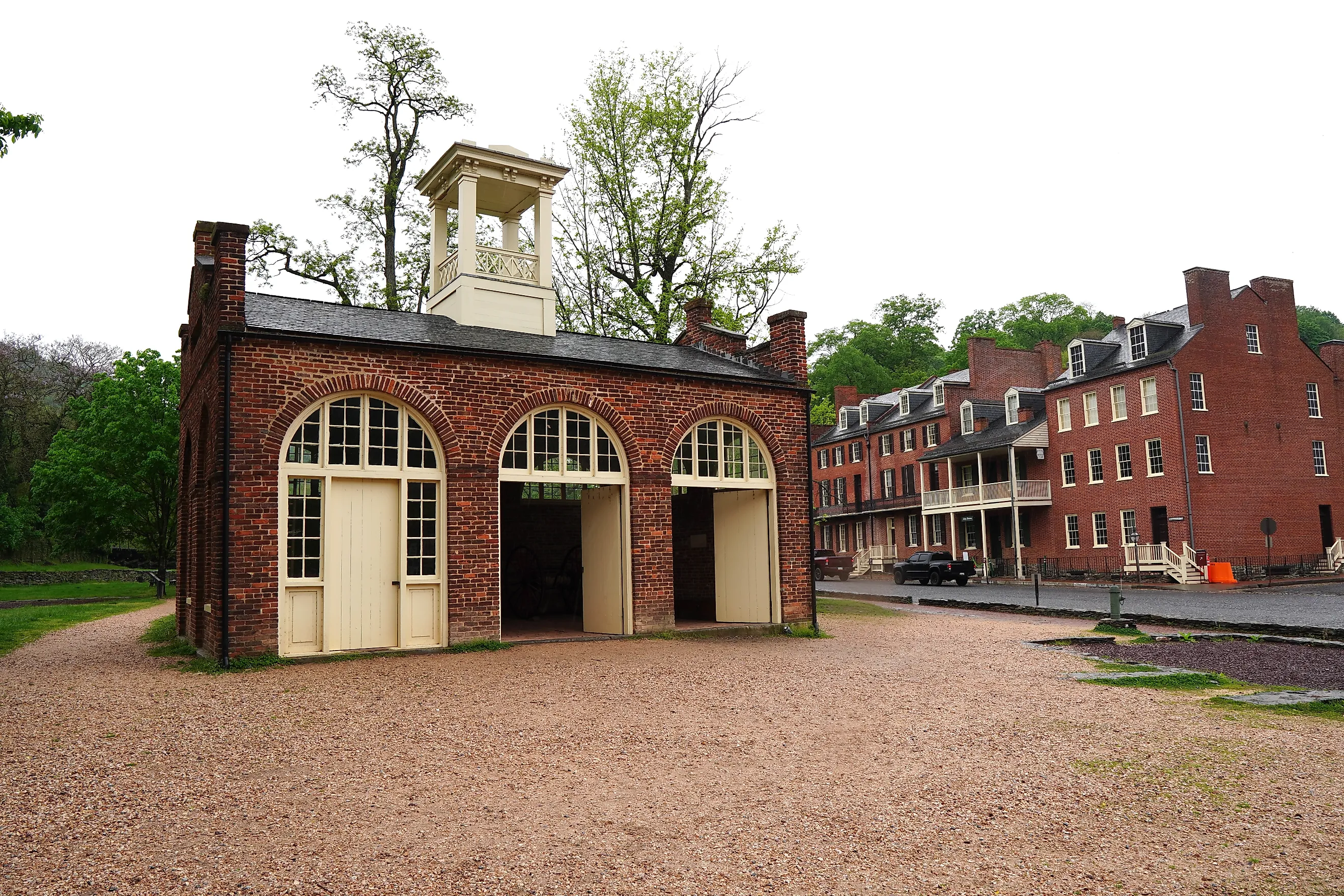
The small brick building now known as John Brown's Fort was built in 1848 as the fire engine house and guardhouse for the U.S. Armory at Harpers Ferry. It took on its later name in October 1859, when abolitionist John Brown used the building as his final refuge during his raid on the federal armory. Brown believed armed action was the only path to ending slavery in the United States, and he led 21 men in seizing the federal arsenal (which held tens of thousands of weapons) in the early hours of October 17, 1859. The plan was to arm an enslaved uprising that Brown expected would spread south through the Allegheny Mountains.
The raid failed within 36 hours. Local militia trapped Brown's force in the engine house. U.S. Marines under the command of Colonel Robert E. Lee (the future Confederate general) and Lieutenant J.E.B. Stuart stormed the building on October 18. Ten of Brown's men were killed, including two of his own sons, Watson and Oliver. Brown was wounded with a sword thrust and captured. He was tried by the Commonwealth of Virginia at Charles Town for treason, murder, and conspiring to incite slave insurrection, convicted, and hanged on December 2, 1859.

Brown's raid is widely regarded as one of the immediate catalysts of the American Civil War, which began 17 months later in April 1861. The engine house survived the raid and the four years of war that followed and became a pilgrimage site for freed people and abolitionists after emancipation. The building has been moved several times: to Chicago in 1893 for display at the World's Columbian Exposition, back to Harpers Ferry in 1895, and to the Storer College campus (a historically Black college founded in 1867) in 1909 after the college purchased it. In 1968, the National Park Service moved it to its current location at Harpers Ferry National Historical Park, approximately 150 feet from the original armory site. It is open during park operating hours.
Prickett's Fort

Prickett's Fort sits in Prickett's Fort State Park near Fairmont, Marion County, on the site of the original 1774 settler refuge built during Lord Dunmore's War, a short colonial conflict in the fall of 1774 between the British Colony of Virginia and the Shawnee and Mingo. The original fort was named for Captain Jacob Prickett, who donated the land. Through the Revolutionary War, the palisade served as a refuge for more than 80 families from the surrounding Monongahela Valley during Native raids on outlying farms. The original structure was dismantled after the war, when settler families returned to permanent farms.

In 1976, the Prickett's Fort Memorial Foundation reconstructed the fort as the centerpiece of the 188-acre Prickett's Fort State Park, with the reconstruction based on archaeological evidence and 18th-century specifications. The reconstructed log fort encloses roughly 110 feet on each side, with two-story blockhouses at each corner and 14 small cabins and common buildings inside the palisade that illustrate the cramped conditions of frontier refuge life. Costumed interpreters demonstrate 18th-century crafts including blacksmithing, weaving, and open-hearth cooking. The brick Job Prickett House on the same property, built on Prickett family land in 1859, is preserved as part of the museum complex. The visitor center includes interpretive displays, a research library, and a museum store.
The Forts in Context
The four forts represent three distinct periods of the Appalachian frontier: the French and Indian War (Fort Ashby, 1755), the Revolutionary War (Fort Randolph, 1776; Prickett's Fort, 1774), and the long lead-up to the Civil War (John Brown's Fort, 1848/1859). Together they cover roughly a century of frontier defense, Native-settler conflict, the Revolutionary War on the western front, and the armed prelude to the Civil War. Fort Ashby is the only one of the four with original 18th-century fabric still standing; the others are 19th-century survivor or 20th-century reconstructions. All four operate as accessible living-history sites and offer the most direct surviving connection to the colonial and antebellum periods of what would become West Virginia in 1863.