12 Prettiest Small Towns In Florida's Emerald Coast
Along Florida's Emerald Coast, where the Gulf turns a startling green over quartz-white sand, the prettiest places are the small towns. In Seaside, an amphitheater and pastel cottages lie a two-minute walk from the water. Nearby, Scenic Highway 30A threads a string of communities onto a single bike path past coastal dune lakes found in only a few places worldwide. State parks and a national seashore protect long reaches of wild, undeveloped shore. These 12 towns trace the coast, each with its own reason to stop and admire.
Perdido Key

The western end of Florida's Emerald Coast belongs to Perdido Key, a slender barrier island shared with Alabama that remains quieter than the beaches to its east. Perdido Key State Park protects a couple of miles of undeveloped dune and white sand, home to nesting sea turtles and the endangered Perdido Key beach mouse. The water carries the same clear green that gives the whole coast its name.
Across the sound, Big Lagoon State Park adds salt marsh, pine woods, and an observation tower with a wide view over the water and its wading birds. Part of the key falls inside Gulf Islands National Seashore. Long reaches of shoreline stay wild as a result. Pensacola and Orange Beach both lie only a short drive away.
Pensacola Beach

Pensacola Beach spreads along Santa Rosa Island off the historic city of Pensacola, its quartz sand bright enough to feel cool underfoot at midday. The candy-striped beach-ball water tower marks the center, above Casino Beach and the long Gulf fishing pier. Clear green water over a pale bottom makes this the picture most people carry of the Emerald Coast.
West of the crowds, Gulf Islands National Seashore takes over with miles of empty dune, ending at Fort Pickens, a brick fort from the 1830s that once guarded the mouth of Pensacola Bay. The seashore leaves a long run of the island free of building. Between the history at the fort and the sand in between, Pensacola Beach packs the range of the whole coast onto one barrier island.
Gulf Breeze

A green peninsula between Pensacola Bay and Santa Rosa Sound gives Gulf Breeze water on nearly every side. Its prettiest ground belongs to the public. Naval Live Oaks Reservation, part of Gulf Islands National Seashore, preserves a coastal forest of ancient live oaks that the US Navy once set aside for shipbuilding timber, with shaded trails leading down to the sound.
Shoreline Park and a boardwalk through the wetlands give easy reach to the water for paddling, fishing, and birdwatching. The town links Pensacola with Pensacola Beach, close to both yet noticeably calmer than either. For a place this compact, Gulf Breeze leaves a surprising amount of shoreline open to everyone.
Navarre

Facade of colorful houses along the bay in Navarre, Florida.
Navarre calls itself "Florida's Most Relaxing Place." The long, thin reach of Santa Rosa Island it occupies backs the claim with uncrowded white sand and water clear enough to show the bottom. The Navarre Beach Fishing Pier extends far out over the Gulf, one of the longest piers in Florida and a steady spot for watching rays and dolphins pass below.
Just offshore, the Navarre Beach Marine Sanctuary offers artificial reefs to snorkelers and divers at no charge. A sea turtle conservation center and a marine science station operate nearby. Much of the surrounding island belongs to Gulf Islands National Seashore, which preserves the dunes and an empty horizon. Navarre remains the rare beach town that still feels like a secret between Pensacola and Destin.
Niceville

Set on Boggy Bayou off Choctawhatchee Bay rather than the open Gulf, Niceville offers calm water, shade, and a settled feel the beach towns cannot quite match. Mature oaks shade the streets. Turkey Creek is the centerpiece, a spring-fed creek so clear it looks lit from below, traced by a boardwalk through cypress and hardwood.
Fred Gannon Rocky Bayou State Park adds more shaded trails and quiet paddling on the bayou a few minutes away. The long-running Boggy Bayou Mullet Festival returns each fall, a reminder that the town grew from fishing rather than tourism. For a coast defined by its beaches, Niceville makes the case for the bays behind them.
Miramar Beach

Miramar Beach trades the small-village feel for something busier, with wide Gulf beaches backed by shops, restaurants, and resorts. Silver Sands, one of the largest designer outlet centers in the Southeast, lies just inland. Next door, the Sandestin resort surrounds The Village of Baytowne Wharf, a waterfront cluster of dining and events around a marina on Choctawhatchee Bay.
The beach itself remains the point, the same white sand and green water as its quieter neighbors. Topsail Hill Preserve protects dunes and dune lakes just west in Santa Rosa Beach. Henderson Beach State Park guards shoreline a short drive east toward Destin. Miramar Beach fits visitors who want the Gulf in the morning and everything else a few minutes away.
Santa Rosa Beach

Low Altitude off the Beach at Ed Walline Park, Santa Rosa Beach, Florida.
Wider than any of its 30A neighbors, Santa Rosa Beach reaches from the Gulf-front dunes inland toward Choctawhatchee Bay. Blue Mountain Beach, its eastern neighborhood, climbs onto some of the highest ground on the coast, which in Florida is not saying much but is enough for a real view. Much of the prettiness here is protected land rather than built streetscape.
Topsail Hill Preserve State Park protects towering dunes, three coastal dune lakes, and miles of quiet shoreline across roughly 1,600 acres. Inland, Point Washington State Forest threads cycling and hiking trails through pine and wiregrass. Eden Gardens State Park frames a white-columned 1890s mansion with moss-draped oaks and formal gardens along Tucker Bayou. Together they give Santa Rosa Beach more open space than almost any town on the coast.
Grayton Beach

Grayton Beach is the oldest town on this stretch of coast. It has preserved its Old Florida character while newer developments rose around it. Weathered cottages line sandy lanes shaded by wind-bent oaks. The streets still follow a loose, unpaved grid.
The Zoo Gallery on Hotz Avenue has sold local art and oddball gifts here for decades. The Red Bar, a beloved music-and-dinner spot that burned in 2019 and reopened after a rebuild, again marks the corner. The real prize lies just outside town at Grayton Beach State Park, regularly ranked among the finest beaches in the country. It protects tall white dunes, pine flatwoods, and Western Lake, one of the region's rare coastal dune lakes, where fresh water meets salt within sight of the surf.
Seaside

The town square shopping area in Seaside, Florida
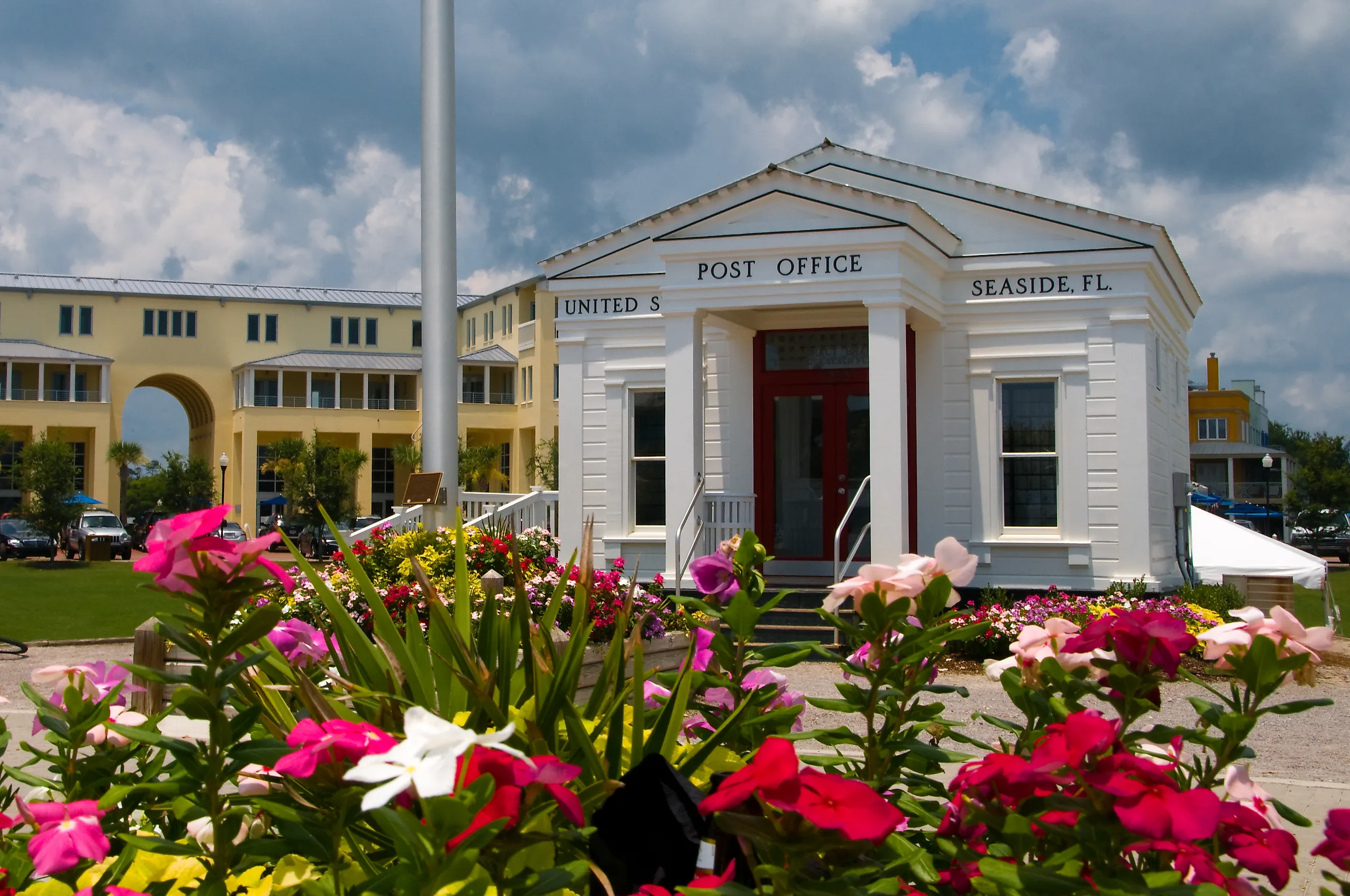
Seaside launched the whole look of 30A, a planned village of pastel cottages, white picket fences, and sandy streets that all aim toward the Gulf. Its walkable core looked so tidy on screen that it doubled for an entire manufactured town in the 1998 film "The Truman Show." The grassy amphitheater at the center hosts outdoor concerts and movies a short walk from the water. Silver Airstream trailers along the highway serve grilled cheese, tacos, and shaved ice.
Mornings tend to start at Modica Market, a grocery and deli from the 1990s stacked with wine and prepared food, or at Amavida Coffee a few doors down. Cyclists pick up the Timpoochee Trail here, the paved path that follows Scenic 30A past dune lakes and beach boardwalks. Even at peak season, the scale remains small, with nothing taller than a few stories and the sand never more than a couple of minutes off.
Rosemary Beach

Cobbled and narrow, shaded by courtyards and archways, the streets of Rosemary Beach look unlike anything else on 30A. Architecture borrowed from the West Indies, New Orleans, and the Dutch Caribbean lends the whole town a dusky, Old-World color. Barrett Square, the central green, faces the Gulf and gathers cafe tables under the trees.
The town was built for walking. Cars mostly remain parked. Visitors collect pastries and coffee around the square, browse the small shops, and settle onto pocket parks set between the houses as the light drops. It reads less like a Florida beach strip than a compact European village that happens to face the emerald Gulf.
Mexico Beach

Mexico Beach markets itself as the way Florida's coast used to look, a claim it backs up. No high-rises break the skyline here, only low cottages and beach houses along a wide, gentle shore. The town took a direct hit from Hurricane Michael in 2018 and has rebuilt deliberately, protecting the quiet, low-density character that first brought people here.
Fishing organizes much of local life, along the canal, off the pier, and out at the offshore artificial reefs a local association built to bring marine life within reach of small boats. Days pass simply, with swimming, shelling, and a long walk toward the sunset. For visitors who find even 30A too built up, Mexico Beach offers the emptier, slower alternative near the coast's eastern end.
Port St. Joe

Cape San Blas Lighthouse in George Core Park in Port St. Joe, Florida.
Port St. Joe faces St. Joseph Bay from a small, walkable downtown centered on Reid Avenue, where local shops and cafes occupy the storefronts of a former port and mill town. The bay lies unusually calm and clear, sheltered by the long arm of the St. Joseph Peninsula. Scallopers and paddlers work its shallows through the warm months. George Core Park offers an easy vantage on the boats and the sunset.
The peninsula itself, protected as T.H. Stone Memorial St. Joseph Peninsula State Park, offers some of the highest-rated beaches in the state, with tall dunes and shoreline on both the Gulf and the bay. Downtown, the small Constitution Convention Museum State Park marks the site where Florida drafted its first constitution in 1838. Port St. Joe rests at the quiet eastern edge of the coast, closer in spirit to old fishing Florida than to the resort strips west of it.
What Ties the Emerald Coast Together
What makes these the prettiest small towns on the Emerald Coast is rarely the water alone, since they all share the same green Gulf. It is the small-town character behind the sand. Grayton Beach guards its Old Florida cottages and a dune lake. Rosemary Beach reads like a transplanted European village. Navarre and Perdido Key protect long reaches of nearly empty shore. Port St. Joe carries working-waterfront Florida at the eastern end.
That mix is what rewards a slower look. The prettiest small towns on this coast make it feel less like one long beach and more like a string of distinct places, each pretty in a way the next is not, all sharing a single remarkable shoreline.