11 Safest Towns In New York For Senior Living
The towns below cover the practical retirement options across New York State outside the New York City metro and the Buffalo-Rochester corridor. Bath in the Finger Lakes anchors a 1793 settlement with the Bath National Cemetery (established 1879). Cooperstown sits at the south end of Otsego Lake and remains the home of the National Baseball Hall of Fame. Saranac Lake spent the late 19th and early 20th centuries as the country's leading tuberculosis-treatment town, and its distinctive "cure cottages" still dot the streets. Seneca Falls hosted the first Women's Rights Convention in July 1848 and preserves that history through the Women's Rights National Historical Park. The eleven towns below combine that kind of historical depth with the practical retirement essentials: established healthcare, walkable downtowns, and housing markets below Manhattan-or-Westchester comparisons.
Bath

Bath was established in 1793 by Sir William Pulteney's land company and named after the English spa town of Bath; it served as the county seat of Steuben County in the western Finger Lakes from its earliest years. The Bath National Cemetery, established in 1879 alongside the New York State Soldiers and Sailors Home, holds the graves of over 14,000 American veterans across multiple wars and remains an active national cemetery today. The town's annual Steuben County Dairy Festival in June anchors the local agricultural calendar.
Mossy Bank Park covers about 245 acres of hilltop trail network with a small nature centre on the bluff above the town. The Glenn H. Curtiss Museum, in nearby Hammondsport (about 12 miles east), preserves the aviation legacy of one of the early-aviation pioneers and is the regional history-and-aviation destination. The Taylor Health Center provides nursing-home-level care in town. Single-family housing prices in Bath remain modest by New York standards, typically running around $200,000 to $250,000, making it one of the more affordable retirement options on this list.
Cazenovia

Cazenovia sits on the south shore of Cazenovia Lake in Madison County, about 20 miles southeast of Syracuse, and runs as a well-preserved 19th-century village built around the lake and the surrounding rolling farmland. The village's 1797 founding by John Lincklaen, a Dutch land agent, produced the rectangular street grid and substantial Federal-era and Greek Revival housing stock that still defines the downtown. Cazenovia College, founded in 1824, was a longstanding part of the village identity but closed permanently on June 30, 2023 after defaulting on a $25 million bond payment; the former campus now houses a New York State Police training academy.
The Lorenzo State Historic Site, on the south shore of Cazenovia Lake, preserves John Lincklaen's 1807 Federal-style mansion and its formal gardens. Chittenango Falls State Park about 10 minutes north of town features a 167-foot waterfall along Chittenango Creek. The Brae Loch Inn and the Lincklaen House are the two long-running historic-inn restaurants on Albany Street. Single-family housing in Cazenovia typically runs around $300,000 to $350,000.
Cooperstown

Cooperstown sits at the southern tip of Otsego Lake and is best known as the home of the National Baseball Hall of Fame and Museum, which opened in 1939 and remains the dominant tourism draw for the town. The village was established in 1786 by Judge William Cooper, whose son James Fenimore Cooper grew up here and later set several of his Leatherstocking Tales novels in the surrounding country. Beyond the baseball connection, the village holds the Fenimore Art Museum (housing significant collections of American folk art and Native American material), the Farmers' Museum (a working historic-village re-creation), and the Glimmerglass Festival, a major summer opera company.

The Otesaga Resort Hotel, completed in 1909 on the lakefront, anchors the village's hospitality and operates the Hawkeye Grill for upscale dining. Outdoor access centres on Glimmerglass State Park along the lake's eastern shore. Bassett Medical Center, the regional hospital affiliated with Columbia University Medical School, provides full hospital services in town. Single-family housing prices in Cooperstown typically run around $350,000 to $400,000.
Hamilton

Hamilton is the home of Colgate University, founded in 1819 as a Baptist seminary and now one of the country's most selective liberal arts colleges. The university's presence shapes the village's cultural and economic life: Hamilton runs a year-round calendar of lectures, performances, and exhibitions tied to the academic schedule. The Hamilton Public Library, housed in the 1855 Park-Russell House, anchors the village green along with the village's tightly preserved 19th-century commercial streetscape.
The Colgate Inn on the village green has operated as a hotel and restaurant since 1925. Seven Oaks Golf Course, on the Colgate campus, is open to the public and ranks among the better-regarded New York university courses. The Community Memorial Hospital in Hamilton provides full local hospital care including specialised geriatric services. Single-family housing in Hamilton typically runs around $300,000 to $350,000.
Lowville

Lowville is the county seat of Lewis County in the Tug Hill region of north-central New York, named after Nicholas Low, the early-19th-century investor whose land company developed the area. The town's economy has been dominated by dairy since the 19th century and remains so today, with the Kraft cream-cheese plant in Lowville one of the largest cream-cheese-producing facilities in the country. The annual Cream Cheese Festival, held in September, builds the town's dairy identity into its cultural calendar.
Whetstone Gulf State Park, six miles south of Lowville, runs trails along a three-mile-long, 300-foot-deep gorge cut by Whetstone Creek through the Tug Hill Plateau. The Ridge View Inn and Gary's Restaurant are the long-running local dining fixtures. Lewis County General Hospital provides emergency and primary services in town. Single-family housing in Lowville runs around $200,000 to $250,000, the most affordable of the towns on this list.
Owego

Owego is the county seat of Tioga County in the Southern Tier, sitting on a curve of the Susquehanna River about 25 miles west of Binghamton. The village's 19th-century commercial core has been substantially preserved, and Owego was named one of the "Coolest Small Towns in America" by Budget Travel in 2009. The Strawberry Festival held every June draws crowds from across the region.
The Owego Kitchen and the Cellar Restaurant are the local long-standing fine-dining fixtures, the latter focused on Italian cuisine. The Tioga County Historical Society Museum on Front Street anchors the local-history calendar. Hickories Park along the river runs picnic areas and walking trails. Single-family housing in Owego is among the most affordable on this list, typically running around $150,000 to $200,000. Riverview Manor offers senior-living and skilled-nursing services in town.
Penn Yan

Penn Yan sits at the northern tip of Keuka Lake in the Finger Lakes wine country. The village's name is a blended portmanteau of "Pennsylvania" and "Yankee," reflecting the mixed origins of its early 19th-century settlers. Founded in 1823, the village's downtown carries an intact stretch of early Federal-period and mid-Victorian commercial architecture along Main and Elm Streets.
The Keuka Restaurant and the Water Street Wine Bar handle waterfront dining, with the latter showcasing the region's wineries. The Oliver House Museum interprets the area's history. Indian Pines Park on the lake provides walking access for retirees. Single-family housing in Penn Yan typically runs around $375,000 to $400,000, somewhat higher than other Finger Lakes towns because of the lakefront premium. Penn Yan Manor Nursing Home provides skilled care.
Potsdam

Potsdam is one of two SUNY college towns on this list (the other is, in effect, Hamilton with Colgate), housing both SUNY Potsdam (founded 1816 as the St. Lawrence Academy, now one of the oldest public teacher-preparation institutions in the country) and Clarkson University, the private engineering school founded in 1896. The combined college population gives the town an unusually strong cultural infrastructure for its size, with multiple performance venues, art galleries, and lecture series tied to the academic calendar. Potsdam's distinctive red sandstone architecture (quarried locally from the Potsdam Sandstone deposit) is visible in many of the town's older buildings.

The 1844 House offers fine dining in a restored farmhouse, and Jake's on the Water sits along the Raquette River. The St. Lawrence County Arts Council regularly hosts exhibits and workshops. Postwood Park provides waterfront recreation. Canton-Potsdam Hospital handles regional healthcare. Single-family housing in Potsdam typically runs around $150,000 to $200,000, among the most affordable in upstate New York.
Saranac Lake

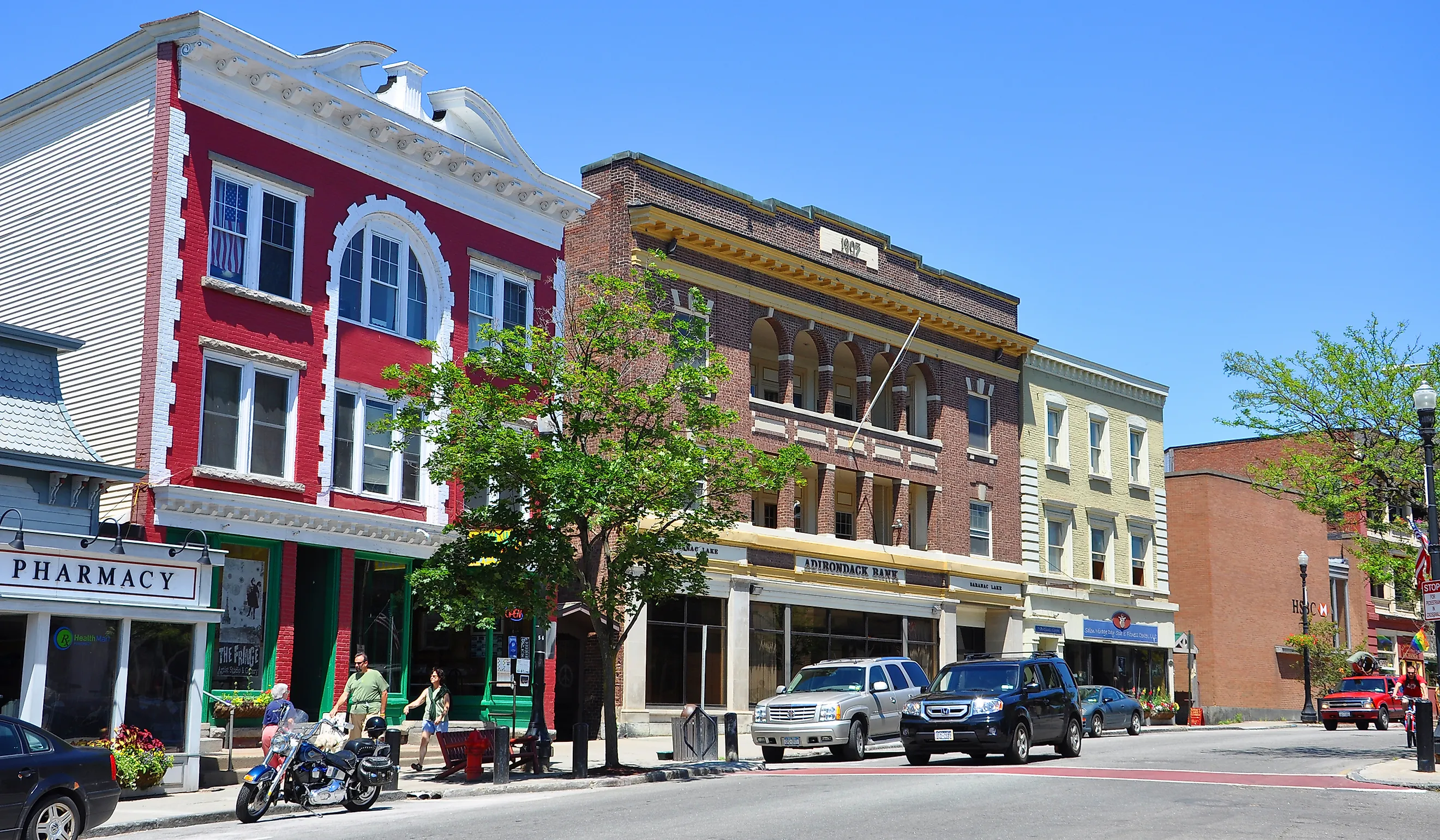
Saranac Lake in the Adirondack Mountains became the country's leading tuberculosis treatment centre after Dr. Edward Livingston Trudeau established his Adirondack Cottage Sanitarium there in 1885, and the village preserves over 50 "cure cottages" (purpose-built houses with open porches for fresh-air therapy) from the resulting late-19th and early-20th-century era. The Saranac Lake Winter Carnival, held every February since 1897, features an ice palace built each year from blocks quarried from Lake Flower, the village's central lake.

The Left Bank Café handles Parisian-style cuisine and Nori's Village Market covers natural and organic groceries. The Saranac Laboratory Museum, in Dr. Trudeau's original 1894 research building, documents the village's medical history. The Robert Louis Stevenson Cottage and Museum preserves the cottage where Stevenson spent the 1887-88 winter undergoing tuberculosis treatment. Single-family housing in Saranac Lake runs higher than other upstate towns on this list, typically around $400,000 to $500,000, reflecting the Adirondack premium. Saranac Village at Will Rogers offers independent and assisted living.
Seneca Falls

Seneca Falls hosted the first Women's Rights Convention from July 19 to 20, 1848, when over 300 attendees including Elizabeth Cady Stanton and Lucretia Mott met at the Wesleyan Methodist Chapel and drafted the Declaration of Sentiments. The Women's Rights National Historical Park, established in 1980, preserves the chapel, the Stanton House, and several other associated sites; the visitor centre on Fall Street is the entry point. The village is also the model for Bedford Falls in Frank Capra's 1946 film It's a Wonderful Life, a connection actively celebrated through the annual It's a Wonderful Life Festival every December.
Café 19 (named for the 19th Amendment) handles local-ingredient dining. The Seneca Museum of Waterways and Industry interprets the town's role in the Erie Canal system. Montezuma National Wildlife Refuge, just east of the village, runs important bird-watching trails along the Cayuga-Seneca Canal. Single-family housing in Seneca Falls runs around $200,000 to $250,000. Senior-care services include the nearby Huntington Living Center in Waterloo.
Ticonderoga

Ticonderoga sits on the narrow land connection between Lake Champlain and Lake George in the eastern Adirondacks, a position that made it militarily critical through the French and Indian War and the American Revolution. Fort Ticonderoga, built by the French as Fort Carillon in 1755, was captured by Ethan Allen and the Green Mountain Boys on May 10, 1775, in one of the first American offensive actions of the Revolution, before Henry Knox famously dragged its captured artillery 300 miles to Boston that winter to break the British siege.

The reconstructed fort, restored beginning in 1909 by William Ferris Pell, is one of the most extensive military-history museums in the United States. Burleigh's Luncheonette in town runs as a long-standing local diner. The Hancock House serves as the Ticonderoga Historical Society headquarters. The LaChute River Trail runs through town along the historic portage route between the lakes. Single-family housing in Ticonderoga is modest by Adirondack standards, typically running around $250,000 to $300,000.
The Pattern Across the Eleven
The eleven towns above cover four distinct retirement settings in New York. The Finger Lakes wine country (Penn Yan, Seneca Falls, Bath) trades off the most extensive wine, water, and waterway access for moderate winters by upstate standards. The college towns (Hamilton, Potsdam, and Cazenovia even after its college closed) carry the strongest cultural infrastructure relative to size. The North Country and Adirondack towns (Saranac Lake, Ticonderoga, Lowville) take the harshest winters but offer the strongest outdoor access and the lowest housing prices on the list. The Mohawk Valley and Southern Tier outliers (Cooperstown, Owego) round out the list with their specific historical and cultural draws. Across all eleven, the practical retirement essentials hold: established hospital access, walkable downtowns, and housing markets that remain workable on a typical retirement budget.