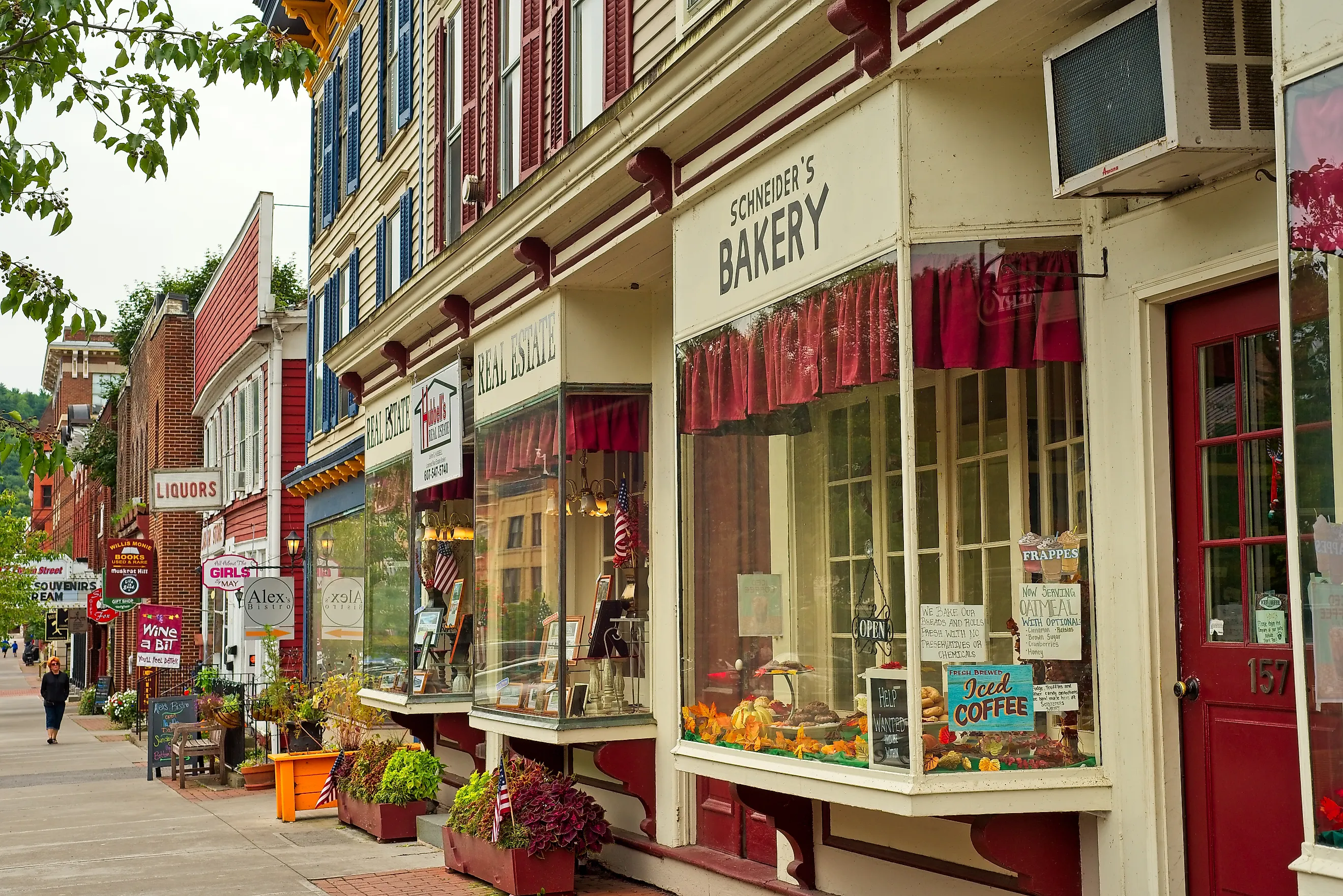
10 Best Small Towns To Retire In New York
New York offers retirees everything from Finger Lakes waterfront living to Hudson Valley villages and Adirondack mountain towns. You can stay active with lake access in places like Canandaigua and Cooperstown, or with trail-rich settings in places like Saranac Lake. For those after community events and a lively restaurant scene, Skaneateles has you covered with its Thursday farmers market and walkable main street. All with small populations and accessible healthcare amenities, these are 10 of the best towns to retire in New York.
Cooperstown

With a population of roughly 1,850, Cooperstown sits at the foot of Otsego Lake in Otsego County and functions as one of the most culturally rich small towns in the state. Most people know it as the home of the National Baseball Hall of Fame and Museum, which draws around 260,000 visitors annually and gives the town a genuinely lively summer season without losing its small-town character. The Fenimore Art Museum on Lake Road holds one of the most significant collections of American folk art in the country, including a dedicated gallery of Haudenosaunee (Iroquois) artifacts that provides real depth for history-minded retirees. The Glimmerglass Festival, held at the Alice Busch Opera Theater just north of the village each summer, has built a national reputation for commissioning new operatic works in a lakeside setting that feels unlike anything else in the region.
For daily activity, the Clark Sports Center covers the practical side of retirement fitness well. The 110,000-square-foot facility includes an indoor pool, full fitness equipment, and 17 acres of outdoor fields, giving retirees year-round options without driving to a larger city. Otsego Lake itself rounds things out with kayaking, fishing, and open-water swimming from late spring through fall.
Corning

Corning sits in Steuben County in the Southern Tier, near the Pennsylvania border, with a population of around 10,000. It is not a town that announces itself loudly, but the Corning Museum of Glass has been drawing serious visitors since 1951 and holds over 50,000 glass objects spanning 3,500 years of glassmaking history, making it one of the most visited cultural institutions in the region. Retirees who want something more walkable will find it on Market Street, a restored 19th-century commercial strip through the Gaffer District, lined with galleries, restaurants, and independently owned shops that give downtown a lived-in quality rather than a tourist-focused one.
The Rockwell Museum on Cedar Street focuses on the American West and holds one of the most significant collections of Western American art in the eastern US. For outdoor access, the surrounding Chemung River valley offers hiking and cycling routes within easy reach of town. What makes Corning particularly worth considering for retirees on fixed incomes is the housing cost: the median home value sits well below the New York state average, which puts homeownership within reach in a way that few towns on this list can match.
Skaneateles

Skaneateles, in Onondaga County, consistently ranks among the most photographed towns in upstate New York, and it earns that reputation honestly. With a population under 7,000, it sits at the northern tip of Skaneateles Lake, one of the Finger Lakes chain, and widely regarded as one of the cleanest lakes in the United States. The lake is not just a backdrop here; it is the center of daily life for retirees. Boat tours run from the municipal dock through the summer, the shoreline at Thayer Park fills up on Thursday mornings during the Skaneateles Farmers Market from late June through August, and Anyela's Vineyards on Route 41 just south of the village offers tastings that connect the town to the broader Finger Lakes wine culture surrounding it.
The village's main street deserves its own mention. Independent restaurants, local shops, and a walkable scale that rarely survives in towns this size make it the kind of place where retirees find themselves out more than they expected.
Rhinebeck

Rhinebeck, in Dutchess County, holds a population of around 2,600 in the town proper. The Beekman Arms, operating continuously since the 1760s and widely regarded as the oldest inn in America, anchors the village center with a dining room that draws both visitors and long-term residents on an ordinary Tuesday. That detail matters more than it sounds: a town with a restaurant worth going to on a weekday is a town with actual community life. Wilderstein Historic Site, a Queen Anne-style mansion set on roughly 40 acres above the Hudson River, runs tours and grounds access that give history-focused retirees a genuinely compelling destination within a short drive.
The Old Rhinebeck Aerodrome, a few miles north of the village, stages air shows featuring biplanes and World War I-era aircraft from late spring through fall. The Rhinebeck Farmers Market, held year-round at the Dutchess County Fairgrounds, connects retirees with local food producers across all four seasons. Northern Dutchess Hospital sits just two miles from the village center, covering emergency and specialty care without requiring a trip to Poughkeepsie.
Canandaigua

With 10,500 residents, Canandaigua is the county seat of Ontario County and one of the more complete small-town retirement packages in the Finger Lakes region. The town sits directly on Canandaigua Lake, and the waterfront is genuinely accessible: kayaking, sailing, and shoreline walking are available throughout the warmer months without needing club memberships or special access. Sonnenberg Gardens and Mansion State Historic Park on North Main Street preserves nine distinct Victorian-era formal gardens spread across 50 acres around a 40-room mansion. It is the kind of place retirees visit once and then keep coming back to across different seasons.
The Ontario County Historical Society museum covers the town's role in the Sullivan-Clinton Campaign of 1779 and its significance to early Iroquois Confederacy negotiations, giving history-minded retirees enough material to keep them interested well beyond a single visit. The Canandaigua area also sits near the Finger Lakes Wine Trail, with multiple wineries within a 20-minute drive. Thompson Health, a regional health system serving Ontario County, operates a full-service hospital in town.
Saranac Lake

Spend a February morning watching volunteers haul ice blocks out of Lake Flower, and you will understand something about Saranac Lake that a real estate listing never captures. The town, with roughly 4,900 residents in Franklin and Essex counties inside the Adirondack Park, runs on a culture of outdoor life that predates the modern recreation economy by more than a century. Dr. Edward Livingston Trudeau established the country's first tuberculosis sanatorium here in 1884, drawing patients from across North America on the premise that the mountain air itself was healing. The town never really stopped believing that.
The Saranac Lake Winter Carnival, first organized in 1897, is one of the oldest winter carnivals in the eastern United States and runs for 10 days each February. Its centerpiece, the Ice Palace, is built by volunteers from blocks harvested directly from Lake Flower, and the whole event has the feel of a community that genuinely enjoys winter rather than endures it. In warmer months, Lake Flower connects to a chain of lakes that support kayaking, canoeing, and paddleboarding, while The Wild Center on Nelson Road features the Wild Walk, an elevated trail through the forest canopy that consistently ranks among the top attractions in the Adirondacks. AdirondackHealth operates Adirondack Medical Center in town for year-round emergency and inpatient care.
Geneseo

Geneseo wears its history proudly; the town is a designated National Historic Landmark Village in Livingston County, with a population of around 9,000, and it has a main street that looks much as it did in the mid-1800s. The village sits at the northern edge of the Genesee Valley, and its proximity to Letchworth State Park puts one of the most spectacular landscapes in the Northeast within 20 minutes of downtown. New York State Parks designates Letchworth the "Grand Canyon of the East," and USA Today readers voted it Best State Park in the United States in 2015. The Genesee River cuts through a gorge with cliffs reaching 600 feet, and 66 miles of hiking trails run through the park at varying difficulty levels, meaning retirees at different fitness levels all have something workable.
Closer to home, the Genesee Valley Greenway offers 90 miles of flat, accessible multi-use trail through the valley for walking and cycling. SUNY Geneseo fills the town's cultural calendar with public lectures, theater productions, and arts events throughout the academic year, giving retirees a reason to be out on a random Thursday night in October. Strong Memorial Hospital in Rochester sits about 30 miles north and ranks among the top-rated hospitals in the state for specialty care.
Fredonia

Fredonia, in Chautauqua County near the Lake Erie shoreline, holds a population of around 9,100 and a historic commercial district listed on the National Register of Historic Places. In 1821, the village became the site of the first commercial use of natural gas in the United States, a piece of industrial history the Barker Commons and surrounding Victorian streetscape still quietly reflect. That backstory gives Fredonia a sense of depth that newer planned communities cannot manufacture.
SUNY Fredonia's Rockefeller Arts Center stages professional theatrical and musical performances year-round and puts a full-season arts calendar within walking distance of downtown for retirees who want regular cultural programming without driving to Buffalo. The Chautauqua-Lake Erie Wine Trail runs along the southern shore of Lake Erie through the Fredonia area, with tastings and tours across dozens of regional wineries. Lake Erie State Park, a few miles west of town, provides accessible shoreline trails, swimming, and picnicking directly on one of the Great Lakes. WCA Hospital in nearby Jamestown covers emergency and specialty care for the broader county.
Cold Spring

Cold Spring is the kind of town that makes people stop mid-sentence. The town sits in Putnam County on the east bank of the Hudson River, with a population of around 2,000 and a Main Street that runs downhill toward the water and ends at a riverfront park with direct views of Storm King Mountain across the Hudson. Retirees with an eye for architecture will find two solid hours of material in the walkable downtown, where 19th-century storefronts house antique dealers like the Cold Spring Antique Center alongside independent restaurants with Hudson River views from their back decks.
Hudson Highlands State Park Preserve, directly accessible from the village, contains over 9,000 acres of trails through the Hudson Highlands at varying difficulty levels. Foundry Dock Park at the foot of Main Street gives the village a waterfront gathering point for daily walks. For retirees who want the option of a city day without owning a car, Metro-North's Hudson Line runs directly through Cold Spring and puts Grand Central Terminal about 75 minutes south by train.
Oneonta

Oneonta, in Otsego County at the edge of the Catskill Mountains, has a population of around 14,000 and a downtown that has held together better than most small upstate cities of similar size. The Greater Oneonta History Center on Main Street covers the Delaware and Hudson Canal era and the town's 19th-century history as a rail hub through rotating exhibits that give longtime residents reason to return alongside first-time visitors. Neahwa Park, a 72-acre riverside greenspace along the Susquehanna River, provides trails, athletic fields, and open space accessible on foot from most neighborhoods in the city.
The Foothills Performing Arts Center on Chestnut Street hosts live theater, concerts, and community events across a full annual season. Healthcare access here is stronger than the town's size would suggest: Bassett Medical Center, affiliated with Columbia University, extends specialty clinic access to the Oneonta area and gives retirees a level of medical infrastructure that most towns this size do not offer. Housing costs remain significantly below the state median, making Oneonta worth serious consideration for retirees on a tighter budget.
Small Towns, Big Decisions
New York's retirement landscape rewards people who look past the obvious. Towns like Canandaigua, Saranac Lake, and Geneseo offer recreational access that rivals destinations with far bigger tourism budgets, while Cold Spring and Rhinebeck put Hudson Valley scenery within reach without requiring a trust fund. The 10 towns above were chosen because each holds something specific: a museum worth returning to, a trail that works in January, a healthcare system that removes at least one significant anxiety from the retirement equation. The right fit depends on how much weight a retiree puts on waterfront access versus arts programming, or village-scale walkability versus proximity to a major hospital. Any of these towns can support a full, active retirement. The question is which set of specifics matches your own.