11 Prettiest Downtown Strips In Oklahoma
A "pretty" downtown strip in Oklahoma is rarely accidental. Medicine Park's storefronts, bridges, and retaining walls are built from the same rounded cobblestones as the surrounding Wichita Mountain foothills. Miami's Coleman Theatre rises three pale stories above darker brick neighbors with arched windows and ornamental stonework. Guthrie's Oklahoma Avenue runs block after block of 1890s commercial architecture in one of the most unified late-19th-century streetscapes in the state. Perry's Noble County Courthouse sits in the center of one of Oklahoma's largest historic squares with continuous brick storefronts framing every side. The eleven downtowns ahead each earn the slot through one specific architectural anchor that has shaped how the rest of the strip developed around it.
Guthrie

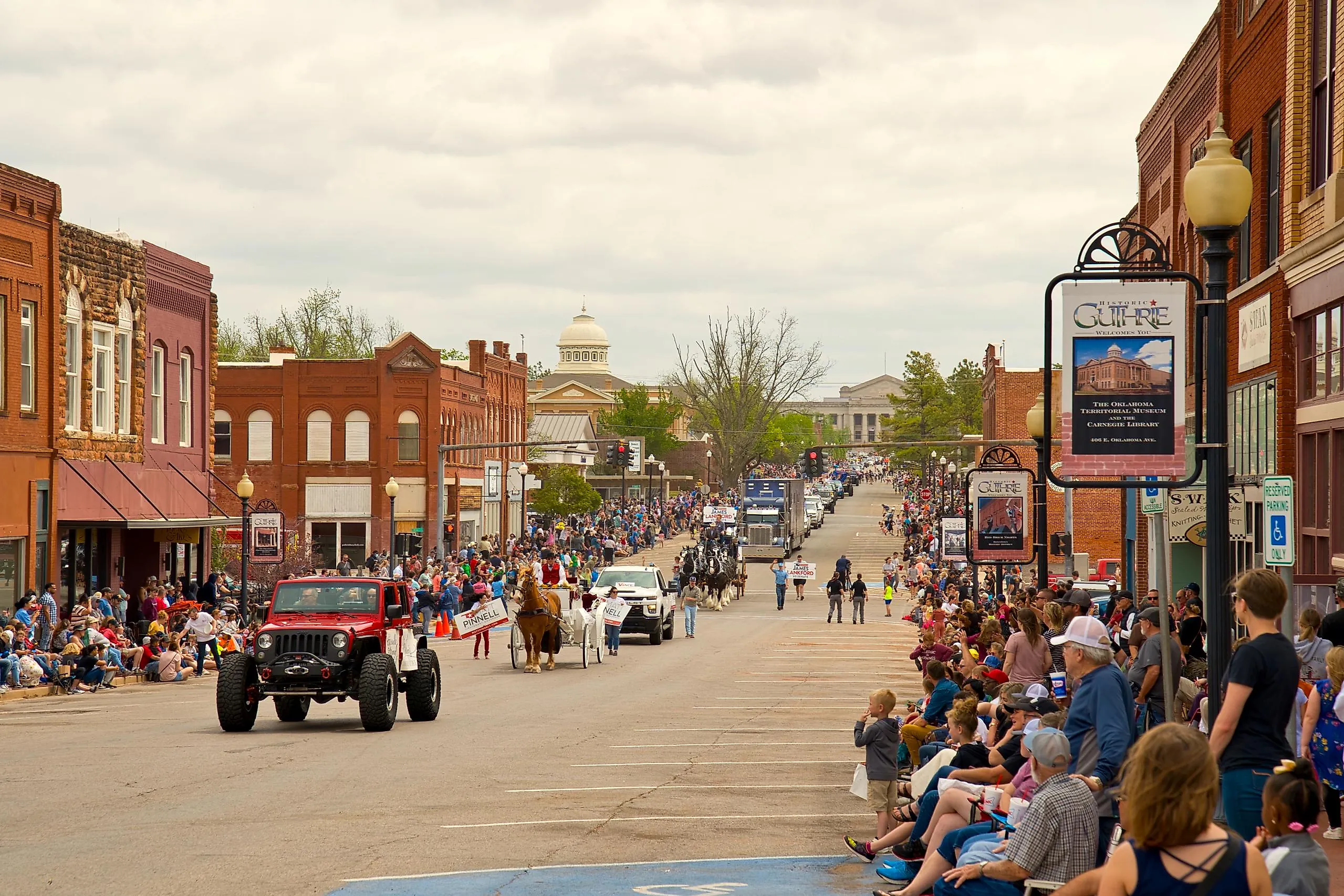
Long stretches of red brick and sandstone give Guthrie one of the most visually unified downtowns in Oklahoma. Oklahoma Avenue carries block after block of late-19th-century commercial buildings, many with decorative cornices, tall upper-story windows, and painted signs still visible above the storefronts.
The Victor Building stands out along the skyline with its steeply stepped roofline, narrow vertical windows, and deep red-brick facade trimmed in pale stone. Originally completed in 1893, the structure rises above many neighboring storefronts and gives the block a sense of height atypical for a smaller town. Nearby, the Pollard Theatre adds a different texture through its recessed entrance and darker detailing, while the Oklahoma Territorial Museum runs exhibits tied to the state's early development. Guthrie served as the first territorial and state capital of Oklahoma from 1890 until the seat of government moved to Oklahoma City in 1910.
Medicine Park

Few Oklahoma downtowns have a material palette as distinctive as Medicine Park's. Rounded cobblestones appear in storefronts, bridges, and retaining walls, creating a level of visual continuity that contrasts the town with the nearby Wichita Mountains.
Bath Lake sits directly beside the main commercial strip, where cascades, stone walkways, and low footbridges offer multiple viewpoints across the water. The Medicine Park Aquarium and Natural Sciences Center follows the same architectural style and invites passersby to learn about ecosystems, reptiles, and local nature. Access to the Wichita Mountains Wildlife Refuge adds another natural dimension, with rugged granite landscapes beginning just beyond the edge of town.
Pawhuska

Pawhuska's downtown carries a vertical feel atypical for northern Oklahoma. In 2024, Pawhuska began a grant-funded Downtown Streetscape project in partnership with the Osage Nation to improve sidewalks, streets, infrastructure, and traffic flow. Just outside town, the Tallgrass Prairie Preserve provides a contrasting landscape of open grassland and rolling hills that frames the community from the north and highlights the local connection to the land.
Along Pawhuska's Kihekah Avenue, multi-story brick buildings create a continuous corridor of storefronts, with upper floors and wide windows adding depth above street level. The Pioneer Woman Mercantile occupies one of the district's most recognizable buildings and offers baked goods, preserves, and lodge tours. The Osage Nation Museum shares local history as the oldest tribal-owned museum in the United States. Farther uphill, the Osage County Courthouse remains visible above the commercial blocks and gives the downtown a clear central point from all directions.
Eufaula

Eufaula's appeal comes from how quickly its downtown shifts between architectural detail and lakeside openness. The Foley Building's domed corner tower acts as a visual anchor among lower brick storefronts, while several large murals add color to otherwise uniform walls.
Closer to the water, Lake Eufaula State Park spreads campgrounds, lakeside trails, and marina access across a heavily wooded section of the reservoir. The park's public docks and picnic spaces keep activity concentrated near the water. Surrounding coves and tree cover soften the transition between the developed downtown streets and the open lake. Nearby marina areas continue that connection with boat slips, walking areas, and gathering spaces positioned directly along the shoreline.
Claremore

Several architectural styles blend cohesively in Claremore. Victorian-style buildings like the Belvidere Mansion sit alongside Route 66-era signage and more modern storefront additions, giving Main Street a layered appearance along each city block.
The Belvidere Mansion itself stands out with its towers, contrasting trim, and elevated profile above its surroundings. Built in 1907 by John Melville Bayless, the mansion followed earlier Bayless projects in Claremore including the Sequoyah Hotel and the Windsor Opera House. The town center hosts restored storefronts, murals, and neon accents that help maintain activity along the sidewalks without detracting from the historic scale of the district.
Miami

The Coleman Theatre is the heart of Miami's downtown. Its pale exterior and decorative detailing contrast sharply with the darker brick buildings surrounding it. Arched windows, ornamental stonework, and the theater's vertical proportions make it the defining feature of Main Street, both inside and out.
Further along the commercial district, the Dobson Museum adds another architectural layer through its combination of preserved residential structures and landscaped grounds. The museum shares local history and archives in a low-key setting. Sections of the original Route 66 pavement remain nearby and visually connect downtown to the town's early automotive history.
Perry

Perry's downtown revolves around one of the largest historic courthouse squares in Oklahoma. The Noble County Courthouse rises from the middle of a broad lawn lined with mature trees, walking paths, monuments, and benches, while continuous rows of brick storefronts frame the square from every direction. Because the streets are set farther back from the courthouse than in many other small towns, the district maintains long, uninterrupted sightlines that make the architectural details easy to capture in a single photograph.
The Cherokee Strip Museum expands on Perry's connection to the 1893 Land Run through preserved buildings, pioneer exhibits, and historical artifacts located just beyond the downtown core. That same history becomes much more visible during the annual Cherokee Strip Celebration, when the courthouse square fills with parade routes, community gatherings, reenactments, and horse-drawn wagons.
Ponca City

Ponca City's downtown reflects a period of major oil-era development, visible in the size and detailing of many commercial buildings. The Poncan Theatre remains one of the town's most distinctive landmarks, its restored marquee and ornate facade standing prominently along Grand Avenue. The surrounding blocks feature early 20th-century brickwork, with larger window openings and decorative masonry that reflect the town's period of rapid growth.
A short distance from downtown, Cann Memorial Gardens introduces a landscaped contrast to the surrounding grid. Designed with winding paths, color-coordinated plantings, a wisteria arbor, and a lily pond, Cann Memorial Gardens surrounds a former residence and now functions as a public green space. The garden paths and flowerbeds stand in clear contrast to the linear block-based structure of downtown streets and offer a quieter environment for an afternoon walk.
The Marland Mansion adds another dimension to Ponca City's built environment. Once the private residence of oilman E.W. Marland, the estate is known for its large-scale design, limestone construction, and detailed interior craftsmanship. Sitting on grounds outside the commercial core, the mansion serves as both an architectural landmark and a historical reference point that ties the city's residential and industrial past to its modern aesthetic.
Enid

Enid's downtown includes one of the strongest collections of Art Deco and early 20th-century commercial architecture in northwestern Oklahoma. Broadway Avenue features buildings of various sizes, with taller structures like Broadway Tower, built in 1931 and about 15 stories tall, breaking up the storefront lines. Decorative brickwork, geometric detailing, and restored historic signage add character throughout the district. The Gaslight Theatre brings a retro feel to the area, with its marquee beckoning passersby. Accompanied by murals and public art installations, downtown displays a dynamic aesthetic.
Sulphur

Sulphur's downtown is shaped by its proximity to the surrounding landscape of the Chickasaw National Recreation Area. Springs, creeks, and shaded public spaces are only a short distance from the commercial core and extend the town's scenic character beyond its storefronts.
The heart of downtown, Broadway Avenue, includes brick storefronts, local cafes, and small boutiques arranged along a compact walkable corridor. The Artesian Hotel, with its prominent facade and elevated position near the center of town, draws the eye both inside and out. The nearby Pavilion Springs and the Travertine Nature Center extend the district's visual character beyond the streets themselves through stonework, water features, and natural scenery.
Tishomingo

Tishomingo's Main Street combines restored commercial buildings, native stone architecture, and tree-lined streets into a compact district shaped by local government and Chickasaw history. The Chickasaw National Capitol remains the most recognizable landmark, with its red granite exterior and columned entrance standing apart from the surrounding storefronts.
For nature, Pennington Creek adds a quieter contrast to the nearby downtown streets. Green spaces are lined with limestone banks, small bridges, and walking access points where the water flows beneath dense tree cover. Nearby, the Blue River continues the natural scenery through clearer water, rocky shorelines, and public recreation areas known for fishing, kayaking, and swimming during summer.
What Ties These Eleven Together
While Sulphur's infrastructure and architecture blend cohesively with nature, and Medicine Park blends stone construction directly into the surrounding terrain, architecture like Claremore's Belvidere Mansion can change the visual identity of an entire street through a single structure. Courthouse lawns, lakeside views, shaded squares, and theater marquees host art installations and heritage parades, and the eleven downtowns above each preserve a recognizable architectural character that defines the warmth of small-town Oklahoma.