9 Most Welcoming Small Towns in Italy
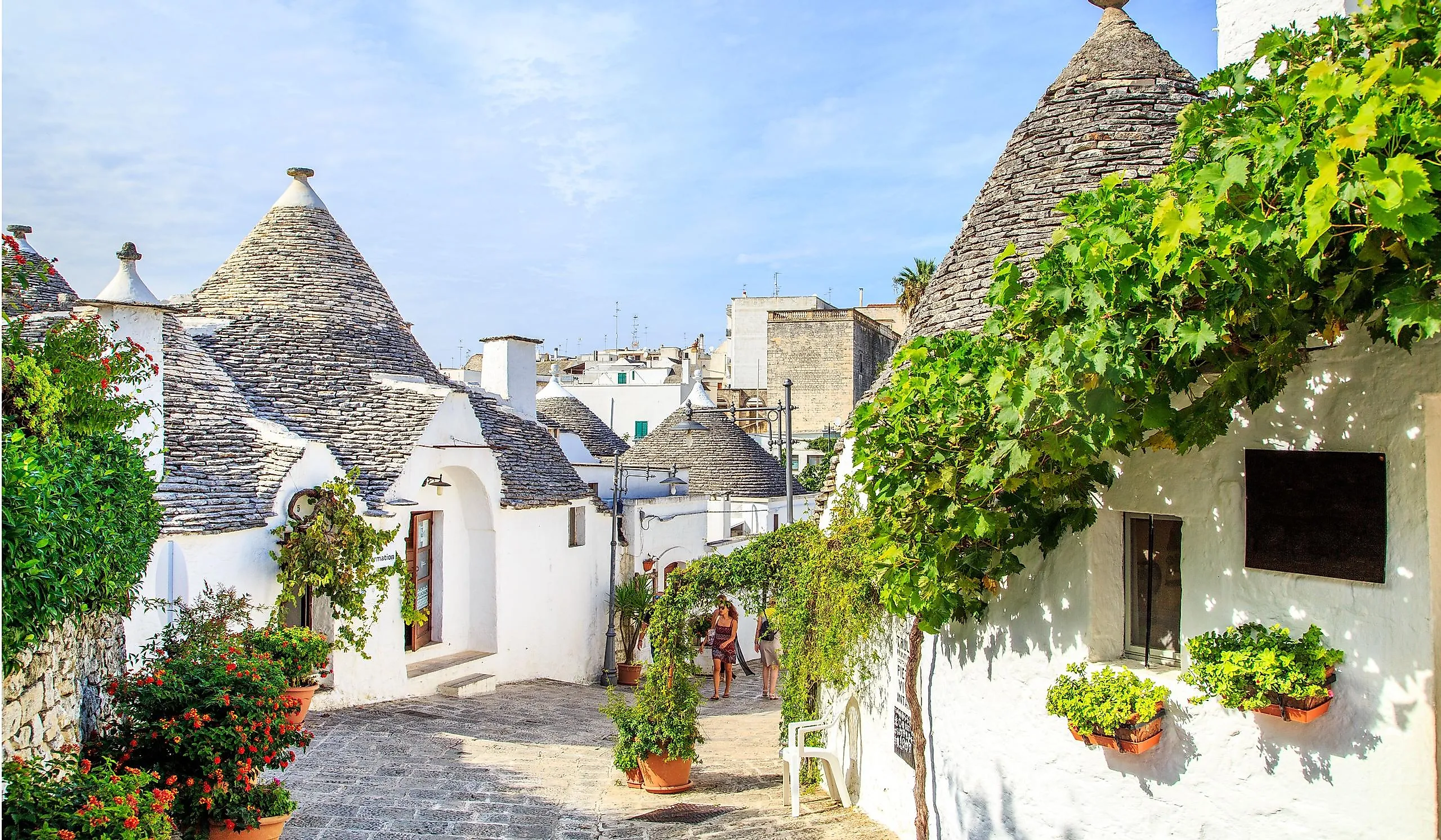
The pastel houses of Portofino climb up from a working fishing harbor in Italy's Ligurian northwest. The whitewashed conical-roofed trulli of Alberobello fill an entire hillside town in Apulia at the heel of the country. Castelmezzano hangs from a sheer rock face in the Lucanian Dolomites. Each of the nine towns ahead has built something distinct over centuries (a harbor, a fortress, a settlement of stone huts, an Olympic ski village) and each carries genuine local hospitality without the headline-city crowds of Rome, Venice, or Florence.
Portofino

Portofino's tight working harbor opens onto the Piazzetta, a cobbled square ringed by pastel facades that stack up the hillside above the water. The town counts roughly 400 year-round residents and almost no through traffic. Roman legionaries built the original fishing settlement here as a stop along the Ligurian coastline. The town then passed between Genoa, the Kingdom of Sardinia, and the Republic of Genoa before falling into its present role as an upscale yachting harbor.
Above the Piazzetta, the medieval Church of San Martino and Castello Brown anchor the headland. Castello Brown started as a 16th-century Genoese fortress, then served as a private home from 1867 under the British consul Montague Yeats-Brown, who gave the fortress its present name and its current museum exhibits. The Faro di Portofino lighthouse sits at the headland's tip on a 20-minute coastal walk past the Church of San Giorgio, where local tradition holds that relics of Saint George are interred. Baia Cannone and Paraggi Bay handle the cove diving and snorkeling about a mile and half east, along the protected coastline of the Portofino Natural Regional Park.
Alberobello

Roughly an hour south of the port of Bari, Alberobello holds about 1,500 of the conical-roofed dry-stone huts called trulli. The technique itself reaches back to prehistoric Apulian pastoral building, but the trulli that fill Alberobello date mainly to the 17th and 18th centuries. Tradition credits the Counts of Conversano with encouraging the dry-stone method (and the roof tiles that locked together without mortar) so peasants could quickly dismantle the roofs whenever royal tax inspectors arrived and avoid the property taxes that the count would otherwise have owed on permanent structures.
The Rione Monti district alone holds about a thousand of the structures, with the smaller Aia Piccola district preserving a quieter cluster. The town's UNESCO World Heritage listing covers both districts in full. The Chiesa di Sant'Antonio at the top of Rione Monti is itself a trullo, built in 1927 with the conical roof rising 21 meters above the floor. The Trullo Sovrano, the only two-story trullo in the town, runs as a small museum showing the layout of an 18th-century trullo household. Locals serve the Apulian standards (orecchiette pasta, burrata, focaccia barese) at restaurants along Via Monte San Michele and the surrounding streets.
Castelmezzano

The jagged Lucanian Dolomites form the backdrop to Castelmezzano, a hill town clinging to the rock face at about 750 meters above sea level. About 750 people live in the village proper. The Volo dell'Angelo (Flight of the Angel) zip line connects Castelmezzano to its near-twin village Pietrapertosa, running 1,415 meters across the Gallipoli Cognato Piccole Dolomiti Lucane Regional Natural Park at speeds approaching 120 kilometers per hour (75 miles per hour). The riders hang prone in a harness and travel along a single steel cable strung between the two peaks.
The Path of the Seven Stones traces an old peasant footpath between the villages with interpretive markers covering the local Lucanian folklore that the writer Mimmo Sammartino set down. The 13th-century Chiesa di Santa Maria dell'Olmo anchors the historic center, with the original Norman castle walls climbing the rock above the town. The town reads best at dusk when the houses glow orange against the gray Dolomite spires behind them.
Pietrapertosa

Pietrapertosa shares the Lucanian Dolomites with Castelmezzano, 25 minutes by road or two minutes by zip line. At 1,088 meters above sea level, it is the highest village in the Basilicata region. The Arabata quarter at the top of the village preserves the layout of the original Saracen settlement, with the ruins of a bell tower, an old fortress, and a Norman castle carved directly into the bare rock face. The Norman castle itself sits at the highest point of the town, with a section of its outer wall built from a hollowed-out boulder.
The other end of the Volo dell'Angelo zip line runs from here back to Castelmezzano. The Gallipoli Cognato Piccole Dolomiti Lucane Regional Natural Park surrounds both villages and runs marked hiking trails as well as via ferrata routes along the rock spires. Local restaurants serve the Lucanian standards (peperoni cruschi, lagane e ceci, fresh lamb dishes) at small family-run trattorie along the narrow village streets.
Cortina d'Ampezzo

About two hours north of Venice, Cortina d'Ampezzo sits at 1,224 meters above sea level inside the Ampezzo Valley, ringed by the UNESCO World Heritage Dolomite peaks of Tofana, Cristallo, and Sorapis. The town hosted the 1956 Winter Olympics and co-hosted the 2026 Winter Olympics alongside Milan in February. The Dolomiti Superski area connects 12 ski resorts and over 1,200 kilometers of pistes accessed directly from Cortina's lift system.
The 1956 Games left an architectural footprint that includes the Olympic Ice Stadium (rebuilt for 2026), the Eugenio Monti bobsled run, and the disused Trampolino Italia ski jump, abandoned in 1990 after the Italian Federation withdrew support. The Open-Air Museum of the World War I covers nearby battle sites including the war tunnels at Lagazuoi, the trenches of the Cinque Torri, and the restored fort at Valparola. Local Ampezzan dishes (canederli dumplings, casunziei ravioli stuffed with red beetroot, Tirol-influenced cured meats) reflect the town's century under Austrian rule before Italian unification in 1918.
Bosa

Bosa sits on the banks of the Temo, the only navigable river on Sardinia, on the west coast about an hour north of Oristano. The Castello Malaspina on Serravalle Hill was built starting in 1112 by the Tuscan Malaspina family and held the local seat through the medieval period. The castle chapel preserves a rare cycle of 14th-century frescoes that show stylistic links to Catalan and southern French painting of the period.
The Sas Conzas district along the river holds the ruins of 19th-century leather tanneries that marked Bosa's role as a major leather-export center to Genoa and Naples during the same period. The houses along the Sa Costa quarter climb the hillside in tightly packed pastel facades. The Cattedrale dell'Immacolata Concezione anchors the lower town. Bosa Marina sits about two kilometers west and runs as a quiet beach village at the river mouth. The Malvasia di Bosa, a sweet fortified wine produced under DOC since 1972 from grapes grown on the surrounding hills, marks the local table-wine tradition.
Civita di Bagnoregio

Civita di Bagnoregio sits on an eroding tufa pinnacle in northern Lazio, reached only by a 300-meter pedestrian footbridge from its sister town of Bagnoregio. The current footbridge was built in 1965 to replace the original donkey path, which collapsed in landslides during the 1920s. Only around a dozen people live in the town year-round, though that number swells to several hundred during the summer tourist season. Civita earned the nickname la città che muore (the dying city) because the pinnacle itself is actively eroding, with the surrounding cliff face losing material to landslides every few years.
The main gate, Porta Santa Maria, was cut through the tufa by the Etruscans around 2,500 years ago, with the surviving Romanesque arch above it dating to the 12th century. Across the Middle Ages the town passed through the hands of the Roman Empire, the Goths, the Lombards, and the Frankish empire under Charlemagne before settling under the Papacy. The town was the birthplace of Saint Bonaventure (born Giovanni di Fidanza around 1217), the Franciscan scholar who served as Minister General of the Franciscan order from 1257 until his death in 1274. The Church of San Donato in the main square sits on the site of an Etruscan temple repurposed as a Christian church in the 7th century.
Staiti

Staiti perches on the side of Rocca Giambatore above the Bruzzano stream in southern Calabria, with about 220 residents recorded in the most recent census. The village preserves a Byzantine and Italo-Greek cultural heritage that has largely disappeared from the rest of southern Italy. Italo-Greek monks settled here during the iconoclastic controversies of the 8th and 9th centuries, fleeing Byzantine imperial persecution of icon veneration.
The Museum of Italo-Greek Saints of Staiti covers the area's Eastern Orthodox traditions and runs a small permanent collection of Byzantine artifacts. The Sentiero delle Chiese Bizantine (Path of the Byzantine Churches) connects the surviving Byzantine sites across the Calabrian interior, with bas-reliefs marking the most important. Three churches anchor the village. The Chiesa di Sant'Anna and Santa Maria della Vittoria date to the medieval period. Santa Maria dei Tridetti, an 11th-century Italo-Byzantine church about two kilometers outside the village, stands on the foundations of a much older temple that the original Locrian Greek inhabitants dedicated to Poseidon. Staiti sits inside the Aspromonte National Park, which opens up the high country to the north.
Roccascalegna

Roughly three hours east of Rome in the Abruzzo region, Roccascalegna is anchored by the Castello Medioevale di Roccascalegna, a fortress that rises more than 100 meters above the surrounding Sangro Valley on a vertical limestone outcrop. The Lombards built the original fortification in the 6th or 7th century to hold off Byzantine incursions during the early medieval period. The structure was later expanded under Norman rule, then reinforced again under the Aragonese in the 15th century. A 1985 restoration opened the fortress to public visits.
Local legend ties the castle to Baron Corvo de Corvis, who supposedly exercised jus primae noctis (the right of the lord's first night with newly married peasant brides) in the 17th century. The handprint on the upper tower window ledge is said to be his bloody mark after a newly married bride dressed as her husband and stabbed him to death on her wedding night. The story is almost certainly a 19th-century fabrication but it brings visitors. The Maiella National Park sits about an hour west and covers much of central Abruzzo's biodiversity, including small populations of Apennine wolves and Marsican brown bears.
What These Nine Have In Common
The nine towns span at least seven Italian regions including Liguria, Apulia, Basilicata, Veneto, Sardinia, Lazio, Calabria, and Abruzzo. None of them sits on the main tourist circuit, which is precisely the point. The Lucanian villages of Castelmezzano and Pietrapertosa share a Saracen-and-Norman past and a zip line. Civita di Bagnoregio and Staiti both run on a population of fewer than 250 year-round residents. Cortina d'Ampezzo holds an Olympic legacy from 1956 and the 2026 Games, while Bosa preserves a rare medieval river-port economy on Sardinia. Each rewards an unhurried visit with food, architecture, and a slower pace than the headline cities offer.